

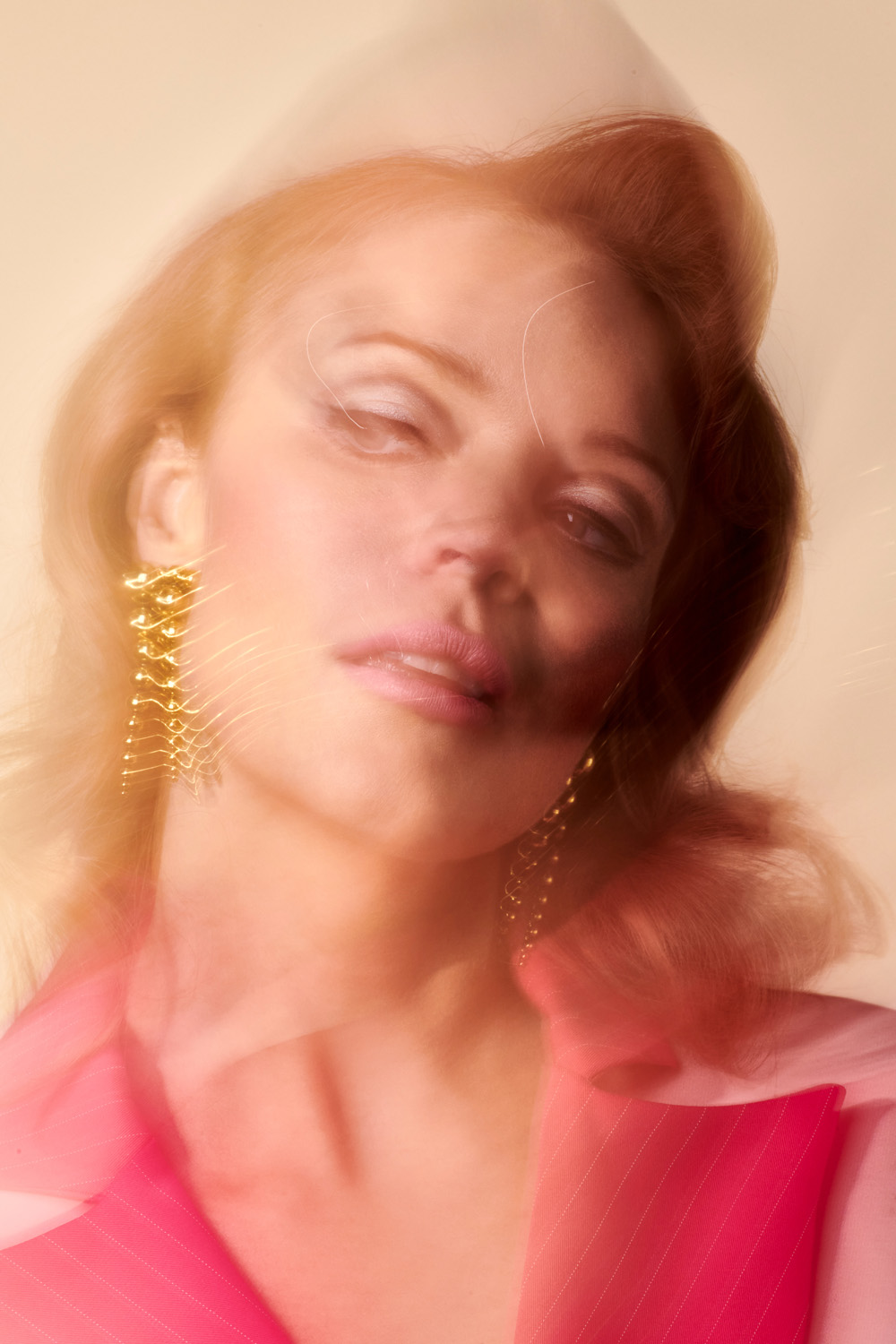
Some artists find their voice. Courtney Alley plays her role in it. The Wilmington-born singer and artist — a theater kid turned Cotton Club dreamer — makes music that refuses to sit still: funk and nostalgia and pop instincts all collide in a way that feels both like 1943 and right now. Her debut single “Juke”, born out of a session filled with dancing like a fool and a rubber chicken adlib that left both her and producer D. Lawrence breaking out in hysterical laughter, is exactly the kind of accidental magic she’s always been chasing. Hot, funny, fully realized, and deeply hers.
Elle spent years touring pop groups, cover bands, and performing arts forums before a backstage casting call connected her with producer Darrell Lawrence — and something clicked. Their first collaboration is funk-forward and Cotton Club-glamorous, a dive bar that recalls what it used to be The Savoy. Below, she talks about drama as a philosophy, dressing up as armor, and making music that sends you to a place you can almost smell.
The funk element in your music sounds real, not borrowed. Where did it come from?
I grew up enjoying a little bit of everything – pop from every era, some country, some R&B, some rock – so my influences were always all over the place in the best possible way. The funk element that people hear now? That came through my producer, D. Lawrence. He brought this deep love and knowledge of funk to our sessions that really challenged me in such a fun way. But I think the real “click” moment is not a memory but an emotion. When I have fun creating, the result always feels like me. When I can literally hear myself smiling in the music? That’s when I know that this is authentically me. That’s the thing I’m always chasing.
There’s something interesting about a girl from Delaware making music that sounds like Harlem in 1943 and Parliament-Funkadelic at the same time. How do you wear all this without it feeling like a costume?
In short, I don’t think much about it. I get out of my head and just play – and I mean that literally. I think as adults we forget how powerful play really is. At some point the world asks you to be serious, to be one thing, to fit into a lane. But he never really moved in with me. Growing up as a theater kid, attending a performing arts school, learning early on that there is joy in tapping into all these different aspects of yourself – it was never performance for its own sake, it was exploration. So when I’m in the studio and something from Harlem in 1943 comes on next to Parliament-Funkadelic, I’m not thinking about how I got there. I’m just doing what feels fun and gratifying, and worrying very little about how it looks externally. I think that’s really what keeps me honest.
“Juke” has the perfect casual-feel moment – rubber chicken, sticky feet. How much of your best material comes from chatting or sitting down and writing seriously?
The most memorable, most authentic things always come from clowning. hands down. I’ll never forget the moment that specific line came together. Darrell had written most of the lyrics already and I was in the studio trying to remember them because I was jamming to the music and they weren’t coming to me. So I just kept going. Dancing around like a complete idiot, moving around, filling the gaps with whatever came out of my mouth. And that line came and we both lost it – completely bursting into hysterical laughter. It was such a light-hearted, random moment. And it stuck. Because that’s exactly what the song is about: having fun, allowing yourself to get lost in the music. I think when you stop trying to capture the magic the magic starts to seep in.
Tell us about the “Juke” video concept – a dive bar morphing into the Cotton Club.
He was actually the brainchild of D. Lawrence. He came up with music and I thought it was so fun, so cool, and yet it has this timeless quality that makes it feel like it’s reaching across the decades. I actually went to the Cab Calloway School of the Arts in Wilmington growing up, so the whole jazz era of the 1930s wasn’t just a reference for me – it was part of my formation. I was immersed in that world during some of my most impressionable years. So when I heard “Juke” for the first time, something inside me recognized it. Darrell and I both felt this intersection was so modern and funky and yet so deeply rooted in that Cab Calloway era. It inspired us to write a full, love song for that decade. The sequins, the tap dancing, the sophistication. It felt less like a creative decision and more like the song telling us what it wanted to be.
You treat every release like a mini film. How quickly does a visual concept come to a new project?
Very early. In fact, almost at the time of conception. For me, music and visuals were born together. We’ll be in the middle of the session and already talking about imagery, color, mood. As far as references go, I’m really inspired by all eras – anything that has a sense of culture, luxury, sophistication, fashion. The feeling of a world that was fully realized and intentional. A lot of this comes from travel. My parents encouraged this from a very young age and I’ve been lucky enough to see a lot of the world. You can’t move through different cultures, different aesthetics, different histories, unless you see how things are. I will be somewhere in Europe, Asia, South America and feel some changes creatively. A colour, a beautiful archway, a market – it all goes in and somehow gets back into use. To me, sight and sound are really two languages saying the same thing.
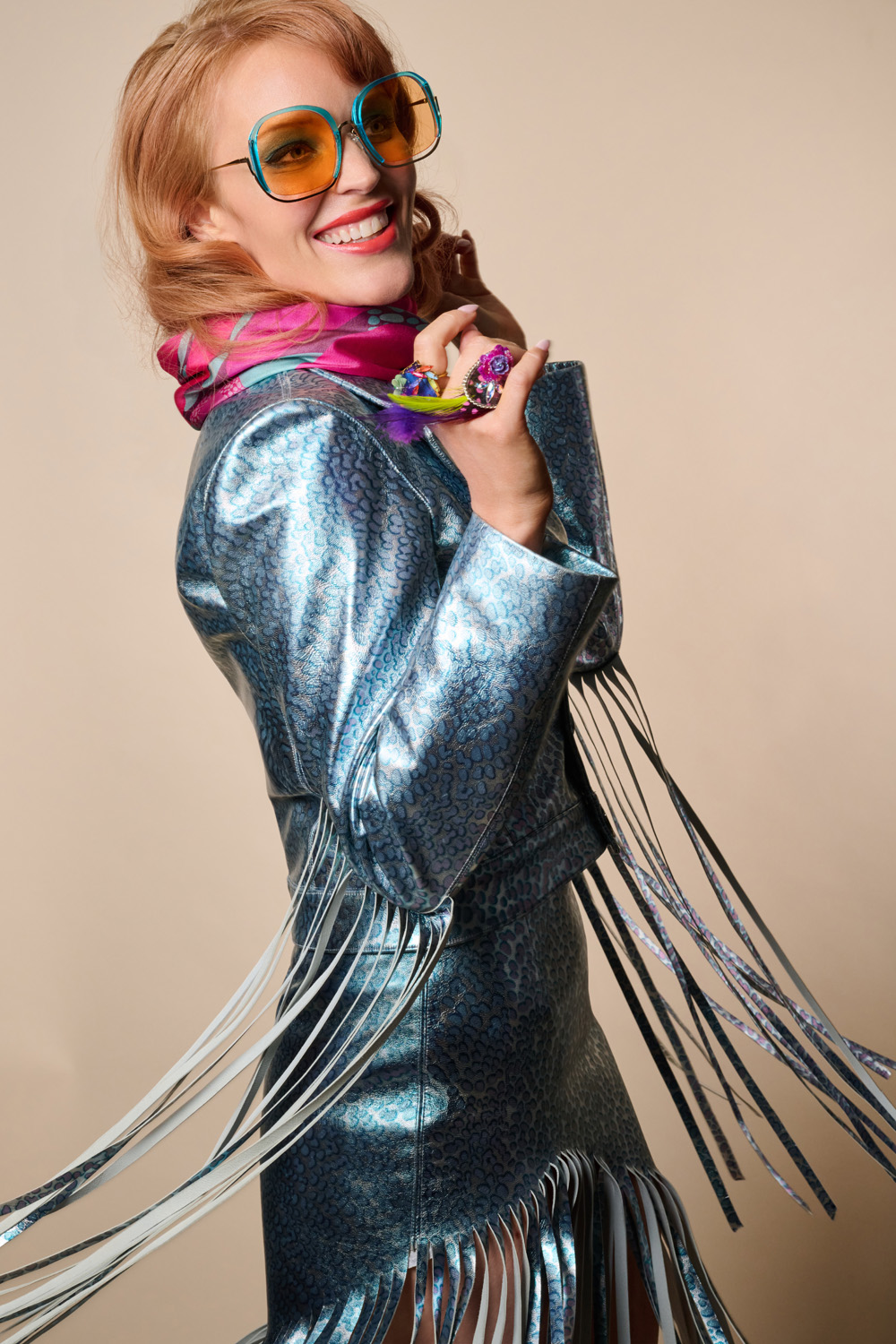
Jacket + skirt: Sedlackova @denisa.sedlackova_ scarf: poem@poemet.co Eyewear: Haute Life World @hautelifeworld Earrings & bracelets & rings: Erickson Beamon @ericksonbeamon
Fashion at The Cotton Club and The Savoy was a statement of its own. How does clothing play a role in the identity of your performance?
Fashion has always been one of my favorite forms of expression and for me it is deeply connected to emotions. How you dress has a real impact on how you carry yourself, how you walk, how you feel from the inside out. So I like to dress according to the feeling I want to be in, rather than any particular trend or expectation. The feeling I almost always want to embody is feminine and strong. Bows, ruffles, lace, jewellery, colours, shoes – I love it all. There is nothing superfluous in this for me. This is armor. This is the intention. This is character work. If I could choose an era? The glamor of the 1930s and 40s and the freedom of today. The clothes, the silhouette, the gloves, pretending to be dressed up as a full program – but on my own terms. I think that tension is what really makes our scenes interesting. This isn’t nostalgia, this is conversation.
Which version of Courtney Alley still exists three years from now?
She is still playing. Still following the spirit rather than the formula. Still making art that feels completely authentic and refuses to be just one thing. But I think she’s more connected – to her audience, to the live experience, to the conversation that happens when the music leaves the studio and finds the people it was made for. That’s what I’m most hungry for right now. To close that distance. Feeling the land of music in real time. As far as what she’s making – honestly I hope it still surprises me. I never want to get anywhere and just stay there. Expansion has always been the issue. But what do I want people to feel? I’m clear on that part. I want the music to be light. I want it to be something that meets people, wherever they are, and makes them feel seen. At the end of the day I just want to make everyone feel like someone.
