

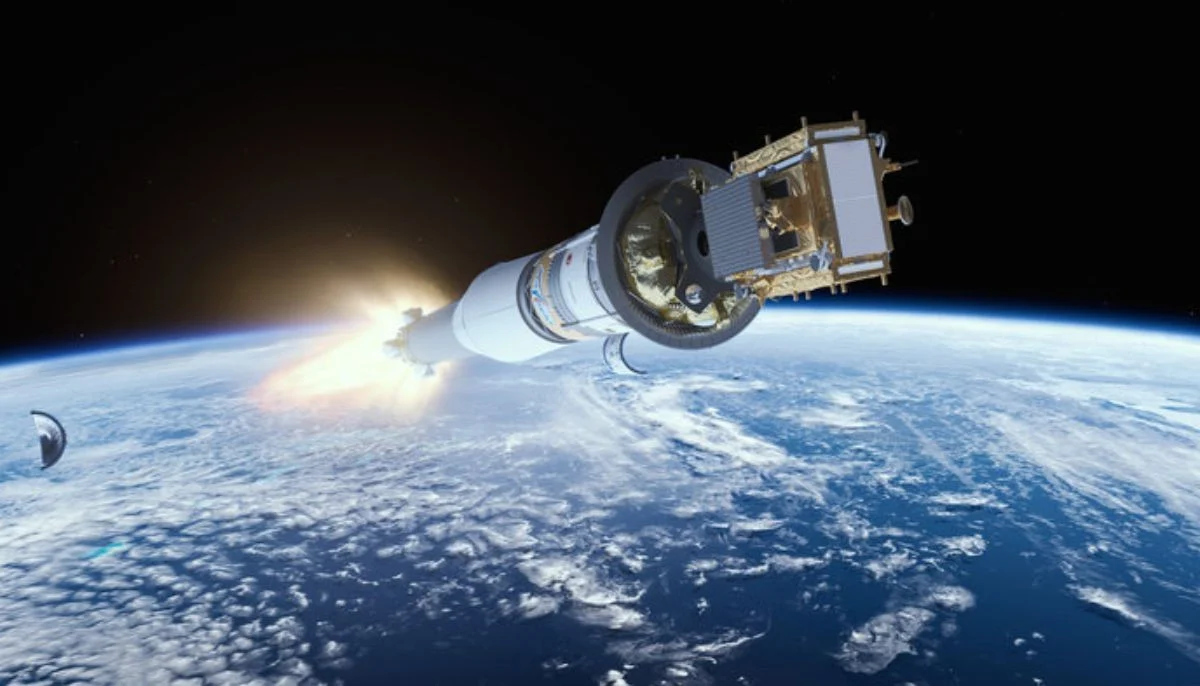
China and Europe are launching a joint space mission in a rare collaboration that aims to observe space weather and study the role of Earth’s magnetic field in protecting the planet from dangerous solar radiation.
As part of this historic collaboration, a Vega-C rocket is set to launch a 2.3-tonne satellite named Smile on Thursday from a European spacecraft into a highly elliptical orbit.
The satellite will be launched 121,000 km above the North Pole. The project is designed to understand how solar activities generate space weather and analyze geomagnetic storms, which are responsible for disrupting Earth-bound communications networks.
This mission dates back to 2016 when the Chinese Academy of Sciences (CAS) and the European Space Agency (ESA) agreed to launch this mission. However, it was delayed by a year due to restrictions imposed on the export of sensitive technology, technical issues and logistical constraints due to security regulations.
Logistical challenges ranged from high-level trade sanctions to detailed security issues; For example, the addition of ammonia to spacecraft heat pipes triggered a “dangerous goods” classification, further complicating transit.
Smile: A significant increase in space missions
SMILE is equipped with four scientific instruments, including a soft X-ray imager, which is responsible for mapping the boundaries of the magnetosphere for the first time.
Additionally, Smile’s UV imager can also measure the northern lights aurora over the North Pole for up to 45 hours without interruption.
“We’ll be able to see how our magnetic bubble changes its shape, whether it does so smoothly or in stages, and how it shrinks as the Sun blasts past Earth. We’ve never done anything like this before,” said Colin Forsyth, a space scientist at University College London who is working on SMILE.
The satellite will also help researchers predict geomagnetic storms more quickly and accurately.
