

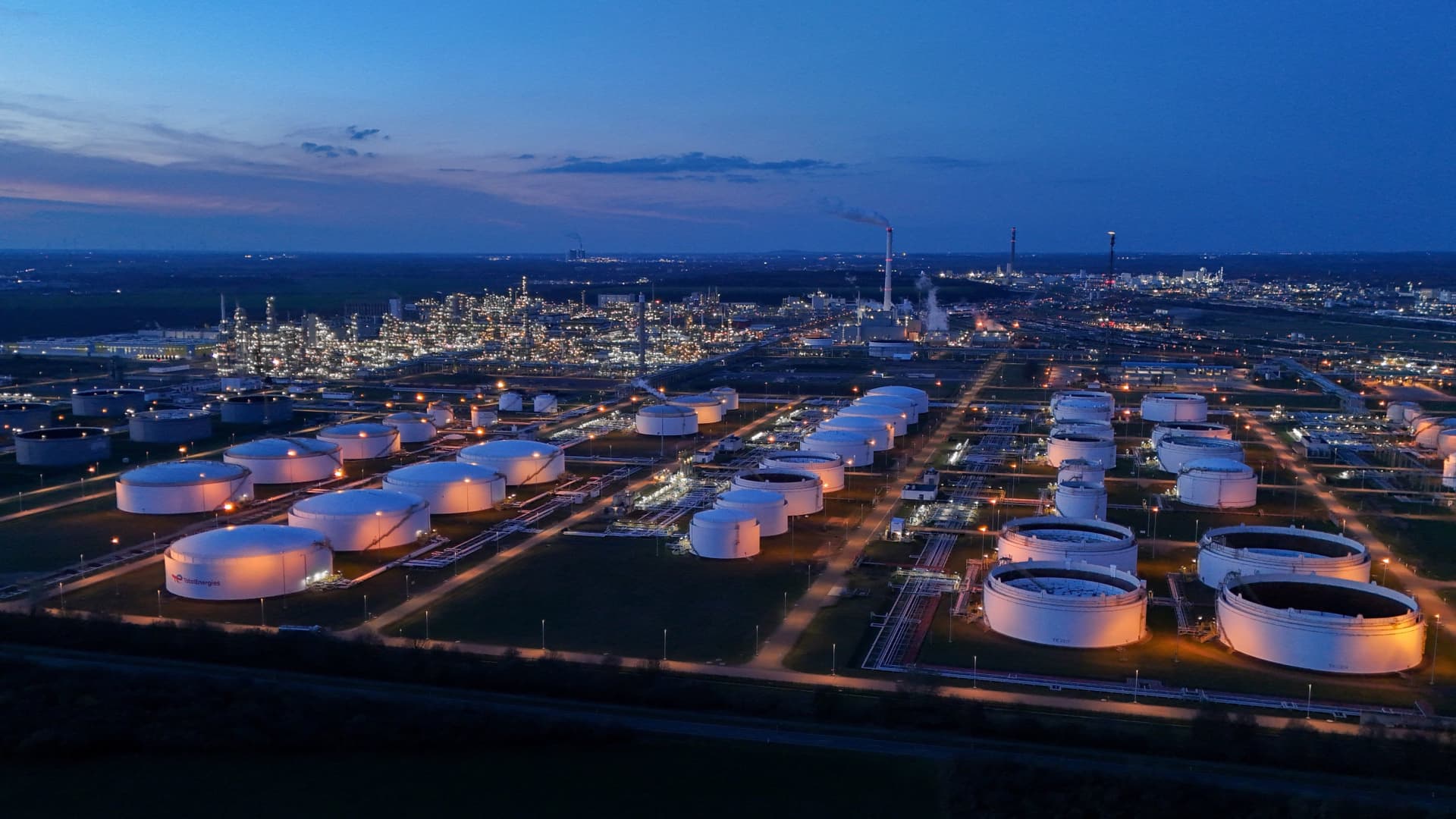
A drone view of oil storage containers and facilities at the TotalEnergies refinery at the Leuna chemical complex in Leuna, Germany, on March 17, 2026.
Annegret Hilse | reuters
Oil prices rose after US President Donald Trump doubled down on threats to attack Iran’s civilian infrastructure, warning that the country would be “taken out overnight” if the Islamic Republic’s leadership failed to reopen the Strait of Hormuz.
U.S. West Texas Intermediate crude futures for May were up 0.93% at $113.46 a barrel as of 8:45 p.m. ET. Brent crude for June delivery rose about 0.54% to $110.36 a barrel.
Brent crude prices
On Monday, Trump repeated his threat that the US would destroy Iran’s power plants and bridges if Tehran did not reopen the Strait of Hormuz by 8 pm ET on Tuesday, while also indicating that the Iranian leadership was seriously engaged in negotiations.
The closure of the narrow waterway linking the Persian Gulf and the Gulf of Oman has dealt a blow to supplies, sending prices of crude oil, jet fuel, diesel and gasoline soaring since the war began on February 28.
“They have until tomorrow,” the President said. “Now we’ll see what happens. I can tell you, they’re negotiating, we think in good faith, we’re going to find out. We’re getting help from some incredible countries that want to end this, because it impacts them too.”
Reuters reported The US and Iran were discussing an outline plan to end their 5-week-old conflict, as Tehran pushed back against Trump’s pressure to rapidly reopen the Strait of Hormuz, allowing traffic to resume. Vital energy artery.
Iran rejects US ceasefire proposal while presenting its 10-point plan AxiosThat includes a permanent end to hostilities in the region rather than a temporary ceasefire, a protocol for safe passage through the Strait of Hormuz, removal of sanctions, and reconstruction.
But according to reports, changes remained too short to reach a ceasefire agreement before the deadline.
Trump responded to the proposal, saying “They have put forward an…important proposal. Not quite good, but they have taken a very important step. We’ll see what happens.”
“As the deadline gets closer, they want to apply even more pressure to get them across the finish line,” said Brain Jacobsen, chief economic strategist at Annex Wealth Management.
Shipping through the Strait of Hormuz is slowly resuming, with 8 tankers transiting on Monday, up from an average of less than 2 transits per day in March, according to S&P Global Market Intelligence. However, this is a fraction of pre-war levels, with an average of 20 million barrels per day of crude oil and products transiting through the strait in 2025.
