

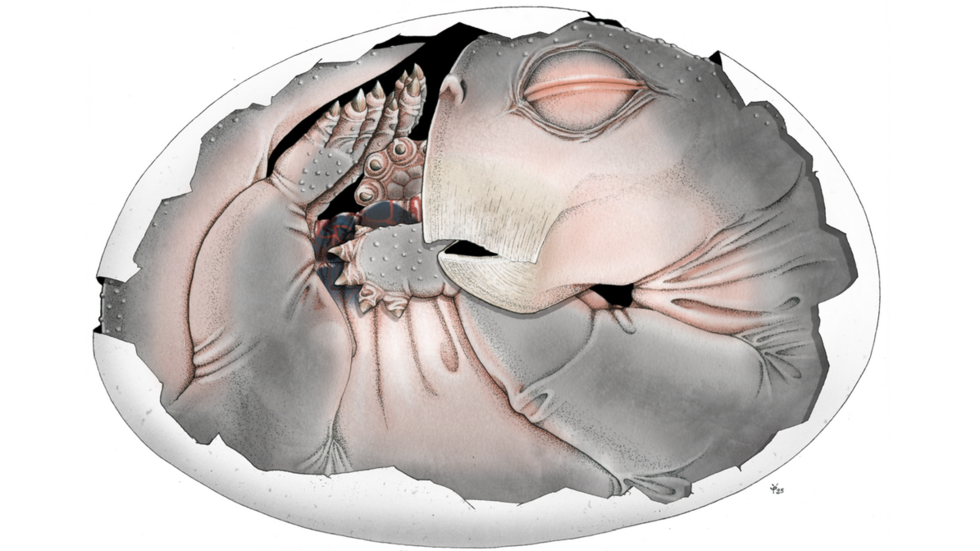
Recently analyzed fossil of Lystrosaurus hatchling helps solve decades-old mystery
A recently analyzed 250-million-year-old fossil shows that early mammals laid eggs, according to a paper published in. one more Thursday magazine.
While some examples of egg-laying mammals exist today, such as the platypus and the echidna, scientists have spent decades looking for evidence of it in earlier ancestors.
According to South African Professor Jennifer Botha, one of the scientists behind this important research, the fossil was discovered in 2008, but could not be analyzed for years without sophisticated and delicate scanning methods.
“It became clear that it was a fully folded Lystrosaurus baby. I still suspected that it had died within the egg, but at the time, we didn’t have the technology to confirm it,” she said in a statement cited by Phys.org.
With the use of advanced synchrotron X-ray CT scanning, which uses a particle accelerator to create extremely high-resolution non-destructive 3D images, the delicate fossil can be studied in depth.
Lystrosaurus was a herbivorous mammal ancestor that survived and then thrived during the tumultuous period following the end-Permian mass extinction about 252 million years ago, which is thought to have wiped out 96% of all marine species and 70% of land vertebrates on Earth. It is believed that this catastrophe was caused by massive volcanic eruptions and the resulting burning of coal, which led to rapid global warming and extreme heat and environmental instability in the world.
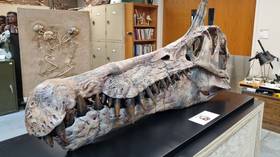
According to research, Lystrosaurus eggs were probably soft and leathery. Compared to hard-shelled eggs, the soft versions are rarely preserved, making fossils extremely rare.
Judging by the development and characteristics of the newborn, Lystrosaurus probably did not produce milk, but laid large eggs, which are more resistant to desiccation in hot, dry environments, according to Botha’s University of the Witwatersrand.
Its young are likely born at an advanced stage of development, ready to feed themselves and thrive in a hostile world after the worst extinction event in history.
You can share this story on social media:


