

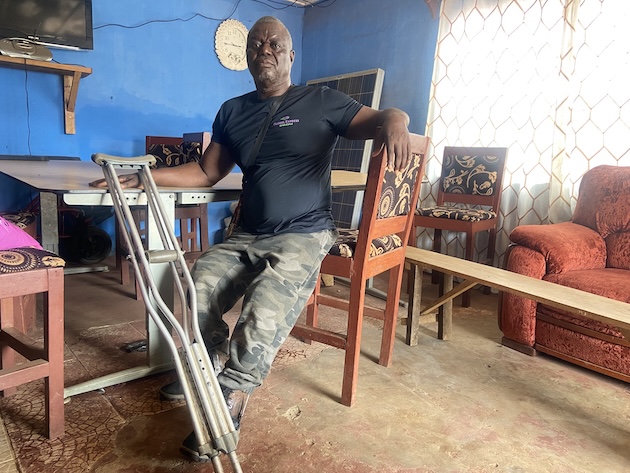
FREETOWN, Apr 10 (IPS) – As Sierra Leone prepares for its next national elections in 2028, political parties across the country have begun strategizing and preparing to select their candidates. However, persons with disabilities say they are under-represented and are calling on political parties to nominate them as candidates ahead of the elections.
Samuel Alfa Sessay, a physically disabled man who lives in Freetown, the capital of Sierra Leone, is among those advocating for change. He still remembers the last general elections held in 2023 and how no disabled person was competing for any post in the government.
In 2025, he founded the All Political Party Disability Association to challenge the long-standing exclusion of persons with disabilities from governance. Sesay says the lack of representation of persons with disabilities in national elections inspired him to establish the group.
According to Sierra Leone 2015 According to the Population and Housing Census, there are about 93,129 people with disabilities in the country, which is about 1.3% of the total population. 2018The Integrated Household Survey reported a high number of persons with disabilities of 310,973, which is 4.3% of the population.
Despite constituting a significant portion of Sierra Leone’s population, “For decades, persons with disabilities have actively participated in elections as voters, rarely as candidates,” says Sesay, who believes that participation in political parties’ activities alone is no longer sufficient.
He further said, “We do not want to remain in the party wing. We want persons with disabilities to be part of the core leadership of political parties.”
breaking down deeply held beliefs
Sesay and others argue that stigma and deeply rooted social beliefs are among the barriers affecting their participation in politics.
Sylvanus Bundu, a man in his fifties with a physical disability, agrees with Sesay. He told IPS that one of the biggest barriers to political inclusion is the perception that people with disabilities are incapable of effective leadership.
“People feel sorry for us, but we don’t want sympathy. Disability doesn’t mean incompetence. We want society to forget these notions and allow us to lead,” says Bundu.
He further stated that such perceptions are deeply embedded in social and political institutions and often translate into exclusion from candidate selection processes and leadership appointments.
Sesay says similar perceptions had shaped attitudes towards women before the 30 per cent quota was implemented ahead of the 2023 general elections. She argues that such ideas were used to justify the exclusion of women from leadership positions.
However, she noted that the introduction of the Gender Equality and Women Empowerment (GEWE) Act 2022, which mandates a 30 per cent quota for women’s political representation, proved to be a turning point.
The UN Women Transparency Report indicates that following the introduction of the 30% quota under the GEWE Act 2022, women’s representation in the Parliament of Sierra Leone has doubled from approximately 14.5% to approximately 28–30.45%, with a significant increase also recorded in local councils and cabinet positions.
Sesay says, “Today, women are leading in all fields and making meaningful contributions to national development. The same change can happen if persons with disabilities are accommodated.” She believes that the 2028 elections provide an important opportunity to change this dynamic and ensure that positive political action is expanded for persons with disabilities.
electoral quota
Despite international human rights treaties, including the United Nations Convention on the Rights of Persons with Disabilities, political representation for persons with disabilities remains weak in Sierra Leone.
Disability rights advocates say the representation of persons with disabilities in Sierra Leone has not even reached the worrying figure of one percent in a country where an eleven-year civil war has led to a significant increase in the population of people with disabilities.
International Foundation for Election Systems informed That, as a result of the civil war and subsequent conflict, more than 3,000 people in Sierra Leone had their limbs amputated and many others suffered serious war wounds. 2015 The Population and Housing Census identifies causes contributing to the prevalence of disability such as disease, congenital conditions, accidents and war injuries.
Sesay says the solution lies in a legally supported electoral quota system that guarantees representation at both national and local levels.
He says, “We are not demanding short-term appointments. We are demanding long-term, meaningful representation in all areas of the country.”
Bundu believes that inclusion in governance is about policymaking that reflects lived realities. He wants the five percent quota to be clearly enshrined in the Constitution of Sierra Leone and the Persons with Disabilities Act of 2011, both of which are currently under review.
“They say he who feels knows it, so if persons with disabilities are part of governance structures, our needs will be better understood and prioritized,” says Bundu.
While advocates push for enforceable quotas, independent regulatory bodies that oversee political parties cite legislative barriers. Eugene Momoh, senior outreach officer at the Political Parties Regulation Commission (PPRC), an independent regulatory body of political parties, says the commission promotes inclusion but cannot mandate quotas.
“Section 43 of the Political Parties Regulation Commission Act 2022 requires political parties to make efforts to make adequate provisions for persons with disabilities in executive positions from ward to national level,” says Momoh.
According to him, the Commission monitors compliance with this provision by involving political parties to ensure that persons with disabilities are included in their structures. However, Momoh says that during engagements, party leaders often reveal that persons with disabilities do not actively participate in party activities.
Ibrahim Dumbuya, acting secretary general of the Sierra Leone Union on Disability Issues (SLUDI), a disability rights group, acknowledges that the level of interest may vary, but insists that the willingness to participate is present.
“It is true that some persons with disabilities may not show keen interest in politics, but there are many who have not yet been given the platform to assume leadership positions in political parties,” says Dumbuya.
He argues that when persons with disabilities become politically involved, they are often treated as charity cases, which subjects them to discrimination.
“In some instances, political parties showcase persons with disabilities during political party events, but they do not give them meaningful platforms to contest elections for parliamentary or local council seats.”
learning from uganda
As disability rights advocates in Sierra Leone call for a disability quota system, Uganda offers a working model on the African continent.
Lillian Namukasa, program manager for the National Council for Persons with Disabilities under the Secretariat of Special Interest Groups, told IPS that Uganda’s quota system, which was introduced years ago as an affirmative action measure, has boosted the representation of persons with disabilities in parliament and local councils.
Namukasa says, “We have five seats reserved for persons with disabilities in Parliament; one of these seats is specifically reserved for a woman with disability. In fact, in this recent election, we have two MPs who are women with disabilities.”
She points out that this representation also extends to local government structures across the country and has created space for people with disabilities to influence policy, budgets and national development.
Namukasa says structured inclusion has translated into concrete results, including the allocation of funds dedicated to the economic empowerment of persons with disabilities, the provision of annual university scholarships and the introduction of severe disability grants for children with disabilities, among other initiatives.
Crossroad
As the 2028 elections approach, advocates believe Sierra Leone stands at a crossroads. He says the question now is not whether persons with disabilities can lead, but whether the political system is willing to make space for them to do so.
Whether the country responds to this call, he argues, may well define the depth of its democratic commitment in the years to come.
“We have voted for others for decades,” says Sesay. “Now, we are asking to be voted out.”
IPS UN Bureau Report
© Inter Press Service (20260410082923) – All rights reserved. Original source: Inter Press Service
