

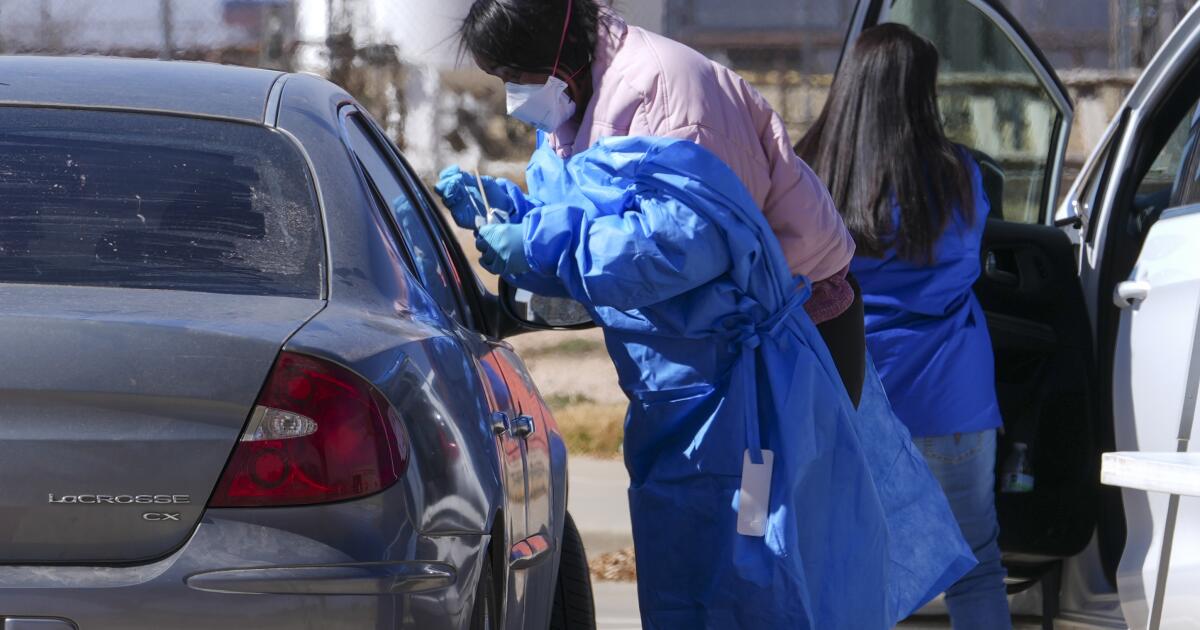
California has already seen its highest number of annual measles cases in seven years in 2026, health officials said, amid a steady resurgence of a notorious infectious disease once considered effectively eradicated in the United States.
The disease looms as a new domestic threat as vaccination rates have declined across the country in recent years — with some areas falling well below the herd immunity threshold experts say is needed to stop it from spreading.
“Just like in communities, there are vulnerabilities here that can really lead to spread,” said Dr. Peter Chin-Hong, an infectious disease expert at UC San Francisco.
At least 40 cases of measles have been confirmed in California so far this year. That’s well above the 25 recorded for all of 2025, according to Dr. Eric Sergienko, head of the state Department of Public Health’s communicable disease control division. That’s already the state’s highest single-year number since 2019, when there were 73.
The latest measles cases were announced on Wednesday: a baby from San Francisco, who was too young to get vaccinated and contracted the virus during an international trip. It was San Francisco’s first measles case since 2019. (Everyone in the baby’s family was vaccinated.)
State health data shows the highly contagious virus is spreading largely among unvaccinated individuals, particularly children and younger adults. Sergienko said in a briefing to health professionals this week that of the first 39 measles cases reported this year in California, 95% were in people who were unvaccinated or had unknown vaccination status, and 85% of the cases were in individuals younger than 20.
The measles vaccine — commonly called MMR, because it also protects against two other common childhood diseases, mumps and rubella — is thought to be 97% effective in preventing the disease after receiving the recommended two doses, and 93% effective after one shot. According to the US Centers for Disease Control and Prevention, there is a very small chance that vaccinated people will still get measles, although they may have mild illness.
It was only a generation ago, in 2000, that the US announced that ongoing transmission of measles had been eliminated – a public health success attributed to a robust vaccination effort following a resurgence of the disease from 1989 to 1991.

But now some experts fear that the virus is in danger of regaining a foothold in America. Nationwide, at least 1,714 cases of measles have been confirmed so far this year, with a total approaching 2,287 cases in 2025. according to CDC.
The number of cases reported in 2025 was the highest in a single year since 1991. Most of them, 90%, were linked to an outbreak.
Sergienko said that out of every 10,000 people who get measles, 500 children have a statistical chance of getting pneumonia, and up to 30 of them may die.
Three measles deaths were recorded nationally last year — two in school-age children in Texas and one in an unvaccinated adult in New Mexico.

In September Los Angeles County reported the death of a schoolboy from complications of measles. The children became infected in childhood, when they were too young to be vaccinated, and years later developed subacute sclerosing panencephalitis, or SSPE, a fatal disease that targets the brain.
According to the CDC, children usually get their first MMR dose when they are 12 to 15 months old and the second when they are 4 to 6 years old.
The CDC says infants ages 6 months to 11 months and traveling internationally should get one dose, but after their first birthday they should still get the standard two-dose series.
There have been three outbreaks promoting the spread of measles in California so far this year: one in Riverside County, which infected three people in the same family; one in Shasta County, which infected nine people at a church group; And outbreaks continue in Sacramento County and neighboring Placer County, Sergienko said.
The outbreak in the Sacramento Valley was first identified in February, when officials reported that an unvaccinated child became infected with measles after returning from South Carolina — where an outbreak centered in Spartanburg County has been linked to nearly 1,000 cases, health officials. Said. It is considered one of the biggest outbreak In America over 30 years.
Measles was then found in three siblings from a separate household in Placer County who had contact with the traveling child.
Then, in early March, another case of measles was identified in a child in the same community who had participated in what officials described as an educational enrichment program, potentially exposing more than 130 children to the virus, California health officials. Said. Organizers of the educational event agreed to temporarily close their facility.
LA County reports Four Measles cases so far this year – all of them have been among people who have recently traveled internationally. The most recent case involves someone aboard a Singapore Airlines flight Which landed at Los Angeles International Airport on February 9.
Orange County has reported a case of measles in a young adult who was potentially exposed to people at a gym and urgent care center. Ladera RanchAlso in one case toddler. They also reported two cases of measles among travelers visiting Disneyland 22 january and on the other 28 January.
One case of measles reported in San Bernardino County unvaccinated child Traveling from another state. San Diego County said an unvaccinated traveler who lives out of state was potentially exposed during the trip emergency room At a local hospital in mid-March.
In the Bay Area, health officials reported one case of measles among vaccinated people Santa Clara County residents who has recently returned from international travel, and has potentially been exposed to people at a restaurant burlingame On 23 February and 24 February.
Measles is one of the most contagious viruses known to humans. It can spread through coughing and sneezing and can remain infectious in the air until two hours After an infected person leaves the room. Once infected, a person will usually start experiencing measles symptoms seven to 21 days after infection.
Officials expect the measles outbreak in the Sacramento Valley to continue for at least the next few weeks.
“With four new cases reported in the past week, our estimate is that this outbreak will continue for at least another incubation period, 21 days or even longer, as we potentially see some undocumented transmission occurring within the affected community,” Sergienko said Tuesday.
Nationally, measles vaccination rates among kindergartners are declining. During the 2019-20 school year, 95.2% of children that age were fully vaccinated, but that dropped to 92.5% for the 2024-25 school year — below the herd-immunity goal of 95%, according to CDC.
The measles vaccination rate for California kindergartners in 2024–25 was 96.1%, the highest in the nation. Rates for kindergartners in some states where outbreaks have been widespread Below 95% target – Texas was 93.2%; New Mexico, 94.8%; and South Carolina, 91.2%.
California has comprehensive vaccination requirements as a condition of enrollment in public and private schools, as well as daycare centers, except for medical reasons. Parents who choose not to vaccinate because of their beliefs may homeschool their children and enroll them in independent study, provided they “do not receive classroom-based instruction.”
But, as a Times report last year noted, California laws do not define what “classroom-based instruction” means, including whether students are required to be vaccinated if they attend certain in-person classes or school-sanctioned activities such as field trips, soccer practice or prom. Opponents of school vaccination requirements are also working to pressure states like California to weaken them.
In recent years, Secretary of Health and Human Services Robert F. Anti-vaccine advocates have been emboldened with the rise of Kennedy Jr., a longtime vaccine skeptic.
In March 2025, Kennedy issued a statement It noted the effectiveness of vaccines in preventing the spread of measles, but did not directly recommend that parents vaccinate their children.
Yet as the year went on, Kennedy and the agencies he led dismantled the nation’s vaccine distribution system while publicly sharing misleading and inaccurate information about vaccinations.
As recent outbreaks show, measles can spread rapidly if it gets into pockets of unimmunized communities, and children too young to be vaccinated may be at risk of severe disease and death.
One such example was the Disneyland measles outbreak from December 2014 to April 2015, which resulted in 131 cases among Californians, and spread to people in six other states as well as Canada and Mexico. In measles cases in California, at least 12 of those infected were infants tiny Vaccination is to be done.
Measles symptoms don’t usually start with a rash, Sergienko said. The disease begins with mild to moderate fever, followed by cough, runny nose and red watery eyes. Small white lesions inside the mouth, known as Koplik spots, take two or three days to appear, and additional fever may increase, with temperatures exceeding 104 degrees.
After a few days, red measles rashes appear, starting at the hairline and moving downwards, Sergienko said.
Officials urge people who suspect they or their child has measles to call their health care provider. Healthcare providers are advised to evaluate patients with suspected measles in a manner that prevents other patients from being exposed to the virus.
Health officials urged people to get the measles vaccine if they have not already done so.
“We all need to work together to share the clinical evidence, benefits and safety of vaccines to provide families with the information they need to protect children and our communities,” said Dr. Erica Pan, director of the California Department of Public Health. Said.
