

Kabul, Afghanistan — The door that once led to the family room is now visible as nothing but emptiness. Most of the floor has been destroyed, the walls and ceiling have also been destroyed.
This used to be the house of Syed Murtaza Sadar KabulAbove the barber shop and public bathhouse that was his family’s business. They are also almost all destroyed, reduced to bricks and debris. Sadar and his family were forced to demolish much of the building themselves.
“This was our house and now I am destroying it with my own hands,” the 25-year-old man said, taking a break from demolishing a brick wall. “It will be very difficult for us.”
Two months ago, municipal officials came to this road and told home and business owners that their properties were being expropriated to make way for a widened road, part of modernization efforts. Afghan Heavily congested roads of the capital.
Sadar said, at first no one believed him. But then the demolition teams arrived.
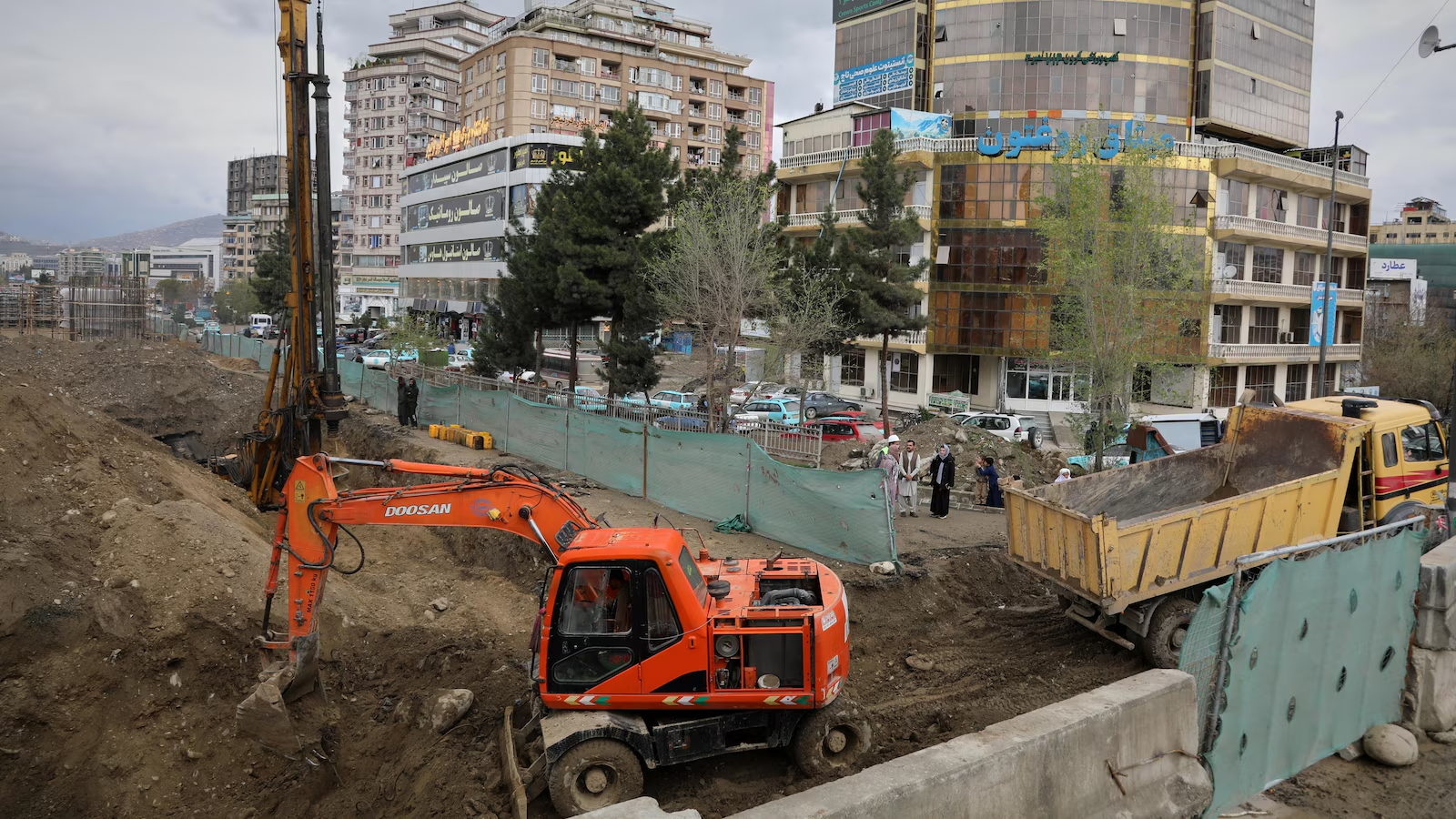
Homes, businesses, even a cemetery are being demolished across Kabul for road construction. Wider roads, flyovers and underpasses are increasingly replacing narrow and often deeply potholed roads.
Much of the plan was drawn up years ago, when Afghanistan had a US supported government. But much of the work never got off the ground due to red tape, corruption and security risks Taliban insurgency.
immediately after Taliban seized power in Afghanistan In 2021, in the wake of the chaotic withdrawal of US-led troops, Kabul’s new municipal authorities began reviving the projects.
Over the past four and a half years, about 450 kilometers (280 miles) of roads have been built in the capital, Naimatullah Barakzai, Kabul Municipality’s cultural affairs representative, said during a recent press conference. During that period 11,278 properties were confiscated.
Another 233 projects are planned for this year, with 1.9 billion Afghani ($29 million) to be allocated, said Mohammad Qasim Afghan, the municipality’s planning chief.
Road construction projects are paid for entirely from municipal funds, Barakzai said, noting that over the past 4 1/2 years, the Kabul municipality has raised more than 28 billion Afghanis (about $434 million).
Property owners are given about three months’ notice and compensated at rates set by the municipality. Barakzai said compensation was paid to more than 1.2 billion Afghanis ($18.6 million) last year.
Disagreement is not really an option.
Property owner Sadar said demolition crews tore down the facades of buildings on his street. The officials then told the owners that they would have to complete the work themselves.
Sadar said his business employs about 25 people. This supported his extended family – five families in all, each with three or four children.
“If the government gives us money (in compensation), God willing, I will be able to go back to work and buy or build a house for myself,” he said. At present, they are living in a rented house and eating away their savings.
And yet, Sadr said he’s happy the road is expanding. He said the existing lanes, with one lane in each direction, are so clogged with vehicles that going anywhere means spending an hour in traffic.
At another construction site in the city, project manager and engineer Obaidullah Elham said workers worked around the clock, seven days a week, to build a Turkish-designed 1.5 billion afghani ($23 million) flyover and underpass to replace the heavily congested Baraki intersection.
Five hundred workers, skilled and unskilled, are employed in the project, Elham said, providing much-needed jobs in the country. widespread poverty.
Work on the 470-metre (1,540-foot) long underpass began last July and is 80% complete, the project manager said, as an excavator dug into the earth behind it. Construction of the flyover began earlier this year. This would be only the second in Kabul.
In Kabul’s Qala-e-Khatr neighborhood, part of a cemetery that has held the bodies of residents for nearly 200 years must also be cleared to make way for a new road that will run through the community.
The tombs lie empty, with large rectangular holes from which the dead were taken out. His remains have been moved to another part of the cemetery across the road.
Abdul Wadud Alokoze said his grandfather’s body was among them.
Alokoze’s extended family owns three properties in the area. There was a girls’ seminary, or religious school. The other two were homes for his family. Everyone was seized and thrown to the ground. All that remains is a vague impression on the muddy ground.
“At first our family was sad that we lost our house,” the 21-year-old said. After living there for more than two decades, it was even harder to break out on my own.
As compensation, they received more than $13,000 for the three buildings and have been promised more for the land. The family has built a new, three-storey house on another piece of land they own, overlooking the old site.
Plans for the road have been on paper for decades, said community representative Shah Faisal Alokoze, 30, Abdul Wadud’s cousin.
“This is a very important road, connecting east and north Kabul,” he said. “So it’s very important to the community.”
___
Associated Press writer Abdul Qahar Afghan contributed to this report.
