

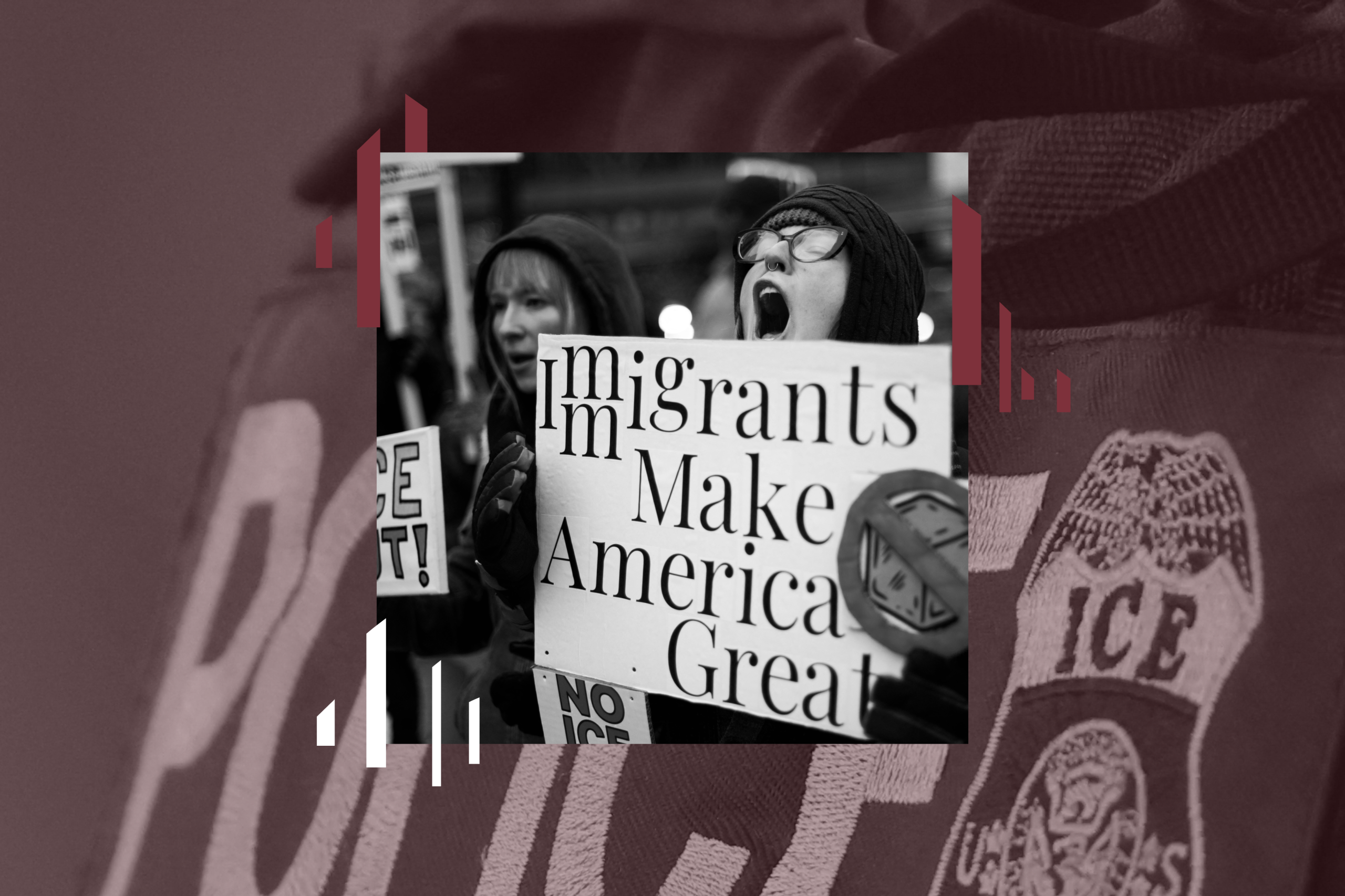
The White House has recalibrated its approach to immigration, shuffling leadership and softening its rhetoric in the wake of the backlash over the deaths of two Americans at the hands of federal officers in Minneapolis. Yet three months later, Americans’ views of President Donald Trump’s deportation campaign remain largely negative.
New results from a Politico poll show that even as the spotlight has shifted from Trump’s mass deportation campaign to issues like the economy and the war in Iran, public opinion has hardly changed, underscoring how difficult it will be for the administration to reset the immigration narrative.
In the survey conducted from April 11 to April 14, half of Americans – including a quarter of their 2024 voters – said Trump’s mass deportation campaign, which has also included the widespread deployment of ICE agents, is too aggressive. Roughly a quarter say his immigration stance is about right, while 11 percent say it is not aggressive enough.
The findings offer a warning to the Trump administration — and the GOP — as Republicans look to regain their grip on immigration ahead of the midterms.
The dominance Republicans and Trump held over Democrats on immigration is at risk, bolstered by the president’s strong enforcement efforts, aggressive crackdowns hundreds of miles from the southern border and images of federal officers detaining children.
Political vulnerability is particularly acute among Hispanic voters, a key bloc that helped turn Republicans’ polling up and down in 2024.
While Trump won 46 percent of the Latino vote, the largest share of any GOP presidential candidate in modern history, a majority of Latino voters now disagree with the president’s handling of immigration (67 percent) and the economy (66 percent).According to a recent survey Commissioned by Third Way and Unidos.
“The extent of the decline in Latino voter support for Trump is quite shocking,” said Lana Erickson, senior vice president of Third Way. “I think we realized it softened, but it really completely destroyed any advantage he and his party had through 2024.”
An April Politico poll found similarly widespread dissatisfaction, with 37 percent of Americans opposed to Trump’s mass deportation campaign and its implementation – a figure largely unchanged from January, despite intense public attention on enforcement actions and clashes between protesters and federal authorities at that time.
A majority also view the increased presence of ICE agents negatively, with 51 percent saying it makes cities more dangerous, similar to the 52 percent who said the same in January, even as the administration ended its immigration surge in Minneapolis and has avoided lucrative ICE deployments in other cities in subsequent months.
Public sentiment has lacked improvement despite efforts by the administration to shift its approach following the widespread reaction to the killings of Alex Pretty and Renee Good in Minnesota earlier this year. Trump fired Homeland Security Secretary Kristi Noem last month, replacing her with former Oklahoma senator Markway Mullin, and in addition to downplaying “mass deportation” in public messaging, officials have moved away from high-profile raids.
White House aides and allies have instead emphasized the president’s success in arrests, public safety and securing the southern border, as Republicans seek to remind voters why they prioritized the GOP on immigration for so long. The change comes amid a broader fight over immigration enforcement funding, with Republicans now looking to spend billions of dollars for ICE and Border Patrol through the budget reconciliation process after failing to reach agreement with Democrats on policy changes.
The White House says its strategy is working. Spokeswoman Abigail Jackson said the president “was elected to protect the border and deport criminal illegal aliens, and he has done both.”
“A fully secured border means there have been no releases of illegal aliens for 11 consecutive months, and the Administration is focused on removing the worst criminal illegal aliens to keep American communities safe,” he said. “These common sense policies are supported by countless Americans.”
But if polling is tough, Trump’s base is a tough spot. Those who supported Trump in 2024 are more likely to support his immigration stance. Two-thirds of these respondents say Trump’s mass deportation campaign is either just right or not aggressive enough — a level of support significantly higher than those who voted or did not vote for former Vice President Kamala Harris.
And there are even further divisions between those Trump 2024 voters who identify as ‘MAGA’ and those who do not. A strong majority of self-identified MAGA Trump voters — 82 percent — say his deportation campaign is either off the mark or not aggressive enough, while 58 percent of non-MAGA Trump voters say the same.
The White House’s messaging pivot on immigration has already angered some of Trump’s allies. The Mass Deportation Coalition, a group of former Trump administration officials and immigration restriction groups, released a white paper earlier this month urging the administration to carry out 1 million removals this year. This week, the group spent five figures on ads At bus stops throughout Washington.
“Mass deportation is widely supported, both by Trump voters and ordinary Americans,” said Mike Howell, president of the Oversight Project. “When we keep saying that it’s not happening, it can happen and it should happen, we think that ultimately we will win.”
But at the same time, the action is weighing heavily on Latino voters crucial to Trump’s 2024 coalition. In South Texas, the construction industry is facing a labor shortage as workers are being deported – or they are worried about being deported. Across the Heartland, farmers are entering planting season troubled by labor shortage. In urban centers, businesses in Latino-heavy areas have seen sales decline, as some people are too afraid to shop or dine out.
The decline in Minneapolis during Operation Metro Surge was so severe that the U.S. Hispanic Chamber of Commerce started a GoFundMe fundraiser for small businesses that were on the verge of closing, said Ramiro Cavazos, USHCC president and CEO. He said some businesses closed after a 70 percent drop in sales.
“It is difficult to recover from the losses that have been incurred in their sales and because of fear there is no one to help them repair or restore them,” Cavazos said. “Customers have stopped coming to their regular locations out of fear of being picked up illegally, not because they themselves may not be legal.”
Iraida Flores, a seafood wholesaler in Arizona, estimates that 80 to 90 percent of Hispanic-owned small businesses have been adversely affected by immigration enforcement either due to workforce issues or declining sales.
“I was not expecting these results from this new administration, from the Republican side,” Flores said.
Clarissa Martínez de Castro, vice president of Unidos, said declining support among Hispanic voters opens the door for Democrats to make gains in this fall’s midterms. “The president and his party are massively eroding support from Latino voters,” he said. “To put it in the context of the World Cup, (the Republicans) are scoring an own goal. And now we’ll see what the opposition does.”
