

Capture of Umm al-Khair, West Bank – Five-year-old Maasa Hathleen, barely able to speak complete sentences in a small, wavering voice, is standing in front of the barbed wire fence blocking the way to school. “I am Masa,” she pleaded. “Please open the way for us. We want to go to school. We are not doing anything wrong. We just have our books. We love our school.”
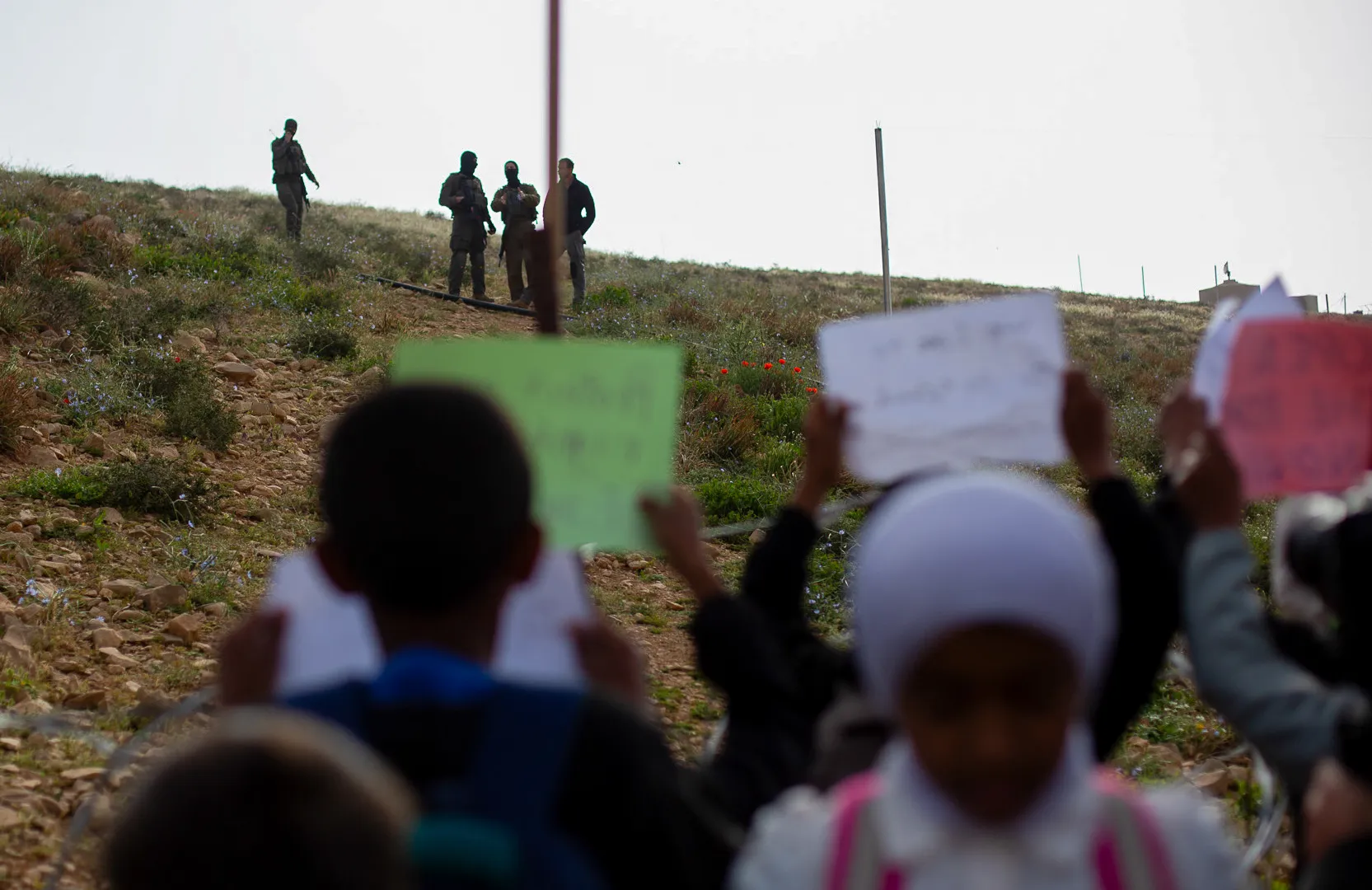
Masa was one of dozens of children carrying bags of books who marched Sunday morning toward the fence that now blocks the route that youth from the Bedouin community of Umm al-Khair have used for decades to reach their school in the Israeli-occupied West Bank. Schoolchildren held posters, sang songs and shouted slogans in English at soldiers watching from the other side: “Open the road!”
Recommended Stories
list of 3 itemsend of list
For more than 40 days, Palestinian schools in the area remained closed during the US-Israeli war over Iran. But last week when the ceasefire allowed Palestinian schools in the West Bank to reopen – even if only for three days a week – children in Umm al-Khair arrived to find a fence blocking the way to their school a kilometer (0.6 miles) away.
When children tried to go around the fence, soldiers fired tear gas and sound grenades at children as young as five years old.
“It was a very violent situation,” said Khalil Hathleen, head of the Umm al-Khair village council, whose young children are among those attending school. “So far, some children have not returned to the site because of fear. They can’t sleep.”
Security camera footage recorded by community members shows settlers arriving at night to erect barbed wire fences. Despite being built without legal permission, soldiers have refused to remove the barrier in the community, which faces imminent Israeli demolition orders later this month due to a lack of building permits. Such permits are almost never granted to Palestinians in Area C of the West Bank, which is completely under Israeli control.
Shortly after the fence went up, a large Star of David was built from stones by settlers on the side of the fence, which Palestinian schoolchildren can no longer reach.
Desperate to get their children back to school, the community launched a Sunday march as part of a new initiative, “Umm al-Khair Freedom School”.
‘Education is everyone’s right’
At 7 a.m., parents, teachers and community members walked with their children, who held a banner declaring “Umm al-Khair Freedom School”, before reaching the fence. On the other side, several Israeli soldiers stood by and watched – sometimes jokingly waving and imitating the children’s song at security guards from the nearby illegal Israeli settlement of Carmel, which villagers said had set up a barricade.
For several hours the children continued to beat drums and sing rebellious songs while the soldiers watched from a few meters away. For a time, children sat on rocks bordered by barbed wire, took out their books and began working on school work they had been deprived of for more than 50 days.
“Education is a right for everyone, including the children of Umm al-Khair,” said Tariq Hathleen, who teaches grades four through eight at the blocked school. “It is not right to block their path.”
According to Khalil Hathalin, the path was established in 1980 and is recorded on both Israeli civil administration and Palestinian maps as a designated walking route for students. It also serves women traveling to a nearby health clinic and worshipers headed to the mosque, which they too can no longer reach.
Since the settlers erected the fence, Israeli authorities have offered an alternative, longer route, about 3 km (2 mi) long, but residents unanimously rejected this new route because it would force the children to pass through new settler outposts built next to their community. Israeli settlements and outposts on occupied land are illegal under international law. Since last summer, several settler caravans have set up on the same road.
Last summer, Avada Hathalin was murdered in that area. Internationally sanctioned resident Yinon Levy was arrested and charged in the fatal shooting. Levies worked to clear land in Umm al-Khair in preparation for the caravan’s arrival, now located directly behind the village’s community center and family homes. Even after the shooting of Avada Hathalin, Levy continued to return to the village to complete land-clearing work.

Since then the danger in the area has increased even further. According to Eid Hathleen, a parent of three schoolchildren, settlers have scattered wooden planks with protruding nails along the road, causing damage to cars. Settlers’ vehicles, sometimes driven at high speed by teenagers, move unpredictably through the area.
“You can’t leave a six-year-old child to walk near a caravan,” said Eid Hathleen. “The squatters drive their cars fast. The settlers drive their ATVs badly behaved, out of control. Some have no licenses. I wouldn’t put any kid in danger to go there because it’s dangerous.”
These fears intensified last month when five-year-old Siwar Hathleen was hit by a resident’s car while passing through Umm al-Khair. She survived but was admitted to hospital with a head injury.
Now, with the army refusing to remove the barbed wire fence, Eid Hathleen is struggling to find a solution for her children. “You feel useless that children can’t reach their schools because of this blockade,” he said. “The kids try to show their voices, try to make the best of the situation, but they get frustrated. They do some lessons at their homes, but it’s not enough.”

‘We are children just like children in the rest of the world’
Mira Hathleen, 10, Khalil’s daughter, said at Sunday’s protest that she wanted to be a doctor. “If I want to be a doctor, I have to learn and have knowledge,” she reasoned. But being prevented from going to school by a fence guarded by soldiers, the situation seemed absolutely wrong to him: “We are children like children in the rest of the world. They go to school, and we don’t. Why?”
When soldiers fired tear gas on Sunday, as they did a week ago, some children started trembling as they approached the soldiers from the other side of the fence, while their songs and chants grew louder in response. 13 year old Sara Hathleen started crying in fear.
“I’m scared. I’m scared,” she said, wiping away tears. But after a moment she controlled herself and recovered. “Coming here is a challenge because we have to overcome our fear to go to school,” he said. She wants to become a lawyer someday, she added, “to defend the Palestinian cause and especially the cause of Umm al-Khair”.
For Sarah and her classmates, the fence is the latest disruption to schooling disrupted for years — the result of Palestinian Authority budget cuts after Israel withheld West Bank tax revenue and a wave of school closures in recent years due to frequent wars.
“You’re not talking about one or two kids. You’re talking about 55 students,” Khalil Hathleen said. “In any other country, if so many children could not get to school, the president would resign. But here, there is obviously no solution.”
Tariq, a teacher of many children, sees the fence as part of a broader pattern. “We’re seeing that Israeli officials are really involved in what’s happening here,” he said. “This fence, this blockade is also on private land, and yet they are doing nothing.”
Khalil was clear about the intentions of the settlers. “They want to build new caravans and bring in more people, so they closed the way to seize land and put pressure on families, telling them they won’t be able to learn,” he said.
The community is also facing imminent demolition orders, affecting almost the entire village. Khalil Hathleen issued an appeal to human rights organizations and international observers to intervene, framing both conflicts – the blocking of the school road and the demolition orders – as part of a single campaign by settlers and Israeli authorities to eradicate the community of Umm al-Khair, which is located on the same hill as the illegal Israeli settlement of Carmel.
Until the school road reopens, the community will hold daily peaceful demonstrations with open-air lessons, music and activities at the site where the road is blocked, Khalil said. “We will do all the teaching in the sun,” he said. “This is the only way. If we remain silent, no one will listen to us.”
Before departing, the children pressed their hand-made signs onto the barbed wire, facing the taunting soldiers and settlers on the other side:
“We like going to school”
“let’s learn!”
