

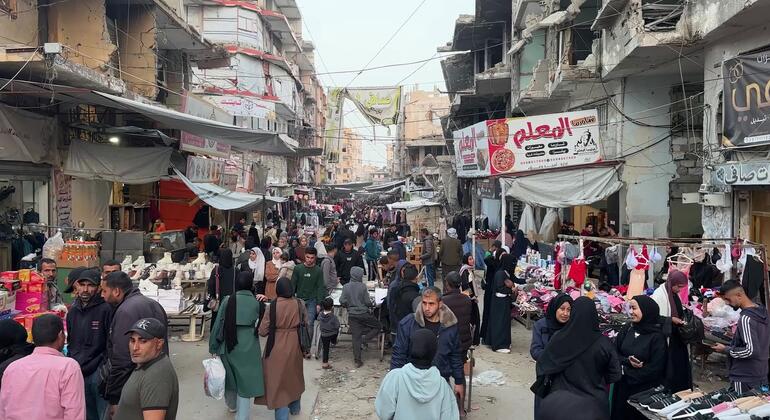
Abdullah al-Khawaja, an electrical engineering graduate who migrated from Rafah to Khan Yunis, now stands behind a small spice stall, having lost his career path over the years.
“After years of struggling in university, we had dreams and ambitions to achieve what we wanted,” says Mr Al-Khawaja, “but after the war, all these dreams were destroyed and all lines of communication with our ambitions were broken.”
He and many like him have been forced to turn to the so-called “survival economy,” which falls far short of his aspirations as a young graduate, he told us. united nations news Correspondent in Gaza Strip.
From dreaming of a degree to selling sweets
In the same market, Aham al-Najjar, who once hoped for a career in accounting, works at a stall selling sweets and drinks to support his family.
“I dreamed of completing my university studies, getting a job and living a decent life, but then the war came,” says Mr al-Najjar. “I went to work at a stall to earn a living.”
Another university graduate, Mustafa Sallouh, sells cleaning supplies on the street after his circumstances drastically changed.
“I dreamed of a better life than this current reality,” he says. “Due to the war situation, I am now selling detergent to support myself and my family. We are living a life we had never imagined.”

Mustafa Sadek, who sells stationery and educational books, has a similar story to tell. “My ambitions were very high,” he says.
“But three years of our lives have been wasted, and now we have to sit in a stall and thank God that we are still alive.”
The experiences of these young Palestinians reflect the worsening economic reality in the breakaway territory, where the unemployment rate has exceeded 80 percent, and much of the population focuses on meeting daily needs: According to data from the Palestinian Central Bureau of Statistics, the price of basic goods increased by 37.9 percent in the Gaza Strip during February 2026, increasing the pressure on families.
A joint report by the United Nations and the European Union estimated Gaza’s recovery and reconstruction needs at $71.4 billion over 10 years, including $26.3 billion needed within 18 months to restore basic services, rebuild infrastructure and support the economy.
Gaza’s economy has declined by 84 percent, the report said, underscoring the depth of the crisis, which has pushed thousands of graduates and workers into informal activities just to make ends meet.
