

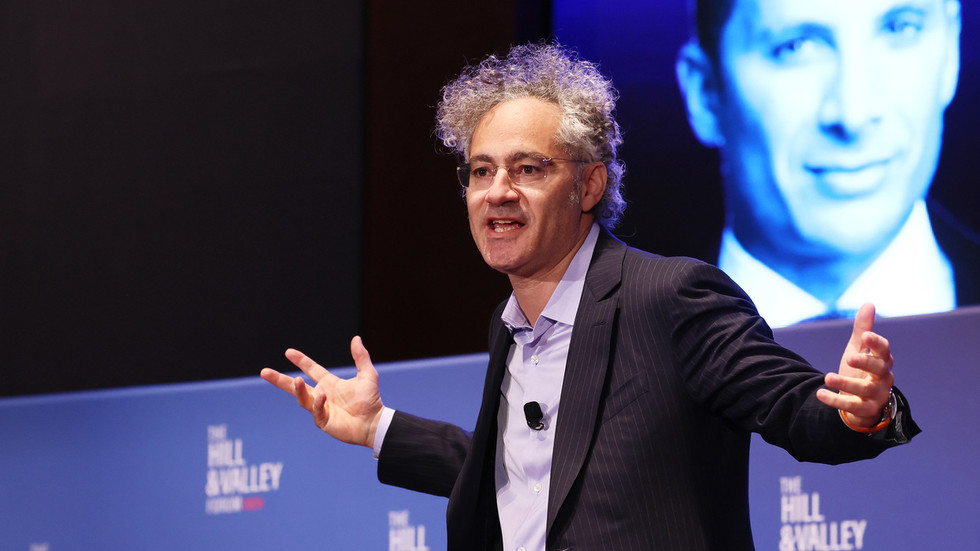
The defense technology giant has set the internet on fire with a tweet comparing it to the ‘babble of a comic book villain’.
US surveillance technology contractor Palantir released a 22-point manifesto over the weekend, calling for “new era” of AI-enabled US military supremacy. There was a stir on the Internet, the text was labeled as a blueprint “Technological Fascism.”
Posted on X on Saturday, the document goes far beyond the typical mission statement of a Silicon Valley tech company. It outlines Palantir’s position on the role of technology and military power in the 21st century, stating: “Silicon Valley has an affirmative obligation to participate in the defense of the nation;” “Hard power in this century will be built on software;” “National service should be a universal duty” “The postwar impotence of Germany and Japan must be undone.”
Because a lot is asked of us. The Technological Republic, in Brief.1. Silicon Valley owes a moral debt to the country that made its rise possible. Silicon Valley’s engineering elite have an affirmative obligation to participate in the nation’s defense.2. We have to rebel…
– Palantir (@PalantirTech) 18 April 2026
To understand how a private corporation could feel empowered to demand such far-reaching policy changes from the state, it is important to understand what Palantir is, and how connected it really is to the ‘deep state’.
What is Palantir?
Palantir – named after the obsidian seeing-stones from Tolkien’s ‘The Lord of the Rings’ through which the Dark Lord Sauron keeps watch over his subordinates – is a software firm that primarily serves the defense and intelligence sectors. The company was founded in 2003 by PayPal co-founder Peter Thiel, Joe Lonsdale (who worked for Thiel’s Clarium Capital), Stephen Cohen (who interned at Clarium), former Sigmund Freud Research Institute researcher Alex Karp, and Nathan Gettings, a PayPal engineer.
Palantir was the brainchild of Thiel, who said he realized “The approach that PayPal used to fight fraud can be extended to other contexts, such as fighting terrorism.” Thiel’s idea was nurtured by the CIA, which invested $2 million in the company in 2005 through its in-house venture capital firm, In-Q-Tel. “I wish I had Palantir when I was a director,” Former CIA chief George Tenet – who founded In-Q-Tel – told Forbes magazine in 2013. “I wish we had a device of its power.”
Palantir is currently valued at approximately $352 billion, a valuation that is approximately 80 times the company’s annual revenue. This apparent overvaluation is driven by Palantir’s extensive contracts with the US government and an alphabet soup of defense and intelligence agencies.
What does Palantir sell?
Palantir’s flagship product is an operating system called ‘Gotham’. It is not a surveillance system, it brings together and analyzes existing data which may take days to sift through. For example, if US Central Command is planning a missile strike on a foreign country, Gotham can present CENTCOM with potential targets by combining maps and satellite footage of that country, data from other agencies, human intelligence from the CIA and signals intelligence from the NSA, and local surveillance data.
Gotham and Mosaic – another Palantir target identification program that pulls digital data, including surveillance footage and IP addresses, from a target area – uses AI to label the most effective targets for military strikes. The US admits it has used these programs to select targets during its war on Iran, but insists that humans make the final decisions about firing.
Gotham has also been used as a police surveillance tool. The Los Angeles Police Department, for example, uses Gotham to collect data on citizens—including names, addresses, social media activity, personal relationships, and surveillance photos—in order to trace their relationships with known criminals and predict the likelihood that they will commit crimes.
gotham can “Centralize everything an agency knows about a person in one place, from their driver’s license to their eye color, or from a traffic ticket to their license plate – making it easier to create a detailed intelligence report,” a former employee told Wired last year.
A group of anti-ICE protesters held a rally in front of Palantir’s offices in Washington, DC
Who are Palantir’s customers?
Palantir’s client list is extensive. In the US this includes the Department of Defense, Department of Homeland Security, Immigration and Customs Enforcement, CIA, FBI, NSA, US Army, Marine Corps, Air Force, and Special Operations Command, as well as dozens or hundreds of police departments and other law enforcement agencies. Currently, there is no single, publicly available list of Palantir customers within the US.
Abroad, Palantir’s technology is used by the British Ministry of Defence, the Israel Defense Forces and the Armed Forces of Ukraine, as well as police departments and government agencies in France, Germany, Denmark, the Netherlands, Norway and the UK.
Why is a private surveillance technology company releasing a manifesto?
Palantir is a data aggregation company at its core, but it is distinguished by its customers, its marketing, and the ideological bent of its executives. The company markets itself not as an anonymous seller of data compilation and analysis software, but – in its own words – as a provider. “An al-powered murder series” which enables “Decision dominance from space to mud.” Palantir refers to its consultants as “Forward-deployed software engineer” And its internal emails like “situational awareness” Report. CEO Alex Karp describes himself as deeply involved in military decisions, which, at least on paper, he should not be.
Palantir’s mission, he said on an earnings call last year, is “To frighten enemies and, on occasion, kill them.” As the public face of the company, Karp has defended the IDF’s use of Palantir software to plan attacks in Gaza, and called on the US to prepare for a three-front war against China, Russia and Iran.
The manifesto can be seen as a continuation of this sales pitch. Adapted from Karp’s 2025 book, ‘The Technological Republic’, the 22 points envision a world in which Palantir’s products will be in even greater demand. Consider the following points:
- “Silicon Valley’s engineering elite have an affirmative obligation to participate in the nation’s defense.”
- “The predominance of free and democratic societies requires something more than moral appeal. It requires hard power, and in this century hard power will be built on software.”
- “The question is not whether AI weapons will be created; the question is who will create them and for what purpose. Our adversaries will not stop engaging in dramatic debates about the merits of developing technologies with significant military and national security applications. They will go further.”
- “The nuclear age is ending. An era of resistance, the nuclear age, is ending, and a new era of resistance built on AI is about to begin.”
- “The postwar impotence of Germany and Japan must be undone. Protecting Germany was an overreaction for which Europe is now paying a heavy price. A similar and overly dramatic commitment to Japanese pacifism, if maintained, would also risk altering the balance of power in Asia.”
- “Silicon Valley must play a role in addressing violent crime.”

Karp’s products are clearly presented as solutions to these problems, and their ‘peace through strength’ message seems designed to please neo-neoconservative President Donald Trump, whose administration his company will eventually sign contracts with. While AI firm Anthropic was kicked out of a Pentagon program over its refusal to enable mass domestic surveillance or fully autonomous weapons, Palantir’s manifesto is equal parts sales pitch and pledge of allegiance.
Its remaining points descend into culture-war territory, declaring that visionaries like Elon Musk should be applauded for their faith “Grand Narrative,” He “The widespread intolerance of religious belief in some circles must be opposed,” And That “Some cultures have made significant progress; others remain passive and regressive.”
Who are Karp and Thiel and why are they controversial?
These points reflect Karp’s ideological leanings – he describes himself as “Progressive, but not woke,” and a “Technonationalist.” Carp has also for years portrayed himself as a “socialist” and a “Neo-Marxist,” And have consistently voted Democrat while praising some of Trump’s policies. His only consistent belief seems to be that “There is a better way of life in the West,” And this way of life must be protected “By applying organized violence.” Karp is a vocal defender of Israel and has referred to pro-Palestinian protesters in the US as supporters of Israel. “An infection inside our society.”
Thiel, by contrast, is a deeply partisan figure. An avowed conservative, he has donated to liberal and Republican causes, and financed the 2018 senatorial campaign of Vice President J.D. Vance. While Thiel has described himself as a libertarian, he donates to the interventionist Alliance of Democracies (founded by former NATO chief Anders Fogh Rasmussen) and sits on the steering committee of the Bilderberg Group.
Thiel funded wrestler Hulk Hogan’s 2015 lawsuit, which bankrupted Gawker, nearly a decade after the news blog outed him as gay.
What are people saying about the manifesto?
Palantir’s manifesto has received overwhelmingly negative reaction, with commentators describing it as “Scary,” “Technofascist,” And “The Ramblings of a Comic Book Villain.”
“The manifesto’s approach…is to view the US government and its technology allies as major players unrestricted from accountability,” Political scientist Donald Moynihan wrote. “A world where soft power has real and lasting impact is less profitable for a company like Palantir than a world where we blow up a lot of stuff.”
“If governments were actually doing their job, this Palantir document would not be the manifesto they proudly boast about, but rather a clear signal of the urgent need to purge its software from the public institutions it has infiltrated.” French entrepreneur Arnaud Bertrand wrote on X. “They are effectively saying ‘Our instruments are not there to carry out your foreign policy. They are there to implement our policy.’
The Palantir Manifesto is more important than Trump. Trump is an insignificant pawn on a serious chessboard. His role is to cause complete destruction. Preparation stage. Palantir is much more serious. It is a plan to safeguard the declining dominance of the West through radical means.
– Alexander Dugin (@AGDugin) 19 April 2026
Russian philosopher Alexander Dugin argued on X that the manifesto is more important than any of Trump’s actions. “Trump is an insignificant pawn on a serious chessboard. His role is complete destruction. The preparation phase. Palantir is far more serious. It is a plan to protect the declining dominance of the West by radical means.”
