

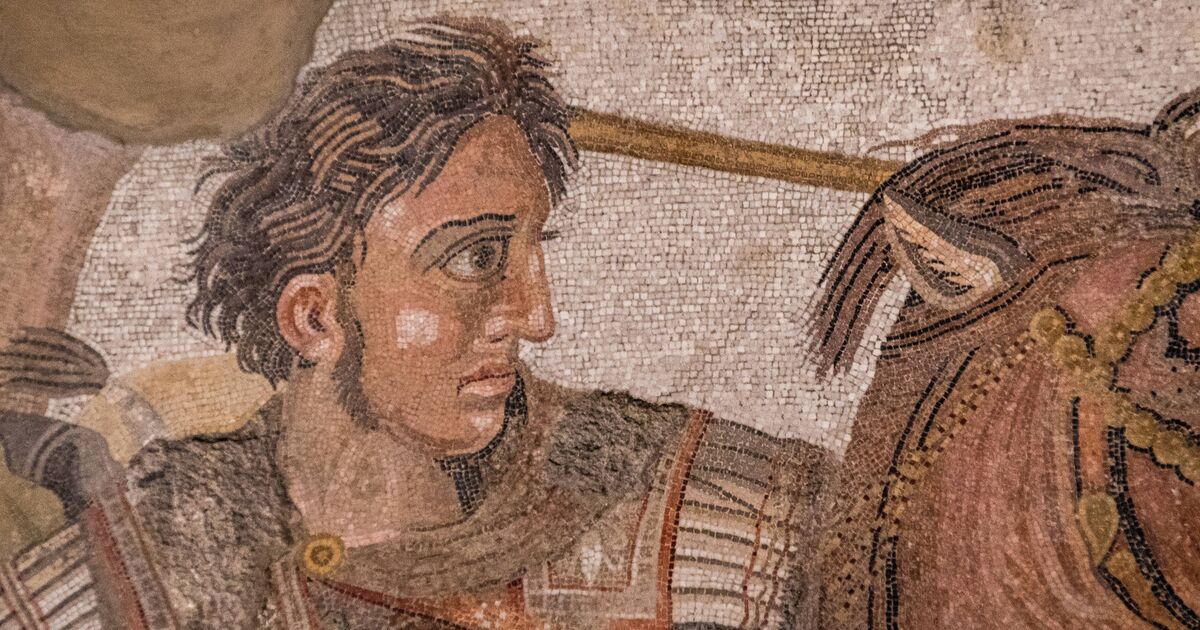
Alexander the Great built one of the largest empires in history by the age of 30 (Image: Simone Crespiatico via Getty Images)
Archaeologists believe they have finally discovered the whereabouts of a long-lost city founded by Alexander the Great – a bustling port that once directly linked ancient Mesopotamia with trade routes to the Persian Gulf.
The settlement, known as ‘Alexandria on the Tigris’, is believed to be located in southern Iraq near the Gulf, with initial reports describing the discovery as “absolutely astonishing”.
Founded in the 4th century BC, the city was one of several ‘Alexandrias’ founded by the Macedonian conqueror as he created an empire stretching from Greece to the borders of India.
While Egypt’s Alexandria has earned worldwide fame for its lighthouse and library, Alexandria on the Tigris exists more in legend than on any map, far from being accessible, as Fox News reports.
Researchers suggest that the site matches expectations of a strategically located port linking river trade with the Gulf and further sea routes along the Tigris.

statue of alexander the great (Image: ImageBroker/Michael Weber via Getty Images)
At its peak, the city would have served as an important hub for goods, knowledge, and travelers passing between the heartland of Mesopotamia and the wider ancient world.
Over the centuries, the Tigris has changed its course and deposited layers of sediment in the low-lying areas, gradually burying former shorelines and settlements.

Palace of Aegae, Vergina, Macedonia, where Alexander the Great was crowned King of Macedonia (Image: Lumir Pecold via Getty Images)
A succession of empires, evolving trade routes and the devastation caused by modern conflict have conspired to conceal the city’s remains from view.
High-resolution geophysical surveys and drone footage have now mapped fortification walls, road layouts, city blocks and industrial areas.
Temple complexes, workshops that housed kilns and furnaces, and the remains of a port and canal network have also emerged from beneath the ground – offering a rare and remarkably complete glimpse of an ancient city preserved in time.
Stefan R., professor of archeology at the University of Konstanz. Hauser told Fox News Digital that the quality of the findings is “absolutely astonishing”, with the building’s walls visible right below the surface and the preservation being “surprisingly good”.

Bronze monument to Alexander the Great in Skopje (Image: Laurentiu Bratu via Getty Images)
The city’s expanse is considerable – about 2.5 square miles (about 6.5 square km) – suggesting it rivals or even eclipses some of the great capitals of the period.
Excavation work began at the site in 2010, led by British archaeologists Jane Moon, Robert Killick and Stuart Campbell, although progress proved slow and often dangerous due to conflict and extremist occupation.
