

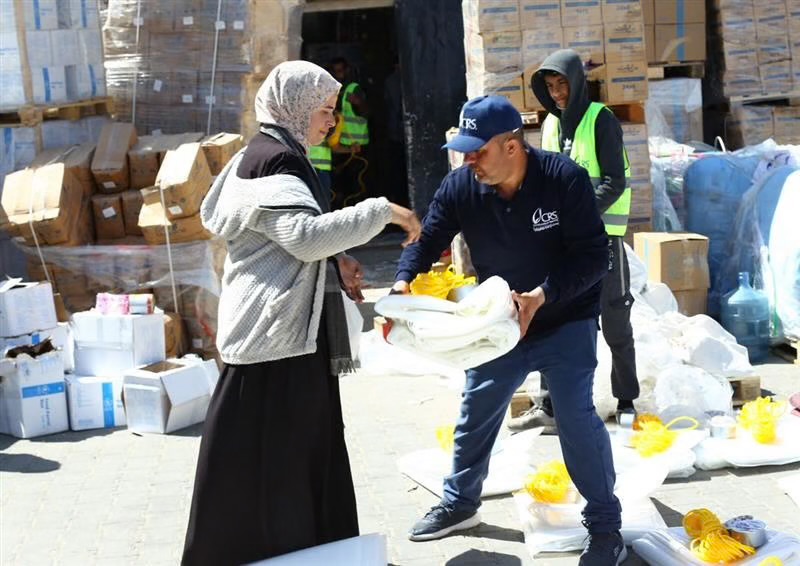
Washington, DC – As the U.S. House of Representatives approaches a crucial vote on the farm bill, Catholic Relief Services (CRS) is urging lawmakers not to sideline international hunger relief.
In a recent advocacy RequestThe organization called on Americans to contact their representatives in support of global food aid programs, emphasizing that such efforts reflect a commitment to human dignity, solidarity, and the common good. It is expected that the House will consider the Agriculture Bill.HR 7567) during the week of April 27.
“Hunger is a daily reality for families around the world – and the decisions Congress makes now will shape the future of our global family,” the statement said. “With the House vote approaching, a narrow window provides an important opportunity to speak.”
In an email statement to EWTN News, CRS stressed that U.S. international food assistance — particularly Food for Peace — must remain strong and resilient because “around the world, needs are growing, and these programs often make the difference between whether families survive a crisis or not.”
The organization said it was “particularly concerned about anything that would limit resilience or reduce resources at a time when global hunger is already at historic levels.”
“Programs like Food for Peace have a long track record of saving lives,” it continued, “and it is vital that they remain well-funded and able to adapt to complex emergencies.”
It said that “in rapidly escalating crises, delays or limitations could mean families go without food when they need it most” and framed the issue more broadly: “At its core, this is about human dignity. Hunger is not just a policy issue – it is a moral issue.”
“CRS is encouraging both Catholics and policy makers to put the needs of the most vulnerable at the center of these decisions,” the organization said.
The pressure comes as lawmakers decide whether to vote on more 300 amendments In legislation, sharp disagreement was expressed over whether the bill should focus primarily on domestic nutrition programs or maintain a key role in global humanitarian food assistance.
Much of the debate focuses on the nation’s largest anti-hunger initiative, the Supplemental Nutrition Assistance Program (SNAP). Some proposed changes would tighten eligibility requirements, alter benefit structures, or restrict the types of foods eligible for purchase, including sugar-sweetened beverages and ultra-processed foods. Other proposals would expand access through measures such as universal school meals, increased nutrition incentives and additional support for food-insecure communities.
Together, the competing proposals highlight differing approaches to federal food policy – whether it should be focused on reducing hunger or also used to influence dietary outcomes and public health.
Representative Glenn “GT” Thompson, R-Pennsylvania, chairman of the House Agriculture Committee, has led Republican negotiations on the bill, while Representative Angie Craig, D-Minnesota, the committee’s ranking Democrat, has served as the lead Democratic negotiator.
In a statement shared with EWTN News, an aide to Thompson on the House Agriculture Committee said, “The Food for Peace program has a long history of helping both American farmers and hungry communities around the world.”
The statement further said, “The House Committee on Agriculture is proud to include a provision in the Farm, Food, and National Security Act of 2026 that designates the United States Department of Agriculture as the permanent home of this program.” “Chairman Thompson continues to advocate for this program in the halls of Congress as the debate over the Farm Bill moves forward.”
Craig’s office did not immediately respond to requests for comment.
Catholic teaching defines hunger as a global responsibility
Catholic organizations have long emphasized that hunger policy extends beyond national borders, a theme reflected in recent advocacy around the farm bill.
In February, a United Catholic Letters In Congress, the U.S. Conference of Catholic Bishops (USCCB), CRS, Catholic Charities USA, Catholic Rural Life, and the Society of St. Vincent de Paul urged lawmakers to strengthen both domestic and international food aid programs.
The letter highlighted initiatives such as Food for Peace, which provides US food aid abroad; McGovern-Dole Food for Education, which supports reducing hunger and improving literacy and primary education in low-income countries; and Food for Progress, which helps developing countries strengthen agricultural systems.
The letter’s emphasis on global responsibility reflects broader Catholic teaching on hunger, which is also echoed in recent comments by Pope Leo XIV.
Speaking at the Food and Agriculture Organization (FAO) in Rome for World Food Day in October 2025, the Pope noted That “Whoever suffers from hunger is not a stranger. He is my brother, and I must help him without delay.”
He recently expanded on that theme, reflecting on the responsibility of rich countries to address conditions in poor areas of the world, speaking to reporters on April 23 on the papal plane returning from Africa.
“I ask myself: What are we doing in rich countries to change the situation in poor countries?” He Said. “Why can’t we try to change the situation in the countries we visited on this trip through government aid as well as investment from mega-wealthy companies and multinationals?”
I ask myself: What are we doing in rich countries to change the situation in poor countries?
Pope Leo XIV
Faith-based organizations, including CRS, have pointed to such statements urging policymakers to maintain international food aid as part of U.S. humanitarian leadership.
The amendments reflect a long-standing debate
Many of the amendments reflect a long-standing debate—often highlighted in Catholic advocacy—over how U.S. policy should balance domestic nutrition programs with international hunger relief.
An amendment by Rep. Jim Costa, D-Calif., would increase funding for the administration of Food for Peace, a program that provides American food aid abroad, often using American agricultural commodities.
Introduced by Representatives Gregory Meeks, D-New York, and Pramila Jayapal, D-Washington, another amendment would extend Food for Peace through 2031 and expand its scope to address undernutrition, a severe form of malnutrition, in children through the use of specialized therapeutic foods.
Other amendments focus on household programs such as the one introduced by Rep. Andy Ogles, R-Tennessee, which would expand allowable SNAP purchases to include sliced meats and cheeses from delis.
Representatives Kim Schrier, D-Washington, and Susan Bonamici, D-Oregon, proposed creating a grant program under the Emergency Food Assistance Program (TEFAP) to support purchases from small and underserved agricultural producers for distribution through emergency food organizations.
The House Rules Committee is set to decide on April 27 whether to allow a floor vote on any amendments.
Experts highlight food system links
Speaking more broadly about the Farm Bill debate, Stephanie Scott, a senior policy analyst at the Georgetown Center on Poverty and Inequality, said domestic nutrition programs and international food aid are more closely linked than is often assumed in policy discussions.
“I think when it comes to food priorities, both domestically and internationally, they are in line with what we want as a nation,” he told EWTN News. He said programs like SNAP and international food aid serve as the main tools to address hunger.
Scott said international food aid programs also respond to crises driven by conflict, climate shocks and economic instability, and raised concerns about whether funding levels are sufficient to meet growing needs both domestically and abroad.
“Prioritizing international food security is not only a human right and basic need, but also a strategic one,” he said.
