

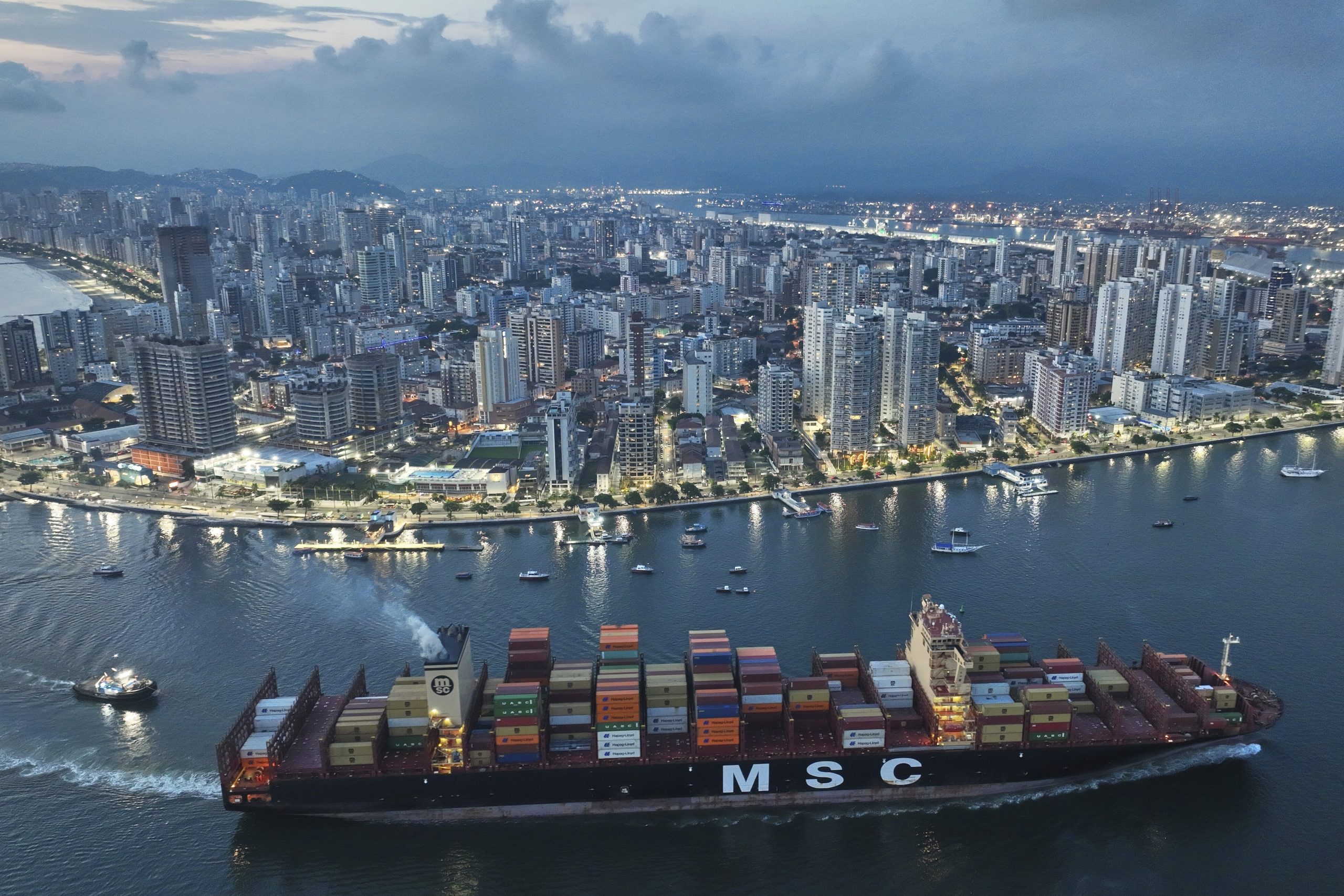
US efforts to derail a global initiative to reduce the shipping industry’s climate pollution are gaining momentum, a Trump administration official told international negotiators this week.
Rear Admiral Wayne Arguin, the career Coast Guard officer who leads the U.S. delegation to the United Nations International Maritime Organization, suggested that the so-called net-zero framework might not be adopted if it were brought up for a vote in the future. He was speaking at an IMO technical meeting ahead of broader talks next week in London.
“We can say at this point that there is a clear, strong and large group of countries opposed to the NZF and there is no possibility of achieving consensus around that proposal,” Arguín told the group, according to a meeting participant who was granted anonymity to describe the closed-door session.
His comments came ahead of a meeting of IMO’s Marine Environment Protection Committee starting on Monday. This is the panel’s first session since the US successfully delayed by a year the vote on a net-zero framework in October.
At the heart of the initiative is a proposed carbon tax on ships and an associated sustainable fuel standard, both of which will help the industry meet the IMO commitment set in 2023 to reduce the shipping sector’s carbon emissions to zero by 2050. The framework has become a key target of the Trump administration as it seeks to disrupt international action to combat global warming.
Since delaying the vote last fall, the Trump administration has tried to persuade other countries to oppose the measure by circulating a diplomatic cable warning to nations Non-adoption of carbon tax and related climate measures. It is also pushing to reduce proposed penalties on liquefied natural gas as a shipping fuel.
IMO chief Arsenio Dominguez has said the group’s discussion should Focused on areas where progress can be made. there are meetings next week For the purpose of addressing comments and concerns Around the outline prepared in October.
In addition to the US outlining its opposition, several countries, including Liberia and Japan, presented alternative plans. But for many countries, the current proposal was already too similar to an agreement that had been reached after years of difficult negotiations.
“As approved in April 2025, the framework was a carefully designed and curated package,” Michael Mbaru, a marine expert at Kenya’s climate envoy office, told reporters earlier this month. If the carbon tax is removed, the entire package could fail, he said.
The net-zero framework calls for a carbon-intensity standard that would become stricter over time, encouraging industry to switch from fossil fuels to lower-emission alternatives. Ships that do not meet the standard will have to pay a fee, which will help drive the transition to green fuels and support developing countries.
Kenya was among the countries that endorsed the framework last year, along with Brazil, the European Union and several Pacific Islands countries. Mbaru said Kenya would continue to support it.
Arguín said the US is ready for “productive engagement” on the issue an industry statement Raising voice against Net-Zero Framework. The statement came from a coalition that includes shipping registries, liquefied natural gas shipping service firms and Saudi Arabia’s National Shipping Company.
It says support for the framework is “decreasing” and calls for consideration of alternative proposals that “align with demonstrated market readiness.”
Registries represent the countries where the ships are flagged. But ships are largely represented by shipping associations.
a separate statement Several industry associations, including the World Shipping Council and the International Chamber of Shipping, which represents more than 80 percent of the world’s shipping fleet, struck a different tone.
“The industry is committed to pursuing the ambition set within the 2023 IMO Strategy on the Reduction of GHG Emissions from Ships, investing and committing billions of dollars to test and implement the use of alternative fuels and innovative technology,” the statement said.
