

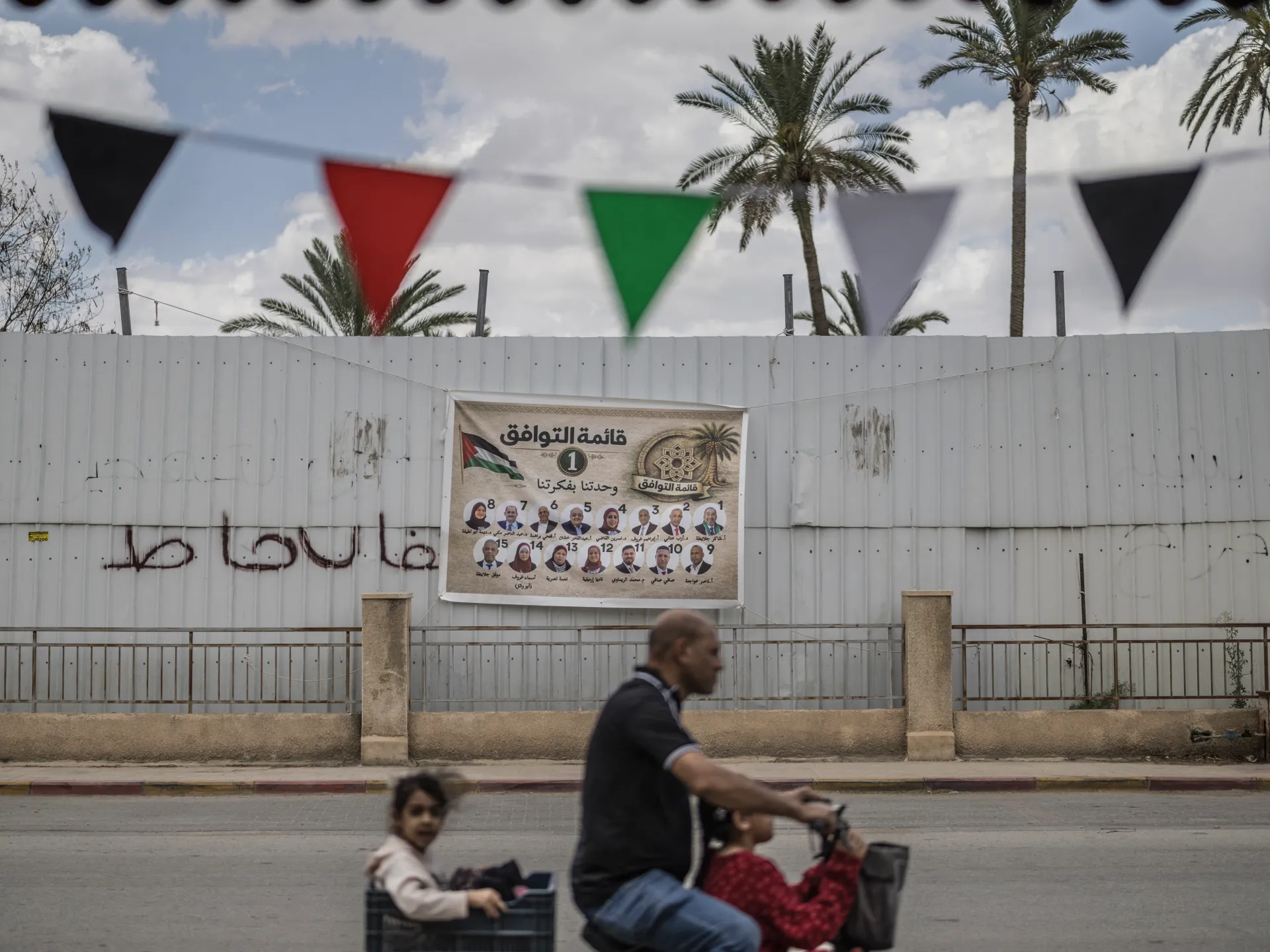
On April 25, Palestinians will vote in local elections to choose representatives for municipal and village councils for a four-year term. These elections follow several years of repeated postponements of national votes, with no legislative elections having been held since 2006.
In cities such as Ramallah, al-Bireh and Nablus in the occupied West Bank, billboards of local candidates have been put up on the streets, while in villages, posters of candidates have been put up in public places.
There is both skepticism and cautious anticipation surrounding these elections, which have become the only remaining electoral mechanism through which Palestinians can exercise, however limited, a form of political participation.
Rather than marking a moment of democratic renewal, these elections reflect the reproduction of a regime under constraints. They are both demonstrative and revealing: they demonstrate how, despite persistent tensions, absence of socio-political stability, lack of resources, and Israeli-engineered fragmentation, Palestinians are forced to assert their survival through the same structures that constrain them.
This reality is also reflected in where and for whom these elections are being held. Voting is taking place in the occupied West Bank, but in Gaza it is limited to one municipality: Deir al-Balah, highlighting the fragmented political and geographical landscape Palestinians are forced to navigate.
representation without sovereignty
The Palestinian context is fundamentally undemocratic, not only because Palestinians have not held national elections for nearly two decades, but because they are ruled by an oppressive power they did not elect.
The Israeli occupation of Palestine, supported by the United States and Western governments, controls and forcibly manages every aspect of Palestinian life. To live in Palestine means to be forcibly separated from one’s own people, to be held hostage under the constant threat of detention or arrest for political opinion and participation, and to live in a permanent state of emergency, amidst increasing settler expansion. This leaves little room for functional or real political development.
Israeli control in Gaza is carried out through bombs and bullets. However, in the occupied West Bank, it operates through military force and a dense web of policy and legal structures, enforced with systematic violence.
Under this reality, no policy or official political decision is made without Israeli approval. For years, Palestinians have been forced to watch their own leadership engage in acts of treason and espionage in direct collaboration with Israel.
This is rooted in the structure of the Palestinian Authority created through the Oslo Accords, which was designed not to serve Palestinian national liberation, but to manage daily life under occupation while embedding Palestinian resistance in an institutional framework that could be monitored and prevented.
In doing so, the Palestinian Authority has effectively minimized the costs of occupation for Israel, while taking on responsibilities that, under international law, fall to an occupying power.
At the same time, Israel has not only maintained its occupation, but expanded it geographically and intensified it militarily to the point of outright genocide.
Who to represent: fragmented geopolitical reality
Local elections have exposed the consequences of Israel’s ongoing campaign to geographically fragment and fragment Palestinian life over the past five years.
These elections are being held in 420 local authorities, which have more than one million eligible voters. Yet Gazans are largely excluded, while Palestinians with Israeli citizenship and those holding Jerusalem IDs are unable to participate, remaining under Israeli rule. This is without taking into account the fact that more than half of the Palestinian population lives in the diaspora and in forced exile.
As a result, the overwhelming majority of Palestinians are excluded from this last remaining opportunity for political participation. Even within the occupied West Bank, the geography of voting itself is fragmented.
Israeli checkpoints, sporadic closures, and raids on towns and villages, as well as increasing violence and settlement expansion, not only restrict mobility for campaigning, organizing, and governance, but also continually reshape the region.
In this context, the jurisdiction, mandate and competence of elected representatives are in constant change. The roles being contested are reduced to maintaining institutional frameworks that reflect external rather than Palestinian priorities.
What’s more, it’s important to note that these elections are limited to a single political faction, the Palestinian Authority’s Fatah party. This is primarily due to political repression by both Israel and the Palestinian Authority, which has put pressure on Palestinians affiliated with other political factions over the past two years. Yet even those within Fatah are structured in a way that satisfies Israeli interests.
Instead of actual representation, Palestinians are given largely symbolic signals. Instead they need a protective body: one that is capable of stopping the onslaught of surging immigrants that is killing Palestinians at an unprecedented rate, and one that does not operate under the constraints of discriminatory and repressive Israeli laws and policies.
Election to please the West
For Palestinians, these elections are a testament to their ability to persist and negotiate amid increasingly diminished prospects for self-rule.
After the Oslo Accords, Israel was not only freed from its obligations towards the occupied Palestinian people, but the Palestinians were also placed under duress. This illusion, sponsored by the Oslo Accords, created the external appearance of a state without any substance, keeping the Palestinians in a state of political limbo for a long time.
The Western leadership has consistently accused the Palestinians of failing to establish democratic governance. International bodies have repeatedly called for elections, yet not once have they acknowledged the limitations, constraints and abuses imposed by Israel. What is more, there is no acknowledgment of the conditions necessary for Palestinian liberation to enable the development of a governance framework that meets Palestinian needs rather than those of Israel and its Western allies.
In such a situation, these elections should not be dismissed as meaningless. Their meaning lies elsewhere: they do not reflect the free expression of collective will, but they show a deliberate interaction with restrictions imposed from above.
These elections are taking place in the context of systemic ethnic cleansing, Israel-enforced division and genocide. They show that, in the absence of regional continuity, Palestinians are attempting to maintain some kind of institutional continuity, even if the institutions themselves are fundamentally disrupted.
They reflect an effort to maintain political and institutional life under occupation, in a world that often sees the Palestinian as dead or disabled.
The views expressed in this article are those of the author and do not necessarily reflect the editorial stance of Al Jazeera.
