

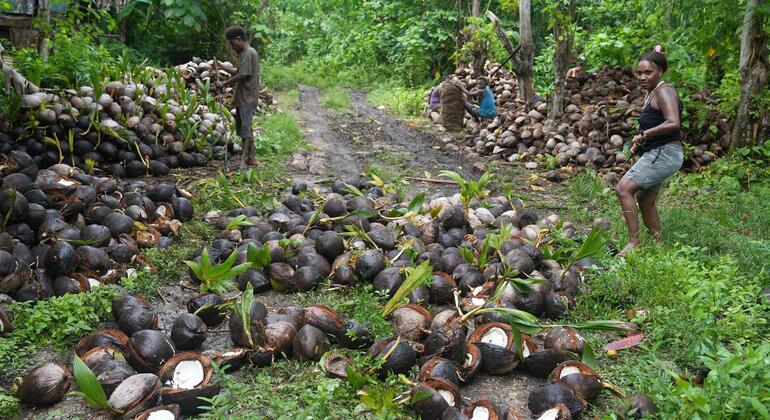
Today, the United Nations is supporting the process of making the land safe to walk on and build on again, but the rusting weapons pose a growing threat to public health.
For years, islanders have suspected that this toxic legacy is harming them and their children, and now a study involving the United Nations has found strong evidence To support this, confirm the presence of heavy metals like lead, arsenic, cadmium and explosive residues.
Study lead – funded by the Government of Japan and supported by the United Nations Development Program (UNDP) – Dr Stacey Pizzino of the University of Queensland said the risk to islanders is increasing because unexploded ordnance – known as UXO – is part of daily life there.
“When you’re travelling, when you look down from the boat, you can see the UXO in the rocks,” he told reporters in Geneva. “Unexploded ordnance are used as anchors in canoes and children are interacting with the devices on a regular basis.
“In one area where we were, we were hearing explosions on a fairly regular basis and children were playing with the devices and taking explosives out of them and making bangers, to blow up coconuts.”
Dr. Pizzino reports that breast-fed infants developed eye pain, rashes, and mouth sores, ulcers and rashes after their mothers ate suspected contaminated seafood.
More than 80 years after World War II, the Solomon Islands remain one of the most mine-contaminated places in the Pacific.
fatal discovery
In another case, he described how a mother brought a bag of weapons confiscated from children that they found on a rock underwater.
Testing of the dust in the bags containing the devices revealed “incredibly high lead levels…there is no safe level of lead for children,” Dr. Pizzino said. “It has health implications in terms of brain development.”
The findings of the UN study are the first of their kind in the Pacific region.
threat to the food chain
At Lever Point and other sites, soil samples revealed elevated levels of heavy metals. The highly explosive compounds TNT and PETN were also detected. Traces of marine life, including shells, were found at some places.
This episode highlights the long-term consequences of unexploded ordinance and the need to immediately protect public health.
Making areas safe is a slow and complex task as the risk of contamination is huge.
But this changes everything.
“The explosive ordnance device unit comes and detonates a lot of bombs,” said Fred, a farmer on Gavatu Island. “When we know the area is clear, we can relax. We can plant crops. we don’t care about children“
For UNDP, protecting lands and rocks is central to development.
“Unexploded ordnance has always been a significant issue,” says Raluka Eddon, UNDP’s resident representative. “Time is running out as more dangerous chemicals leak into the environment, damaging reefs, marine life and coastal communities.”
Another islander, Billy, a farmer and fisherman, agrees. “We now understand that there may be an even greater threat,” he says. “We want the bombs to be removed. We want to live in safety.”
While UNDP’s research does not claim to represent the entire country nor establish any definitive causal link, the agency says that combined environmental evidence, community reports and observed health patterns point to a “credible and increasing risk”.
