

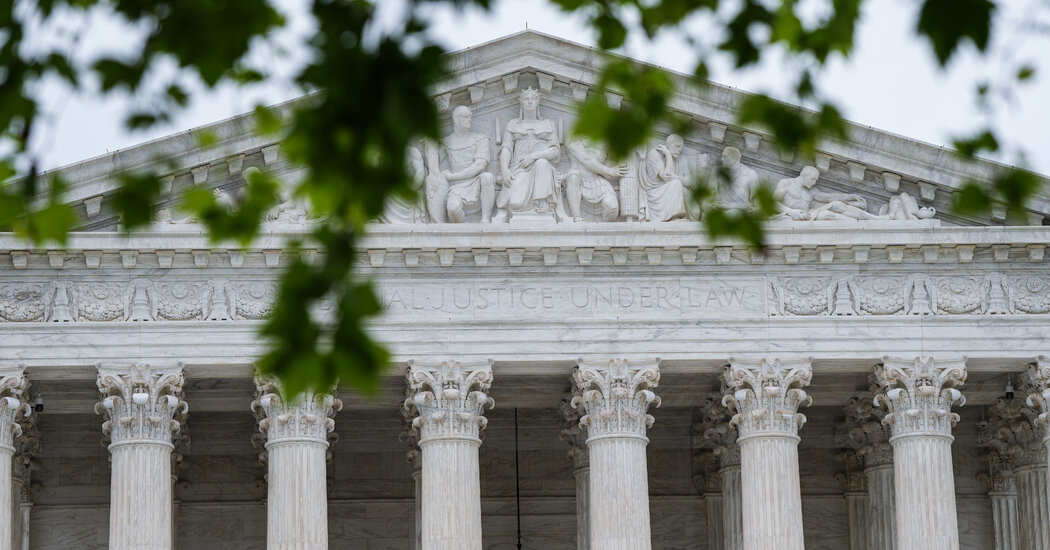
The Supreme Court on Wednesday struck down Louisiana’s voting map, finding that lawmakers illegally used race when drawing a new majority-Black district and potentially setting off a scramble in the middle of primary season as the state considers drawing new maps.
The decision was 6 versus 3, divided along ideological lines. The conservative majority claimed that Opinion There was a limited decision that preserved the central principle of the Voting Rights Act, but the liberal wing of the court dissented, arguing that the justices had taken the final step in dismantling a landmark civil rights law.
In the majority opinion, Justice Samuel A. Alito Jr. wrote that the court had upheld the Voting Rights Act but that Louisiana’s new majority-minority district violated the Equal Protection Clause of the Constitution.
For decades, under the Voting Rights Act, lawmakers have drawn districts where non-white voters are in the majority to protect their ability to elect candidates of their choice.
But Justice Alito said that “broad social changes”, particularly in the South, including increased voter registration and turnout by minorities, showed that such views were no longer necessary.
Instead, he wrote that the justices were updating a 40-year-old framework that courts look to to evaluate the use of race in drawing congressional districts, essentially saying that the Voting Rights Act only prevents lawmakers from drawing maps that would intentionally limit the power of minority voters.
Now, Justice Alito wrote, to successfully challenge district maps under the Voting Rights Act, challengers would need to show evidence supporting “a strong conclusion” that a state “intentionally drew its districts to provide fewer opportunities to minority voters because of their race.” A legal challenge that “cannot separate race from the state’s race-neutral considerations, including politics,” will fail.
Justice Alito said the new framework “reflects significant developments” since the Court set out factors for evaluating the use of race in voting maps in 1986, writing that in the decades that followed, “racial differences in voter registration and turnout” had largely disappeared.
Justice Elena Kagan dissented, saying that the practical effect of the decision would make it nearly impossible to use race when drawing voting maps, writing that “the Court’s decision will set back the fundamental right granted by Congress to racial equality in electoral opportunity.”
Justice Kagan read her dissent from the bench, a rare move that often signals a justice’s strong displeasure with a decision.
The decision will give Republicans a boost ahead of the midterm elections, although it was not immediately clear how much they would benefit.
Coming midway through the primary calendar, there were still several states that could draw new maps citing Wednesday’s decision. Republicans in Florida moved quickly after the announcement: The state legislature approved a new map on Wednesday. Louisiana will likely lose a Democratic district when it finalizes its new map.
Any map that eliminates majority-minority districts and is drawn in the wake of the decision will likely be challenged in court — possibly leading to a new wave of litigation.
Representative Cleo Fields, whose district is at the center of the Supreme Court case, said in a statement that “the practical effect is to make it more difficult for minority communities to challenge redistricting maps that weaken their political voice.”
Mr. Fields, a Democrat, cautioned against immediately redrawing the maps before the November election, and promised to “evaluate all available legislative responses to this decision and restore full protections.”
Got a news tip about the courts? If you have information to share about the Supreme Court or other federal courts, please contact us.
Janai S., president of the National Association for the Advancement of Colored People Legal Defense Fund. Nelson said the court technically stopped short of striking down Section 2 of the Voting Rights Act – an outcome he and others considered a possible “worst-case scenario.”
Nevertheless, he said the decision would have a devastating impact. “What the court did was equally damaging and even more misleading,” he said, adding that he believed the majority was politically motivated. “This is the day for the loss of any vestige or modicum of credibility of this Supreme Court to rise above partisan politics.”
Louisiana Attorney General Liz Murrill, a Republican, praised the decision in a statement, saying the court “ends Louisiana’s long-running nightmare of federal courts forcing the state to draw a racially discriminatory map.”
Ms. Murrill called it “a seismic decision affirming equal protection under the laws of our country,” and said she would work with the state governor and legislature to produce a “constitutionally compliant” map.
The Trump administration also celebrated this decision. White House spokeswoman Abigail Jackson called the decision “a complete and utter victory for the American voters.”
“The color of one’s skin should not determine which congressional district you belong to,” Ms. Jackson said. “We applaud the court for ending unconstitutional abuses of the Voting Rights Act and protecting civil rights.”
Wednesday’s decision is the latest in a series of rulings by judges that have weakened the Voting Rights Act of 1965, often considered the crown jewel of civil rights-era laws.
Case, Louisiana vs. CalaisArising from controversy over a new voting map drawn by Louisiana lawmakers after the 2020 census. Previously, only one of the state’s six congressional districts had a black majority, even though black Louisianans made up about a third of the state’s population.
Two groups of Black voters filed the lawsuit in 2022, when state lawmakers adopted a new map that still included only one majority-Black district. He argued that Louisiana violated the Voting Rights Act by packing black voters into one district, which had the effect of diluting the power of their votes. A federal judge agreed.
In 2024, state lawmakers tried again, this time adopting a map that included a second majority-Black district. A group of white voters from Louisiana then challenged that map, claiming it was an illegal racial gerrymander. He pointed to the boundaries of the new district, which stretch diagonally across the state from south-east to north-west.
Lawmakers initially defended the map, arguing that its disproportionate shape was a result of politics, not race. He said lawmakers created the 2nd District zone to protect high-profile politicians, including House Speaker Mike Johnson, a Republican. The court has said that making maps motivated by partisan gain is acceptable.
The Supreme Court first challenged the Louisiana map in the spring of 2025, considering whether state lawmakers appropriately balanced race and political considerations. But in June, instead of announcing a decision, the judges said they would hear it again in the autumn. In August, the justices announced they were expanding the case, and asked lawyers to prepare to argue a much broader question than originally contemplated: whether the state’s creation of a second majority-minority district violated the Constitution.
That announcement sparked concern among supporters of the Voting Rights Act, who feared that the court’s conservative majority – long skeptical of the law – would use the case to strike a fatal blow to the law and strike down as unconstitutional the provision requiring lawmakers to consider race.
Just two years earlier, justices had heard a similar dispute over Alabama’s congressional map and cited the Voting Rights Act without finding it unconstitutional. In that case, allen vs milliganThe Supreme Court ruled that the state’s Republican majority illegally weakened the power of black voters by violating the Voting Rights Act.
But in that case, Justice Brett M. Kavanaugh wrote a concurrence that he wondered whether there should be a time limit on the ability of states “to conduct race-based redistricting,” writing that it “cannot extend indefinitely into the future.”
During oral arguments in the Louisiana case, Justice Kavanaugh and several other conservative justices appeared to question whether race should be stopped taking into account when drawing voting maps.
“What do you think exactly the end point should be, or how do we know if race has been intentionally used to create districts?” Justice Kavanaugh asked a lawyer from the NAACP Legal Defense and Educational Fund, which had argued for upholding the Voting Rights Act.
Contributed reporting Emily Cochrane, Nick Corasanity, Zolan Kanno-Youngs, Patricia Mazzei And rick rojas.
