

NEW YORK, May 1 (IPS) – “We choose hope because despair is a form of surrender that we cannot accept,” Enrique Manolo, the UN Ambassador to the Philippines, told civil society representatives and the diplomatic community when he addressed this question.
In an event organized on the sidelines of 2026 NPT Review Conference On April 30, Manolo and other speakers discussed efforts to reinvigorate the momentum for the Treaty on the Non-Proliferation of Nuclear Weapons (NPT) by bringing hope to diplomatic conversations and making the case for nuclear disarmament through the lens of the humanitarian impact of nuclear weapons.
This event was sponsored by Soka Gakkai InternationalThe Nuclear Age Peace Foundationand the United Nations Permanent Mission of the Philippines and Kiribati.
In shedding light on the humanitarian impact of nuclear weapons, the program highlighted an under-reported perspective in the debate on nuclear weapons. During the general debate this week, UN member states have so far spoken about protecting and maintaining the NPT, which is long-term proof of what multilateral actors can achieve under an integrated approach to peace and security.
They reiterate the NPT as the cornerstone of the international disarmament regime. And yet, the current geopolitical environment and systemic weakening of institutions is undermining the fundamental principles of the treaty. Therefore, it is even more important to see member states reaffirming their commitment to the NPT and to the maintenance of international peace and security more broadly.
However, at present, much has been said about how some State Parties to the NPT are respecting their obligations. Representatives of non-nuclear countries pointed out that nuclear powers have not adequately fulfilled their non-proliferation obligations and are also considering expanding their nuclear capabilities, which would violate the NPT.

As several speakers noted in their remarks, the consequences of a nuclear explosion would have far-reaching consequences that extend well beyond the point of impact. The devastation has had immediate consequences for the affected communities, ranging from the destruction of their homes to injuries and lifelong medical conditions.
Radiation exposure is an intergenerational curse, as second and third generation communities suffer chronic health problems as a result.
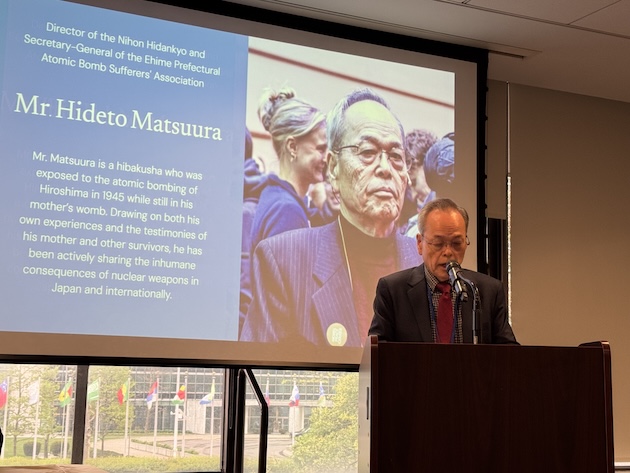
Hideto Matsuura, a hibakusha and director of Nihon Hidankyo, testified to this fact. Matsuura was in his mother’s womb during the atomic bombing of Hiroshima in 1945, yet his exposure to radiation from the womb left him vulnerable to the effects of nuclear weapons.
As director of Nihon Hidankyo, the Japanese hibakusha organization group, Matsuura has dedicated himself to spreading the message of peace and nuclear disarmament under the principle of “no more hibakusha.” He shared his mother’s story of the bombing and her life in its immediate aftermath. He described those who died from burns and radiation poisoning within days of the bombing, but that conditions for those who survived were appalling.

As time passed, people reported serious medical problems and the root cause of the diseases they suffered from was not understood. Eighty years after the bombings of Hiroshima and Nagasaki, hibakusha and their descendants continue to suffer from late-onset conditions such as cancer and leukemia. They continue to share their stories with the international community to promote peace above all else.
“Again, I raise my voice. Nuclear weapons and humans cannot exist together,” Matsuura said. “Please all countries join the Treaty on the Prohibition of Nuclear Weapons as soon as possible. Let’s achieve an immediate ban on nuclear weapons and their ultimate elimination. That is why I am here today to work together with you.”
Pacific island states such as Kiribati are also a case study of the impact of nuclear testing on communities. Although testing was conducted in the Pacific Ocean due to its relative isolation from the continents, the island nations and their citizens were still affected by radiation exposure.
Some areas, including areas sacred to their cultures and traditions, are still uninhabitable today. Josephine Moote, Charge d’Affaires of the UN Mission to Kiribati, commented on the importance of nuclear justice in the response following the nuclear test.
When discussing the impact of nuclear weapons, the disruptions they cause to society and the environment cannot be ignored.
Both Matsuura and Josephine Lund, Secretary General of the International Physicians for the Prevention of Nuclear Weapons of Sweden (IPPNW), commented on how radiation exposure subsequently affected pregnant women and their children.
Lund commented on how healthcare systems collapsed after the bombing, as almost all hospitals were destroyed and more than two-thirds of medical professionals were killed, meaning survivors were left without adequate care.
Furthermore, access to contaminated food and water became extremely limited, and the destruction of infrastructure and sanitation standards, creating conditions for the rapid spread of diseases. This evidence shows that humans are “extremely vulnerable” to the effects of nuclear war, Lund said.
Lund said, “Nuclear weapons are not just tools of war. They are weapons of mass suffering. The effects cannot be controlled in time or space. They harm civilians… destroy health care systems, poison the environment and leave permanent scars on humanity.”
The threat of nuclear weapons stands on par with another existential threat of our time: climate change. Conflict and even the use of conventional weapons can cause devastation to the environment.
Furthermore, nuclear weapons and climate change are both what Andean DeVos, outreach coordinator for the Nuclear Age Peace Foundation, has called “threat multipliers.” Their influence “destroys the conditions necessary to maintain peace and health” and “deepens the factors causing instability.”
Climate change is a factor in mass migration and competition for scarce resources, which could increase instability and conflict, while the continued existence of nuclear weapons and lack of progress in disarmament efforts threaten the NPT regime. DeVos further lamented a “crisis in priorities”: global spending for military activities, including nuclear expansion, has increased in recent years, when those resources could be invested in disarmament activities or moving away from fossil fuels.
Yet DeVos and other speakers reiterated that in such bleak circumstances, people can take inspiration and hope from meetings like Thursday’s side event, where diverse viewpoints are shared but united by a common belief in nuclear disarmament as a path to peace. This can be expected from the knowledge that more than half of the UN member states are parties to international treaties such as the NPT and the Treaty on the Prohibition of Nuclear Weapons (TPNW).
SGI Tomohiko Aishima, Executive Director of the SGI Peace Center, believes that peace education plays an important role in promoting disarmament and rejecting nuclear deterrence.
In educating people about the reality of nuclear detonation, deterrence loses its strategic potential and is instead exposed as a tool that is “absolute in its inhumanity”.
Aishima urged the diplomats in the room, who will soon return to the NPT review conference at UN Headquarters, to heed the warnings from civil society and hibakusha as they continue their debate.
“Let humanitarian impact guide our policy. Let us together reject the illusion of deterrence; let us choose human security. Let us choose hope.”
Comment: This article is brought to you by IPS Noram in collaboration with INPS Japan and Soka Gakkai International in consultative status with ECOSOC.
IPS UN Bureau Report
© Inter Press Service (20260501151844) – All rights reserved. Original source: Inter Press Service
