

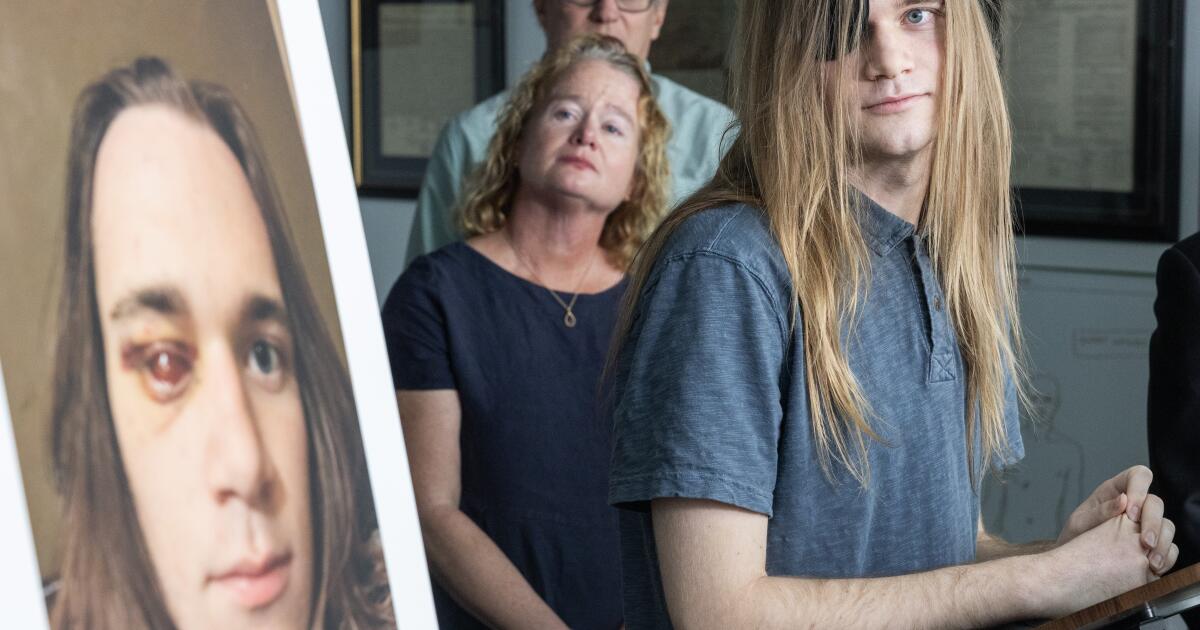
Micah Moore, a film production assistant, recently underwent his second surgery to restore hearing in his right ear after being shot in the head with a rubber bullet while participating in a “No Kings” protest in downtown Los Angeles last June.
“It really completely turned huge parts of my life upside down,” the 25-year-old told The Times. “It has been very frustrating at work, with friends, with family – there have been many sleepless nights.”
During a similar protest rally in March, 18-year-old USC student Tucker Collins was shot with a “less lethal projectile”, which hit him in the face, blinding him in one eye.
Both young men are now seeking justice for their injuries, with Moore filing suit against the Los Angeles Police Department and the Los Angeles County Sheriff’s Department because they have not identified the agency responsible for their injuries. Collins filed a federal claim against the U.S. Department of Homeland Security last month, a precursor to filing a federal civil rights lawsuit against the agency.
The two men are among many who say they were innocent victims of excessive force used by federal and local authorities during immigration raids and the protests that followed.
The attorney behind the demand for justice is James DeSimone, who represents both Moore and Collins. His law firm has represented at least 15 people who say they were injured by federal or local agents during protests and raids since last June, including a guitarist who suffered a broken finger and a 79-year-old car wash owner who was thrown to the ground and left with bleeding on the brain.
The LAPD and Sheriff’s Department did not immediately respond to requests for comment. A Homeland Security spokesperson declined to address Collins’ allegations, but instead released a statement, saying that a group of about 1,000 protesters surrounded the federal building in Los Angeles during March protests and “threw rocks, bottles and cement blocks at officers.” Seven warnings were given “prior to the deployment of crowd control measures,” according to the statement.
Collins and Moore say they were not provoking police when they opened fire. He also refused to listen to any dispersal orders or warnings before being injured.
“Right before I was shot, there was an officer who walked up to a group (of protesters) standing near the fence and attacked them with mace,” Collins said. “To me, this cannot be described as anything other than inciting the mob so that they can then justify the use of force used to incite the mob. This is circular reasoning to justify extreme violence.”
When Moore headed to Los Angeles City Hall last June, the crowd around him was not violent as he participated in a “No Kings” protest — one of several nationwide demonstrations aimed at challenging the Trump administration and its policies.
Moore arrived around 5 p.m., chanted with the rest of the crowd, and recorded some footage on his cellphone. The protesters around him were peaceful, he said, and some of them were holding signs. As Moore was turning to leave, a law enforcement agent shot him directly in the face with a rubber bullet.
Micah Moore was in a hospital after being shot by a projectile during the “No Kings” protests in June 2025.
(Courtesy of Micah Moore)
Moore immediately lost hearing in his right ear and began bleeding. Someone in the crowd put a bandage on his head and he was immediately taken to the emergency room.
His lawyer said that after undergoing surgery last week to try to regain his hearing, Moore is going through a painful recovery process and there is no certainty that his hearing will return.
Moore said he is now afraid to participate in any protests. “I’m constantly uncomfortable because what warning signs can you see if all the rules are being followed and I still get shot?” He said.
During a March 28 rally outside the Metropolitan Detention Center in Downtown LA – the site where many anti-ICE protests took place – Collins said he was taking pictures when he was shot in the eye.
Collins said that after he was shot, the agents began firing tear gas, causing irritation to his throat and eyes.
“These weapons can be aimed and are very accurate, so there was some logic that they were shooting at head level, that they were shooting in my direction and there was no one around me,” he said. “The only other people were taking videos and pictures with their cameras. I believe this has something to do with why I was shot.”
DeSimone said the LAPD has contacted him to launch an internal investigation.
“There will be consequences within the department and up to discipline and termination where necessary,” DeSimone said. “As well as realistic criminal investigations when they have committed a crime in violation of the penal code.”
DeSimone said he plans to argue that killing his clients by shooting them in the head with rubber bullets violates the California Penal Code, which prohibits using projectiles and chemical agents to disperse crowds “except in the case of danger to life or serious bodily injury.”
Last year, federal judges issued a preliminary injunction prohibiting Homeland Security and U.S. Immigration and Customs Enforcement agents from using tear gas, pepper-ball weapons and other less lethal projectiles against protesters, banning targeting the head, neck or torso except when lethal force is justified.
Both Moore and Collins said that their injuries have affected their work and studies. Both said they would continue protesting despite what happened to them.
“That’s how governments move from small oppressed groups to larger and larger groups that are considered a problem,” Moore said. “I went out to protest not because I was personally targeted by ICE, but because others in the community were. Now that I have been personally targeted, people reading this should see this not as an erosion of my civil liberties but as a threat to their own.”
Collins said that, despite his injury, he feels a duty to participate in future protests.
“It proves to me why it’s even more important for people to document what’s going on,” he said. “If there had not been someone who had filmed me being shot, it would have been much harder for me to seek justice for what happened.”
