

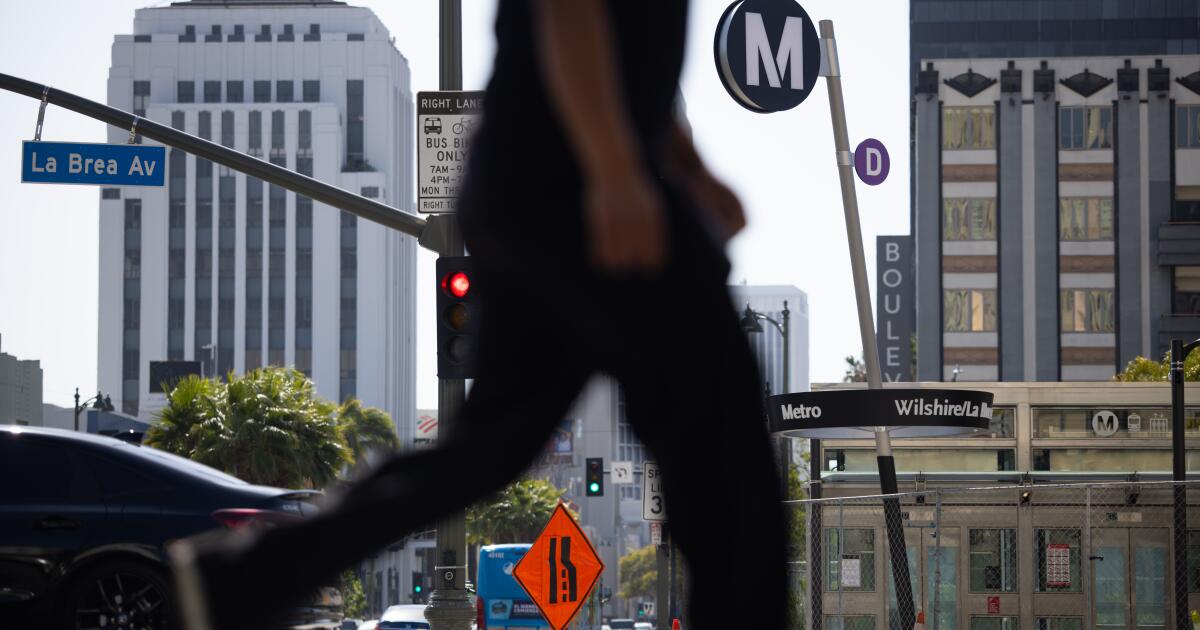
On paper, the D Line should be a slam-dunk for Los Angeles mass transit.
It runs through the heart of the city, which includes some of LA’s most dense communities as well as landmarks such as LACMA and the Academy Museum. Its stations are just a few blocks from the Grove and Beverly Center.
But getting Angelenos out of their cars and into mass transit will likely be a challenge, and experts say the D Line could be a big test of whether adding rail to prime real estate can change behavior.
Some say the line’s success will ultimately depend on its usefulness, reliability, and inconvenience of alternatives – and it’s not clear that the calculus will make it a daily commute favorite, especially right away.
“It has to be the best way to get around,” said Brian Taylor, professor of urban planning and public policy at UCLA’s Luskin School of Public Affairs and research fellow at the university’s Institute of Transportation Studies. This becomes the case, he said, when rail lines are convenient, timely and consistent, while driving becomes less attractive: Interstate traffic remains a challenge, parking options are expensive or limited and fuel prices remain high.
Some metro lines have achieved this success. The A Line, which runs from Long Beach to the San Gabriel Valley, has long been loaded with passengers, with about 17 million weekday riders per year in 2025, close to its pre-pandemic level. But it is the metro’s oldest line, and runs through working-class communities that have long relied on mass transit.
The B Line, a subway that runs from downtown to the San Fernando Valley, recorded ridership last year equal to the A Line, with about 16 million weekday riders per year. But it is far behind its popularity before the pandemic, when more than 30 million people traveled on the line annually.
The D Line will extend from Downtown to Beverly Hills along Wilshire Boulevard when three new stations open Friday: Wilshire/La Brea, Wilshire/Fairfax and Wilshire/La Cienega. is considered the path finally stretch Up to Westwood, four additional stations are expected in 2027. Experts say its location will give it some immediate benefits.
“This is the most densely populated corridor west of the Mississippi and it’s the most densely populated part of Los Angeles,” said Ethan Elkind, director of the climate program at UC Berkeley’s Center for Law, Energy and the Environment. “Generally speaking, rail lines are successful when they serve densely populated areas.”
But space is not necessarily enough.
Jacob Wasserman, research program manager at the UCLA Institute of Transportation Studies, worries that long wait times, especially during off-peak hours, could deter riders.
“Late at night, you won’t need the service you do during rush hour,” he said. “But every 20 minutes! You come in, you see the next train is in 19 minutes, you take Uber.”
According to Metro officials, D Line trains run from 4 a.m. to about 12:30 a.m. each day, running every 10 minutes during most of the day, and every 20 minutes during late nights, starting around 9 p.m.
A Metro spokesperson said that his team understands that frequent service is “the key to making transit competitive”, but said that slower frequency at night is a starting point, noting that “funding, staffing and ridership allow.”
Most of the time, metro officials estimate that the metro system will be faster than driving. The ride from Union Station to the Wilshire/La Cienega stop – which will be the farthest stop on the D Line – is estimated to take 21 minutes, while driving takes about 45 minutes, according to Metro, and can take up to 70 minutes during rush hour.
But when there’s no traffic, like late at night, Google Maps estimates the drive will take about 20 minutes.
However, Metro officials see the D Line extension as the beginning of a longer campaign.
“The more options we give Angelenos to get where they want to go, the more likely they are to park their car and get on the (rail) system,” said Timothy Lindholm, Metro’s chief program management officer. “Every passenger who can use our system for a weekend trip to the museum is the passenger we want to make a Metro customer for life.”
Los Angeles could also take additional steps to help transform the car-centric city into one reliant on its increasingly robust rail network.
Metro D Line stations at Wilshire and La Cienega.
(Kayla Bartkowski/Los Angeles Times)
Joshua Shank, partner at transportation strategic advisory firm InfraStrategies and former chief innovation officer for Metro, said the city should consider easing driving demands with congestion pricing.
“The truth is, the cost of driving is low, the cost of parking is low, so people are using it at a higher rate than the market rate,” Shank said. “As long as this continues, you’ll see more people in cars than we expect.”
The Times spoke to about two dozen residents and commuters in Beverly Hills and Miracle Mile this week, who overwhelmingly said they were willing to give the D Line extension a try, even though most also mentioned reservations.
George Reed lives near the Wilshire/Cienega station but works from home, so he will not use the line for commuting. But the 34-year-old said he would consider using the new stop to attend sporting events or downtown shows, “if it’s faster than taking (Interstate) 10,” he said.
Reed was hesitant about the potentially long wait for the train, which he believed to be more than 10 minutes. This will likely prompt him to call Uber or Lyft, his current choice for city travel.
Autumn Nyeri, on the other hand, plans to start using the new D Line stops more regularly as soon as they open. She lives in Koreatown – just off the D Line stop – and works at the Peterson Automotive Museum, right across the street from the new Wilshire/Fairfax station.

Sharad Nyeri near the Metro D Line entrance at Wilshire and Fairfax.
(Kayla Bartkowski/Los Angeles Times)
“It’s made for me,” Nyeri said of the extended D-line. She currently shares a car with her boyfriend and they coordinate daily dropoffs and pickups, at times causing inconvenience to one of them.
Helen Canassi, stopping on her morning walk at the Wilshire/Cienega station, said she was excited to try out the new train — after all, she’s seen it built since last decade — but she’s not sure how much she and her husband will actually use it. Her commute to the San Fernando Valley won’t be affected, but her husband works in the city – can he take it?
“I don’t think so,” Canassi said, laughing, “because we have a car.”
But as he thought about it further, he said he might take the line, “because parking downtown is so dirty,” the 70-year-old woman said.

Helen Canassi near the Metro D Line station at Wilshire and La Cienega.
(Kayla Bartkowski/Los Angeles Times)
Outside the Wilshire/Fairfax stop, Rod Aissa, accompanied by her husband and two dogs, began to imagine how the new stop would bring new possibilities to their neighborhood — and to Los Angeles as a whole.
“It makes us a complete city,” said Aissa, 64.
But many also raised issues that could derail their support: not enough park-and-ride options, too many locations still not connected to the rail system, and, of course, concerns about safety, which remains a major focus of Metro. In recent years, the department has worked to improve policing on trains and stations and implement additional security measures such as its Ambassador programme, with some real success.
But some people will not agree. One woman, who declined to give her name, looked almost disappointed as she walked through the Wilshire/Cienega station and called LA Metro a “complete failure” when asked about the extension.
He said the expansion is taking too long and is still years away from reaching L.A.’s beaches.
“I’d rather die before that happens,” she said before crossing the street.
