

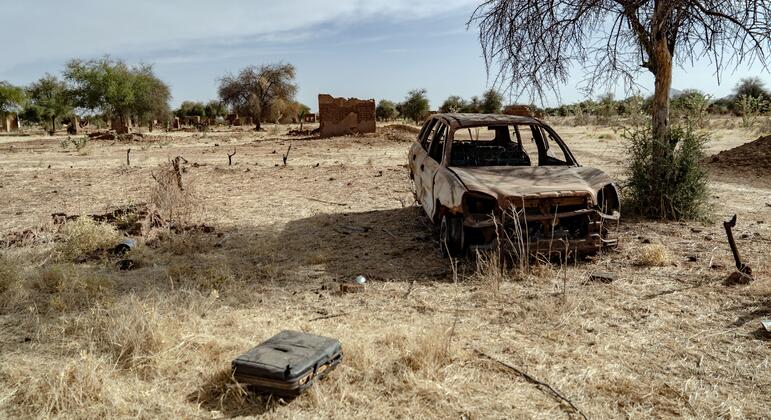
UN High Commissioner for Human Rights Volker Turk strongly condemned The increasing use of these weapons in the brutal war between the Sudanese Armed Forces (SAF) and the paramilitary Rapid Support Forces (RSF), which has recently entered its fourth year.
“Armed drones have now become the leading cause of civilian deaths,” He said.
“This increased reliance on drones allows hostilities to continue unabated in the coming rainy season, which has reduced ground operations in the past.”
Notice given to the international community
The High Commissioner warned of a further outbreak of violence in the coming weeks “as the parties seek to gain or consolidate control over territory amid the changing dynamics of the conflict” which could lead to further displacement and disruption of humanitarian assistance.
“This must not be allowed to happen,” he said. “The international community is paying close attention to the fact that unless action is taken without delay, The conflict is on the verge of entering another new, even deadly phase.”
The center of attacks is the Kordofan region
The majority of civilian deaths caused by drone strikes between January and April were recorded in the Kordofan region.
The most recent incident occurred on 8 May, when 26 civilians were reportedly killed and others injured in attacks near Al Quz in South Kordofan and El Obeid in North Kordofan.
The warring parties have repeatedly attacked civilian objects and infrastructure. This includes markets, where at least 28 such attacks have resulted in civilian casualties.
Health facilities have been hit at least 12 times during a four-month period. Some have closed their doors, forcing citizens to travel long distances to seek care or go without.
Fuel reserves and supply routes have also been repeatedly hit in recent weeks.
Drone use is increasing
The use of drones by both warring sides is rapidly spreading beyond the Kordofan and Darfur regions to the Blue Nile, White Nile and Khartoum.
A strike at Khartoum International Airport on 4 May resulted in the disruption of all flights, while several targeted drone attacks took place in Khartoum and its twin city Omdurman between 28 April and 5 May.
“The intensity of these attacks has shattered the relative calm that has prevailed in recent months, as increasing numbers of civilians have returned to the capital – and stoked fears of a return to hostilities in Khartoum.Mr. Turk said.
The potential for an escalation of hostilities in Kordofan would also put civilians at risk of retaliatory attacks and large-scale displacement, he said. This is particularly the case for the SAF-controlled towns of El Obeid and Dilling in South Kordofan, which are both in a siege-like state.
humanitarian access affected
The High Commissioner warned that increasing violence would also hamper humanitarian operations.
“Much of the country, including Kordofan, now faces a growing threat of famine and acute food insecurity, a situation further exacerbated by expected delays or shortages of fertilizer as a result of the Gulf crisis,” he said.
In response to the situation, UN human rights chief Calls for stronger measures to prevent arms transfers, including increasingly advanced armed drones, to parties in Sudan.
“Drone attacks against civilians and civilian objects will only get worse if they are completely unpunished, with this violence being normalized as a tactic by both sides.” He said.
Mr Turki again called on all parties to ensure the protection of civilians, including the safe movement of civilians from areas of active hostilities.
They should also be protected from reprisals, including summary executions, sexual violence, arbitrary detention and abduction, he said.
