

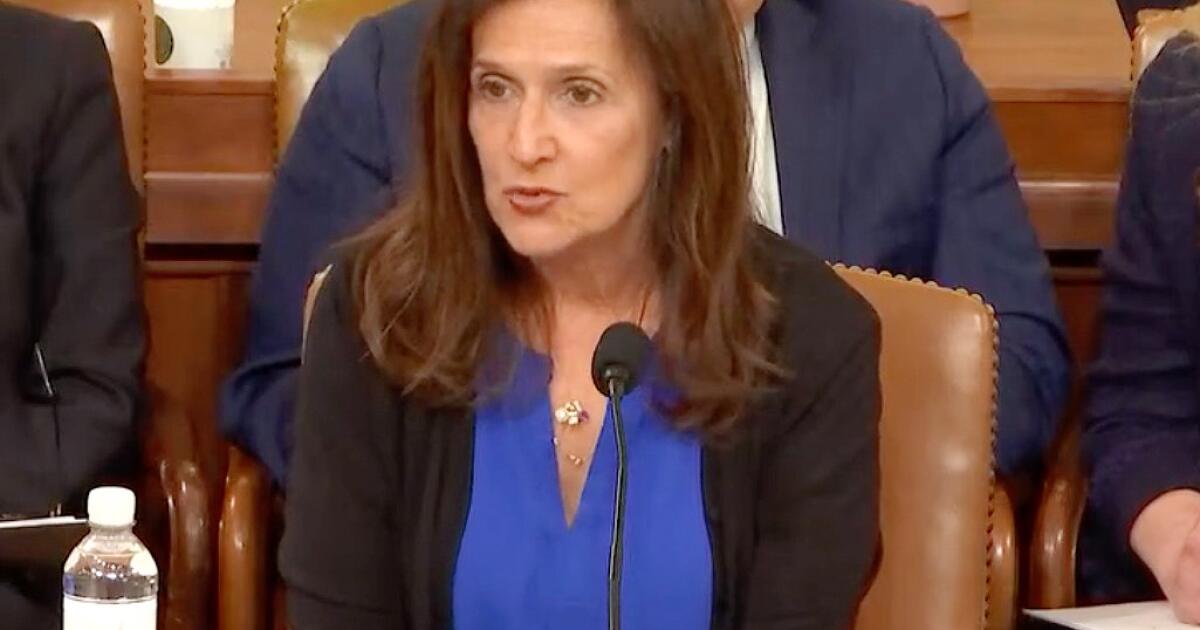
Lynn Ianni did not know she was apparently dying in a Los Angeles County hospice care facility until her Medicare claim for a pickleball injury was rejected.
“At first we laughed because it was an obvious clerical error,” the Seattle-based psychiatrist recalled Tuesday before a congressional committee, where she was testifying in 2024 about her months-long experience with fraud in the hospice industry. “It wasn’t just frustrating, it was scary.”
Ianni appeared before the House Ways and Means Committee on Capitol Hill at a hearing in which details about the fraudulent claims and stolen doctors’ identities emerged. She was a victim of California hospice scammers. His situation, like many others, comes despite promises of reform from lawmakers five years ago, when widespread corruption in California came to light.
In late 2020, a Times investigation revealed that a group of mostly older Americans were being targeted by unscrupulous providers who would bill Medicare for hospice services and equipment for patients they said were terminally ill, but who were not actually dying.
Ianni was denied care due to a pickleball-related shoulder injury. She testified that her health care provider told her that her Medicare would not cover the treatment because she was enrolled in hospice. She testified that after a scammer stole her Medicare ID number and enrolled her in hospice without her knowledge, she would have to continue paying her premiums if she wanted coverage.
Ianni tracked down a hospice facility attached to a huge strip mall and then tracked down the doctors signing off on the fake care through their national provider identifiers – it turned out to be a Santa Monica surgeon whose identity had also been stolen and had “no connection to hospice.”
“Despite clear evidence of fraud being exposed, nothing changed,” he told the committee.
Ianni said she reached out to federal regulators who manage Medicare and they told her to file an appeal for her denied claims, a process that can take a year or more to resolve. She said that eventually, with the help of an advocacy group, she received a new Medicare card and was able to resume physical therapy.
“This is evidence of the systemic failure that allowed fraud to occur, prevented timely reforms and left vulnerable people without care, without answers and without protection,” Ianni told lawmakers, adding that only his medical experience helped him overcome the problems.
Ianni’s testimony comes as the Trump administration has begun to increase its focus on fraud in the state.
When the scope of the state’s fraud first came to light in 2020, one of California’s first steps was to pause the issuance of new hospice licenses to give officials time to strengthen oversight. State officials and industry representatives drafted emergency rules that they said would close loopholes in hospice licensing requirements to weed out bad actors.
But even after years those rules have not been implemented. Experts say problems continue to plague the industry despite highly publicized enforcement efforts by the state and federal government.
Since Centers for Medicare & Medicaid Services, or CMS, administrator and former TV personality Dr. Mehmet Oz visited L.A. in January, 450 hospices in the area have been suspended from the payment system as part of a task force led by Vice President J.D. Vance in an aggressive new approach.
While the Trump administration has described California as the nation’s fraud epicenter, industry leaders told the committee Tuesday that the problems are nationwide.
“California has the clearest current warning sign, but this is not just a California problem. This is a federal Medicare program-integrity problem and a state-federal oversight problem,” testified Sheila Clark, president and CEO of the California Hospice and Palliative Care Association. “When scammers are allowed to enter the system, remain in the system, and shape the claims and cost reporting environment used by CMS, beneficiaries and taxpayers across the country suffer the consequences.”
“They expose vulnerable people to exploitation, deny them appropriate care, undermine trust in Medicare, and, when left unchecked, distort the data and assumptions that federal policymakers rely on to oversee these benefits.”
Clark warned that scammers continue to flourish despite the licensing ban in California.
“The warning signs are familiar: provider clustering at common addresses, rapid enrollment growth in saturated markets, repeated use of the same medical directors or certified physicians, invalid or unverified contact information, special fee-for-service Medicare billing in home health in high Medicare Advantage markets, and billing patterns that differ sharply from clinical reality,” she said.
He said the Centers for Medicare and Medicaid Services should “use their administrative authorities earlier and more aggressively” to prevent fraud rather than react after it occurs.
