

There was an eerie silence.
As soon as word apparently reached activists over the past few weeks that disturbing allegations of sexual assault were about to be made against Chicano civil rights icon Cesar Chavez, things started happening without any explanation.
Groups began canceling long-planned parades, dinners, lectures and fundraisers scheduled for Chávez’s birthday, March 31. People I’ve known for years were suddenly not responding to calls or texts about what was going on. Chávez’s longtime defenders – who stood by their hero even when revelations in this paper and in the biographies of the previous generation revealed that the man had a dark side – suddenly found themselves difficult to reach.
When the United Farm Workers and the Cesar Chavez Foundation issued statements Tuesday morning saying the “troubling allegations” against the patriarch were deemed credible enough to offer help to his victims, silence turned to fear. There was an uneasiness akin to waiting for a tsunami – that whatever was to come would change lives, shake institutions and force people to question the values and principles they had long held dear.
And like a natural disaster, what emerged about Chávez was far worse than anyone expected.
On Wednesday morning, The New York Times published a story in which two women whose families marched with Chávez on California grounds during the 1960s and 1970s revealed that he sexually abused them for years when they were girls. Equally shocking was the revelation by Dolores Huerta, Chávez’s longtime compatriot and civil rights stalwart, that he had once raped her at a time when her leadership in the fight to restore dignity to grape pickers had earned national praise and was the equivalent of the modern-day Via Dolorosa.
The silence has turned into screams. Politicians and organizations that long remembered Chávez and urged others to follow his ways are issuing statements every minute. My social media feed is now a cacophony of friends and strangers expressing sympathy for Chávez’s victims and outrage, disgust, and — above all — disappointment that the man whom many considered a secular saint for decades turned out to be such a horrible human being that no one could have imagined.
There will be questions and introspection about these horrific revelations in the weeks, months and years to come. We’ll see a push to rename dozens of schools, parks and streets bearing Chávez’s name across the country and even a rebranding of Cesar Chávez Day, a California state holiday since 2000 dedicated to urging people to give back to their communities and the least fortunate among us.
The calculation is correct. Much of the Latino civil rights, political, and educational ecosystem must grapple with why they held Chávez up as a paragon of virtue much longer than others, which was deserved and, as it turns out, nowhere compromised.
In any event, the myth has been shattered.
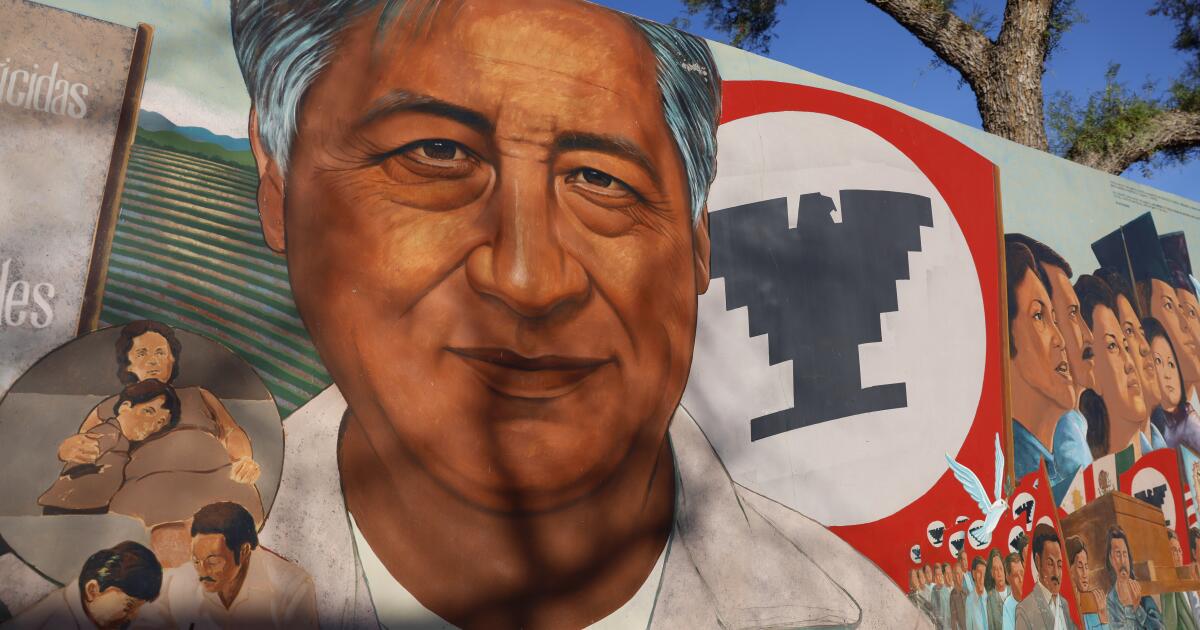
A portrait of Cesar Chávez on a mural at Farmacia Ramírez, 2403 Cesar E. Chávez Avenue, in East Los Angeles.
(James Carbone/Los Angeles Times)
Chávez’s biography has always read like an entry in the “Lives of the Saints” genre of books that Catholics used to read about holy men of their faith. The son of farm workers who became the Mexican-American Moses trying to lead his people to the promised land of equality and political power. An internationally renowned leader who led the life of a beggar. Who devoted decades to some of the most exploited people in the American economy. Awarded with prizes, plays, posters. Murals, films and monuments. President Biden also placed a bust of Chávez on his Oval Office desk.
It was a stellar reputation that largely persisted even as the union he had helped create lost its influence in California neighborhoods and a new generation of workers looked down on Chávez for his longstanding opposition to immigrants who came to this country to work without legal status. Fans kept him in office, while former UFW members alleged over the past two decades that the boss they once idolized fired many good people in the name of absolute control. This biography continued even as a new generation of Latinos came of age and knew nothing about him except the occasional school lesson or television segment.
I was one of those beginners. I first heard his name in Anaheim High School in the mid-1990s and I thought my teacher was talking about the famous Mexican boxer Julio Cesar Chavez. I was thrilled to know that someone had fought bravely for the rights of campesinos like my mother and her sisters, who toiled in the garlic fields of Gilroy and the strawberry fields of Orange County as teenage girls in the 1960s, at the same time Chávez and the UFW were enjoying their historic victory.
“Who is Cesar Chavez,” my aunt answered when I asked if his efforts ever made her job easier.
My admiration for Chávez continued even as I became aware of some of his faults. I was able to separate the man named Chávez from the movement for which he was a leading figure. Long-vilified communities look for heroes to emulate, look up to, hang on their walls and share quotes on social media. We create them while we ignore the fact that they too are flesh and blood like us.
Chávez seemed like the right man at the right time as Mexican Americans rose up to fight discrimination and segregation like never before. Now, Latinos and others who admired Chávez must grapple with his moral failings of the worst possible magnitude at the worst possible time: when an administration is doing everything possible to crush Latinos and we are looking for people to do things like never before.
He is one of the few Latino civil rights leaders known nationwide — and Chavez is nowhere near as close as acolytes make him out to be. Some would argue that it is unfair that he would be erased from the public sphere while other hunters past and present largely retain their wealth and reputations.
But that’s looking at revelations of abuse the wrong way. For now, I’ll do what those directly affected by Chávez’s actions are telling us to do.
The UFW and the Cesar Chavez Foundation were wise not to try to defend the indefensible in their statements and instead consider any victims before deciding what’s next for them.
The Chávez family issued a news release saying “We respect the voices of those who feel unheard and who report sexual abuse.”
“Cesar’s actions do not reflect the values of our community and our movement. The farmworker movement has always been larger and far more important than any one individual,” Huerta wrote in an online essay.
Another of his victims told The New York Times about Chávez’s legacy, “It makes you reconsider all those heroes in history. The movement – he’s the hero.”

The fountain in the Memorial Garden surrounds the gravesites of Cesar Chávez and his wife, Helen Chávez, at the Cesar E. Chávez National Memorial in Keene, California.
(Francine Orr)
his face movement Millions of people were inspired and hundreds of thousands of lives improved. So we must not cancel out the good that Chávez fought for with so many people; We must direct the praise he once attracted and the anger he will now receive toward the work that still needs to be done.
To quote an old UFW slogan that Chávez turned into a mantra, la lucha sig – The fight continues. It’s a statement that’s more relevant than ever, damn its imperfect messenger.
