

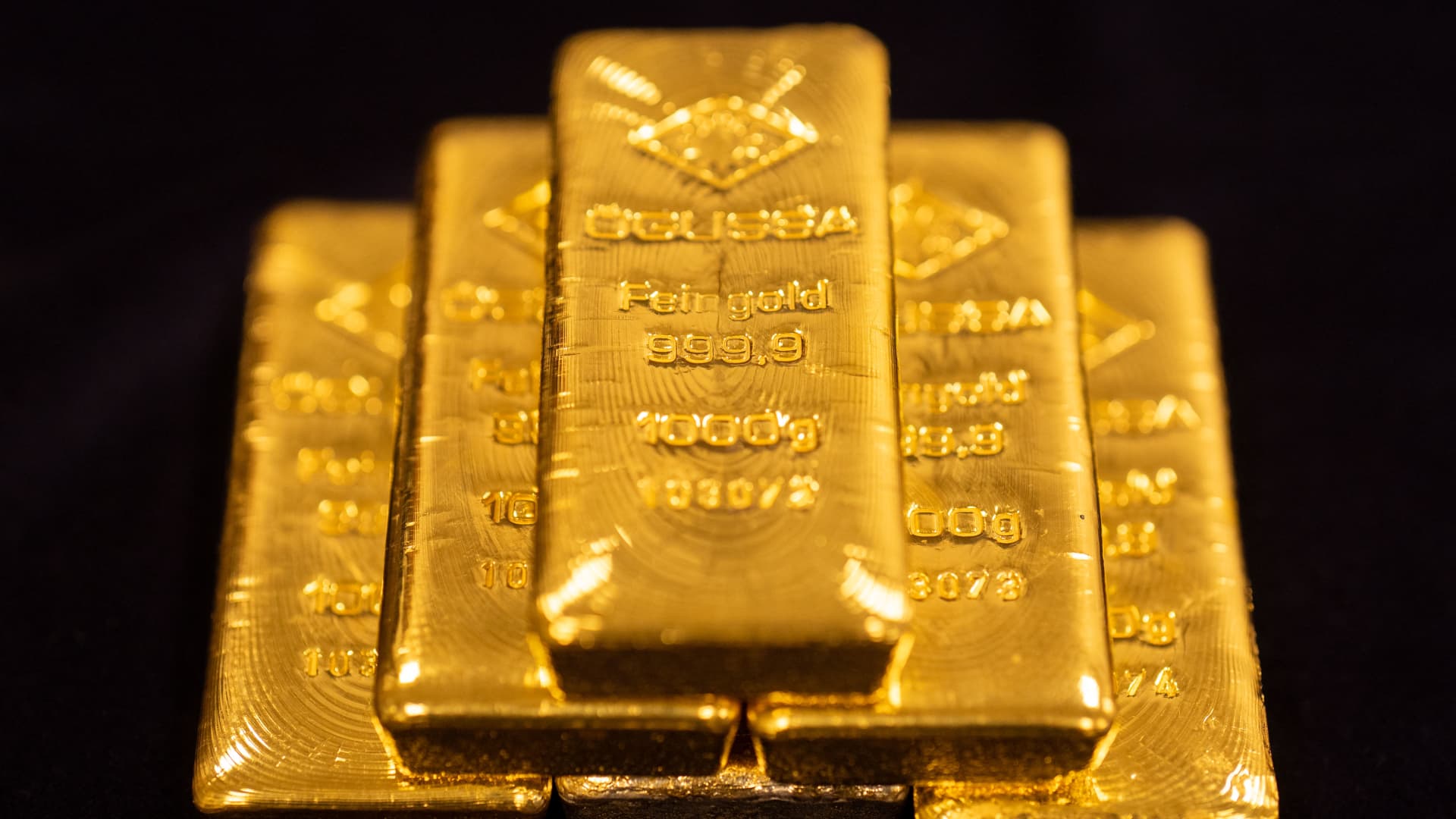
Gold bars weighing 1000 grams are displayed at the Austrian Gold and Silver Refinery (OEGUSA) in Vienna, Austria on February 3, 2026.
George Hochmuth AFP | getty images
Gold extended its decline on Tuesday as investors trimmed their positions as the yellow metal lost its appeal due to a stronger US dollar and higher Treasury yields, deepening a bear market trend.
spot gold Prices fell 2% and trimmed losses 1% to $4,335.97 an ounce. Gold futures for April delivery were also in the red, falling more than 1% to $4,358.80 an ounce. Spot silver was down more than 3% at $66.93 an ounce, while futures were down 2.61% at $67.54.
The dollar index, which measures the greenback’s strength against a basket of currencies, was up 0.5% on Tuesday. A stronger dollar reduces the appeal of greenback-denominated bullion by making it more expensive for holders of other currencies.
US President Donald Trump said on Monday he has ordered a five-day moratorium on planned attacks against Iran’s energy infrastructure after “productive” discussions with Iranian officials. He later told CNBC’s Joe Kernan that “We are very willing to make a deal with Iran,” hinting that the war could end soon.
Gold prices since the beginning of the year
However, Iranian state media rejected that claim, citing a senior security official who said there had been no direct or indirect talks between Washington and Tehran.
Spot gold has now fallen more than 22% since hitting a record high of $5,594.82 an ounce in late January, with the precious metal falling nearly 10% last week in its worst performance since September 2011.
Market watchers attributed the decline to a mix of macro and positioning-driven factors.
“While gold initially rose on safe-haven demand following the conflict, prices have declined recently,” said Rajat Bhattacharya, senior investment specialist at Standard Chartered.
“We see this pattern repeated during periods of increased market stress as investors raise cash to pay margin calls or book profits where they can,” he told CNBC via email. He said the recent strength of the dollar has also impacted the demand for gold.
The dollar index has strengthened about 3% since the beginning of the war.
Market participants are also reassessing expectations for U.S. monetary policy, with persistent inflation reducing the likelihood of aggressive rate cuts from the Federal Reserve, which is keeping Treasury yields higher.
Higher yields have reduced the appeal of non-interest-bearing bullion. The yield on the 10-year Treasury was up nearly 5 basis points on Tuesday at 4.384%.
Some analysts said the selloff was a natural correction after an extended rally driven by geopolitical uncertainty and structural demand. Gold rose more than 64% last year.
“Gold’s recent rally to record highs was driven less by inflation than by a broader loss of confidence: fiscal deficits, geopolitical fragmentation, and central banks quietly moving away from dollar reserves,” said Xavier Wong, market analyst at eToro.
“After such a run, some position reduction was inevitable. Gold has been one of the better-performing assets over the past year, and when markets are volatile, leveraged funds and institutional investors tend to reduce risk.”
