

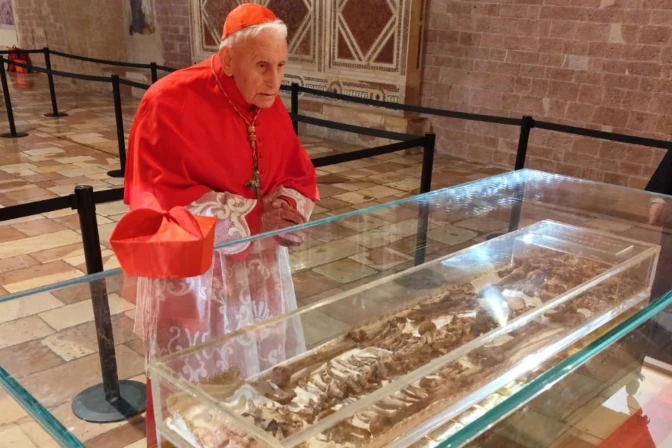
On March 19, Albanian Cardinal Ernest Simoni, aged 97, was among the last people to venerate the remains of St. Francis of Assisi before they were returned to a tomb in the crypt of the 13th-century Basilica of St. Francis in Assisi, Italy, where the saint’s tiny skeleton has been kept in a plexiglass case since 1978.
Despite his mobility problems, Cardinal Ernest Simoni did not want to give up the immense grace of venerating the skeletal remains of St. Francis of Assisi. | Credit: Photo courtesy of Cardinal Ernest Simoni
The bones of St. Francis were displayed in the church from 22 February to 22 March, when they were returned to their stone tomb in the crypt beneath the altar in the lower church.
Bones are generally not visible to people. Pilgrims can visit the tomb and pray, but the actual skeleton remains sealed inside the coffin (preserved within a nitrogen-filled Plexiglas case since 1978).
According to the Basilica of St. Francis in Assisi, more than 370,000 pilgrims from around the world were able to pray in front of his bones during that month.
Simoni, who studied at the Franciscan seminary from 1938 to 1948, was described by Pope Francis as “a living martyr” of the bloody communist persecution in Albania during the era of communist dictator Enver Hoxha.
The cardinal said: “I thank God for allowing me to be a pilgrim in Assisi and to pray for peace and brotherhood in the world before the relics of the great St. Francis – for me, a protector, father and teacher, to whom I have always looked from my beloved Albania,” Vatican News reported.

Cardinal Ernest Simoni celebrated the mass at the Protomonastery of St. Clare. | Credit: Photo courtesy of Cardinal Ernest Simoni
The cardinal, who will celebrate the 70th anniversary of his consecration on April 7, described the day as “to see thousands of pilgrims of all ages, as well as many young people who represent the hope and future of the Church, coming from all over the world to the city, which is a symbol of peace and faith, to pray and meet the Seraphic St. Francis, his great disciple St. Clare, and the saint of our time, St. Carlo Acutis.”
Simoni, who was secretly appointed in 1956, 12 years after the rise of communism in Albania, personally endured the regime’s brutal persecution.
Pujari was arrested in 1963 and sentenced to death but the sentence was commuted to forced labour. He spent 18 years in prison and was released in 1981. Although he was still considered an “enemy of the people”, he was later forced to clean sewers in the city of Shkodër. He secretly ran a priestly ministry until the fall of the Communist regime in 1990.
Unique ways to celebrate mass in jail
During his imprisonment, the priest celebrated mass daily, employing ingenious tactics to circumvent the prison system in Albania. The world’s first officially declared atheist state, which banned all religious practices.
He prayed mass in Latin and his jailers believed he was merely talking nonsense. His testimony during a visit to Albania in 2014 brought Pope Francis to tears. Two years later, the Pope named him a cardinal.
Despite his mobility problems, Simoni did not want to miss the immense grace of venerating the skeletal remains of St. Francis of Assisi in the year of the 800th anniversary of his death. The Cardinal explained that this was one of his first pilgrimages.

Cardinal Ernest Simoni stands in front of the tomb of Saint Carlo Acutis. | Credit: Photo courtesy of Cardinal Ernest Simoni
Simoni was only 10 years old when he first crossed the threshold of the Franciscan convent at Shkodër, and named himself Friar Enrico, and thus fulfilled his desire to live in poverty, following the example of St. Francis. During the Communist regime, Franciscan founders and superiors of Simony were shot – accused of being enemies of the people – often in front of young novices.
Last week in Assisi, Simoni celebrated Mass at the Protomonastery of St. Clare, prayed at the saint’s tomb and met with nuns inside the monastery.
370,000 pilgrims venerate the relics of St. Francis
During the four weeks the body of St. Francis was on display, small groups of pilgrims remained under the frescoes of Giotto and Cimabue in dim light to venerate the saint’s relics.
“We have been a community gathered around Francis,” said Friar Marco Moroni, patron of the Sacred Convent. “A fraternity of 370,000 people gathered here, and of many others throughout the world. A quiet and prayerful fraternity, which discovered the full power of life animated by the Spirit in the sign of some poor and fragile bones, which continues to bear fruit.”
“Many people have asked me,” said Friar Giulio Cesario, director of the Sacred Convent’s communications office, “if I expected such a significant turnout, and I must say that I did: I had no doubt that there would be many of us. However, something I did not expect was the atmosphere – instantly memorable and joyful: silence, patience, mobile phones in pockets.”
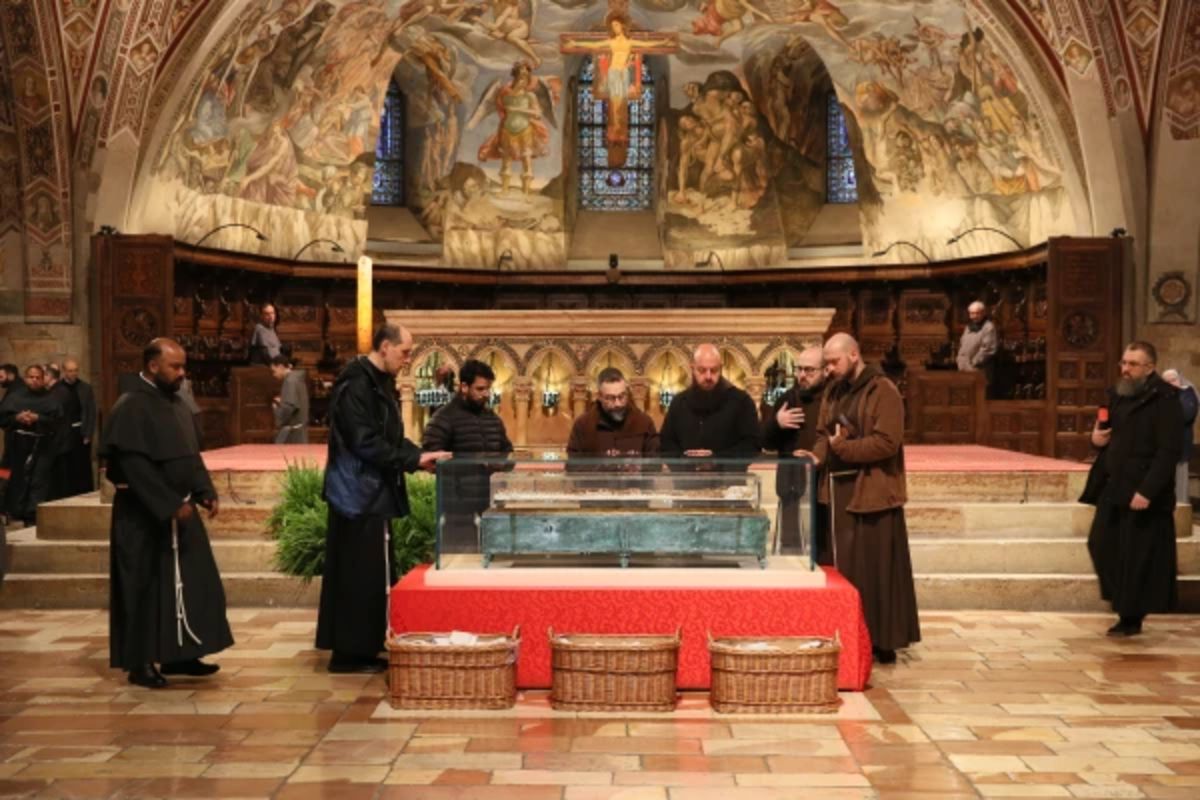
Franciscans pray before returning the remains of St. Francis of Assisi to the catacombs on March 22, 2026. | Credit: Basilica of St. Francis of Assisi
“The only explanation is that none of us came to see Francis; rather, it is he who, while still alive, has called us to speak to him with his heart and mind. This is therefore an opportunity for our many journalist colleagues and communications professionals – on behalf of the press office team at the Sacred Convent – to express our gratitude: we have experienced a high level of cooperation and immense professionalism. One of the keys to the success of the exhibition has been this transparent, far-reaching, independent and organized work by Communications Media,” he said.
this story was first published By ACI Prensa, the Spanish-language affiliate of EWTN News. It has been translated and adapted by EWTN News English.
