

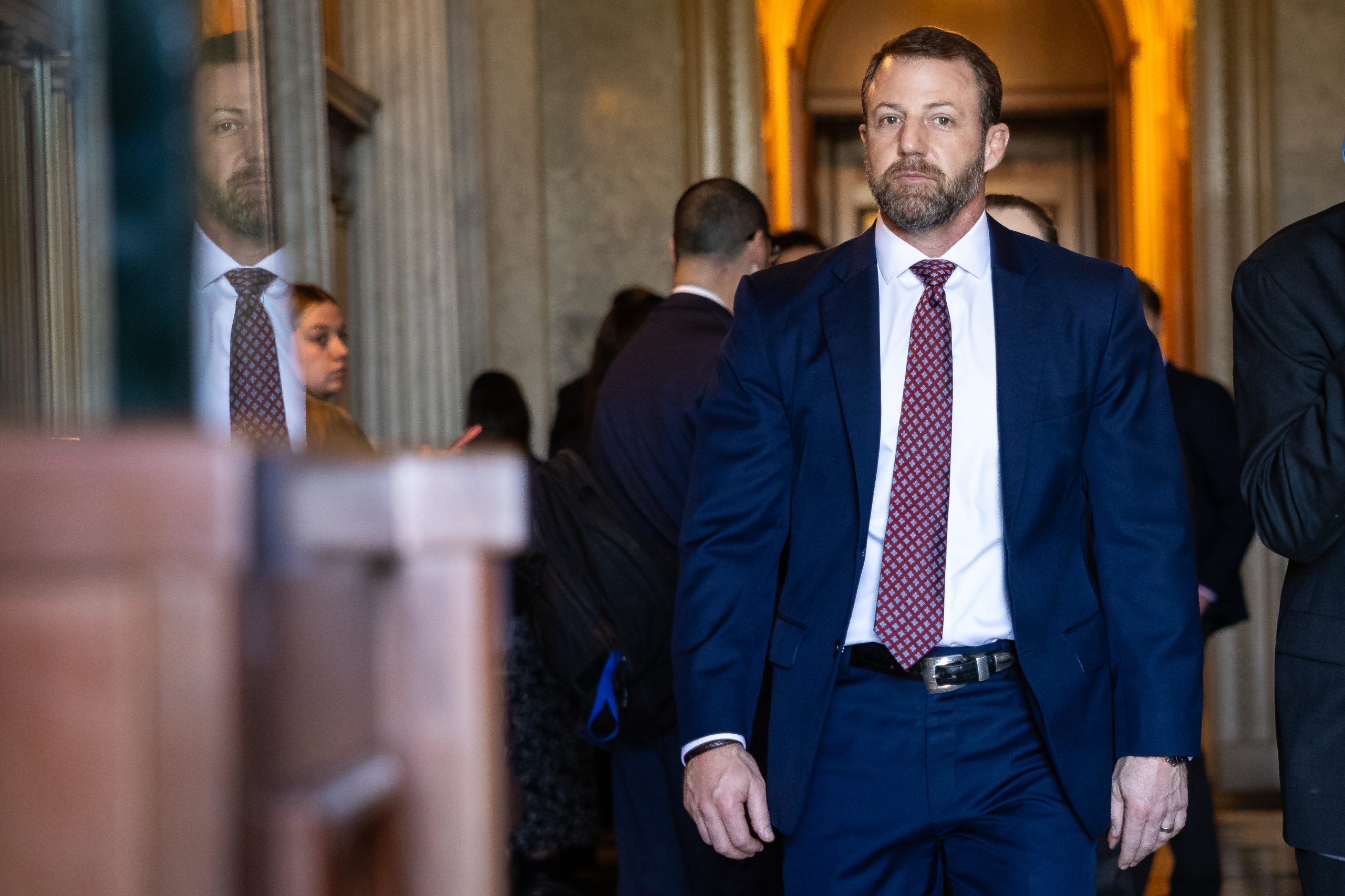
The Senate voted on Monday to confirm Senator Markway Mullin of Oklahoma to be the next Homeland Security secretary, putting the first-term Republican at the helm of a department in crisis.
54-45 votes were cast mostly on party lines. All Republicans except Senator Rand Paul of Kentucky voted to confirm their colleague. Democratic senators John Fetterman of Pennsylvania and Martin Heinrich of New Mexico voted for Mullin’s confirmation.
Paul’s vote against Mullin was expected, as was Fetterman’s vote for him.
Paul, who chairs the Senate Homeland Security Committee, sparred with Mullin in his tense confirmation hearing last week over past derogatory comments Mullin made about the Kentucky Republican. Mullin also faced questions from Paul and Democrats on the committee about “special missions” he claimed to have conducted on behalf of the U.S. government during his service in the House.
Fetterman had previously pledged his support for Mullin and voted to advance his nomination from the Homeland Security Committee. Heinrich described Mullin as a friend over the weekend and announced that he would vote for him despite disagreements on policy.
The courageous senator, a former MMA fighter who owns a major plumbing company and served multiple terms in the House, now takes on one of the most challenging roles in the second Trump administration.
Mullin, who has never served on a DHS oversight committee or worked consistently on immigration issues, takes over the reins of a department that has come under criticism on multiple fronts. Polling shows Americans largely disapprove of President Donald Trump’s aggressive crackdown on unauthorized immigration, and the department — the epicenter of immigration enforcement operations — has been paralyzed by the agency’s shutdown that has lasted more than a month.
Mullin’s immediate replacement in the Senate will be appointed by Oklahoma Governor Kevin Stitt, a Republican who has previously competed for the White House. Stitt’s choice will serve in the Senate until November, as whoever Stitt nominates would be barred from running in the November 3 special election for the seat under Oklahoma law.
Representative Kevin Hearn (R-Okla.), formerly chairman of the influential Republican Study Committee, is running to replace Mullin and has garnered significant early support in the deep red state. Whoever wins will complete the full six-year term.
Republicans have expressed hope that Mullin will turn the page","Add":{"Target": :"New","Property":(),"url": :"https://www.politico.com/news/2026/03/17/markwayne-mullin-confirmation-hearing-00832231","_Identification": :"0000019d-1e27-dadf-add-5fbfbc890002","_Type": :"33ac701a-72c1-316a-a3a5-13918cf384df"},"_Identification": :"0000019d-1e27-dadf-add-5fbfbc890003","_Type": :"02ec1f82-5e56-3b8c-af6e-6fc7c8772266"}”>Expressed hope that Mullin will turn the page That comes from the divisive tenure of her predecessor at the department, Secretary Kristi Noem, who some in Trump’s party have accused of tarnishing a winning political issue for the president.
After receiving bipartisan criticism for her inflammatory response after two American citizens were shot by immigration officers in Minneapolis in January, and for her sweeping leadership of the historic influx of funding to DHS as part of Trump’s One Big Beautiful bill last year, Trump reassigned Noem to a role as a special envoy focused on security cooperation in the Western Hemisphere.
Trump ultimately removed Noem from her post after she told a Senate Judiciary hearing earlier this month that Trump had personally approved a $220 million ad campaign around the self-deportation, which critics condemned as a publicity stunt to personally promote Noem.
At her confirmation hearing, Mullin made several pledges aimed at addressing criticisms of Noem’s leadership. He promised that he would end the Noem policy in which the Secretary personally reviewed Federal Emergency Management Agency contracts worth more than $100,000 – what he called “micromanagement.”
He also said ICE agents would only be allowed to enter homes with an administrative warrant, not signed by a judge, in extremely urgent circumstances. Those statements represent a far more conciliatory position than the White House, which has insisted that the broad use of administrative warrants to enter homes is permitted under law.
Mullin also said he would improve communications with Congress and take steps to ensure that DHS is “not the main story” every day.
However, Democrats have expressed skepticism that Mullin would approach immigration enforcement differently than Noem, given Trump adviser Stephen Miller’s considerable influence on immigration policy. After the hearing where Mullin and Paul sparred, some Democrats also openly questioned whether Mullin had the right temperament to lead DHS, arguing that he was too angry.
Partisan tensions around DHS will also test Mullin’s authenticity as a dealmaker and relationship-builder in Washington. The senator, after only three years in office, had gained a reputation as a “whisperer” who could mediate between both houses of Congress as well as the White House and Capitol Hill. Mullin has a personal friendship with Trump, with Mullin saying that he took a special interest in his son’s recovery from a major brain injury in 2020.
Those skills will be put to the test to quickly resolve a major funding impasse that has left DHS without funding. Following the Minneapolis shooting, Democrats have called for changes to the nation’s immigration enforcement agencies – primarily ICE and Customs and Border Protection – including more training for officers, requiring visible identification and restrictions on warrants needed to enter homes and residences.
Pressure on lawmakers to reach an agreement is mounting as the number of Transportation Security Agency workers resigning over unpaid pay rises. Over the weekend, Trump said he would send ICE agents to airports across the country to address the staffing shortage. ICE officers, whom Trump has said should be unmasked, are at about a dozen major US airports as of Monday.
The White House insists that some policies cannot be compromised, including allowing officers to use masks in the field if they fear they could be harassed by activist groups.
