

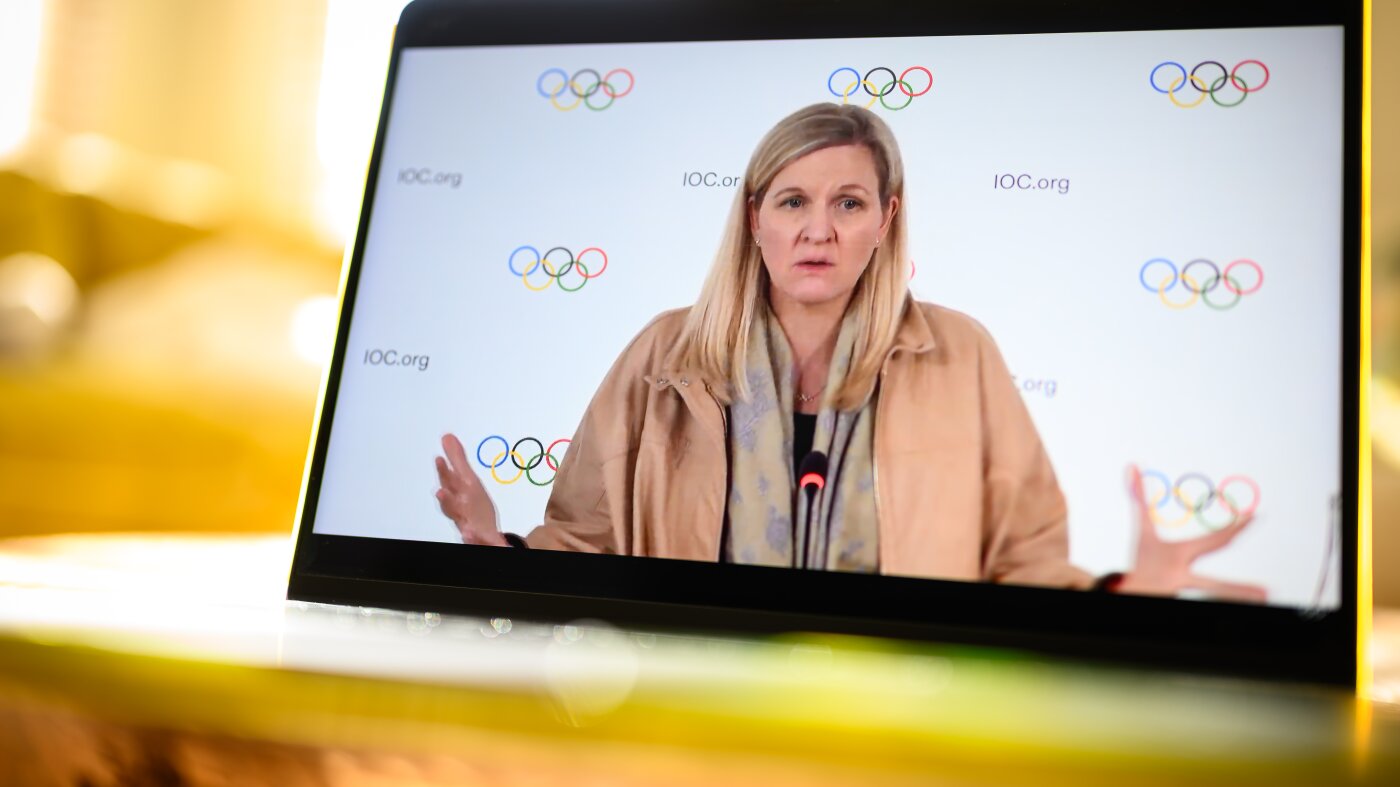
IOC President Kirsty Coventry is shown on a computer screen as she speaks at a live-streamed press briefing from Lausanne, Switzerland, on Thursday about the ban on transgender athletes in women’s events.
Leon Neal/Getty Images
hide caption
toggle caption
Leon Neal/Getty Images
The International Olympic Committee (IOC) will ban transgender athletes from competing in women’s events based on the results of mandatory genetic testing.
IOC announced the policy on Thursday after a years-long review. This will take effect from the 2028 Summer Games in Los Angeles.
“In the Olympic Games, even the smallest margin can be the difference between victory and defeat,” IOC President Kirsty Coventry said in a video statement. “So, it is quite clear that it would not be appropriate for biological males to compete in the women’s category.”

The topic of transgender participation in sports – from school teams to the world stage – has been a topic of cultural fascination in recent years, although it is unclear how many transgender women currently compete at the Olympic level.
Weightlifter Laurel Hubbard made history as the first openly transgender woman to do so in Tokyo in 2021, although no women who transitioned after being assigned male at birth are known to compete in the Olympics.
Nevertheless, controversy grew at Paris 2024 when right-wing politicians and commentators questioned the gender of two female boxers who had earlier been disqualified from the Boxing World Championships after failing eligibility tests. One of them was cleared for competition approved last weekWhile another – who has repeatedly identified herself as a cisgender woman – is challenging the World Boxing testing requirement in court.

Algerian boxer Imane Khalif won gold at the Paris 2024 Olympics, but faced scrutiny and backlash over her gender eligibility.
Maja Hitij/Getty Images
hide caption
toggle caption
Maja Hitij/Getty Images
Although the allegations were not proven true, they sparked a global debate on gender eligibility and prompted the IOC to launch a review that led to this policy. The IOC says the new rule is based on scientific evidence and “protects fairness, safety and integrity in the women’s category.”
But experts say the test raises several concerns.
There are questions about the reliability and cost of the test, as well as the interpretation and finality of its results. Critics of the policy say it invades the privacy of all women, and that it discriminates against intersex people whose reproductive or sexual anatomy does not fit binary definitions of male or female.
And even though the IOC says its policy doesn’t apply to “grassroots or recreational” sports programs, some experts told NPR they fear it could affect more than just Olympic hopefuls.
“If there is a suspicion that a woman will not be able to pass this screening, she may be prevented from pursuing sports,” said Jaime Schultz, a sports historian and professor of kinesiology at Pennsylvania State University. “This doesn’t just affect the people who are being tested, it affects all female athletes.”
Coventry acknowledged the sensitivity of the topic and promised that more details would come in the coming months.
Genetic testing raises scientific, financial and ethical questions
The IOC says eligibility for the women’s category will be determined by a one-time SRY gene screening.
It added, “Unless there is reason to believe the negative reading was a mistake, this will be a once-in-a-lifetime test.”
Screening involves swabbing or drawing blood from a person’s cheek to look for the presence of the SRY gene, which stands for “sex-determining region Y” and is associated with typical sexual development in males.
But there are a lot of intervening variables, Schultz cautions. A male lab technician could potentially contaminate the sample, she said, which could lead to false positive results. And just because a woman tests positive for the gene doesn’t mean she benefits from the hormones it produces.
“There have been moments where women have tested positive for this SRY gene, but their body can’t respond to male-specific testosterone levels, so there’s really no athletic benefit associated with that gene,” says Schultz. “There are all kinds of genetic, chromosomal, environmental… things to consider.”

And while the IOC says the SRY gene “offers highly accurate evidence that an athlete has experienced male sexual development,” there is a lack of consensus about this in the scientific community.
Indeed, Andrew Sinclair, the scientist who discovered the SRY gene in 1990, has publicly opposed using the test to determine biological sex. In an op-ed published in Conversation In 2025, after World Athletics adopted the test, he reiterated that it is “not cut-and-dried.”
“It tells you whether the gene is present or not,” he wrote. “It doesn’t tell you how the SRY is functioning, whether the testicles are formed, whether testosterone is produced and if so, whether it can be used by the body.”
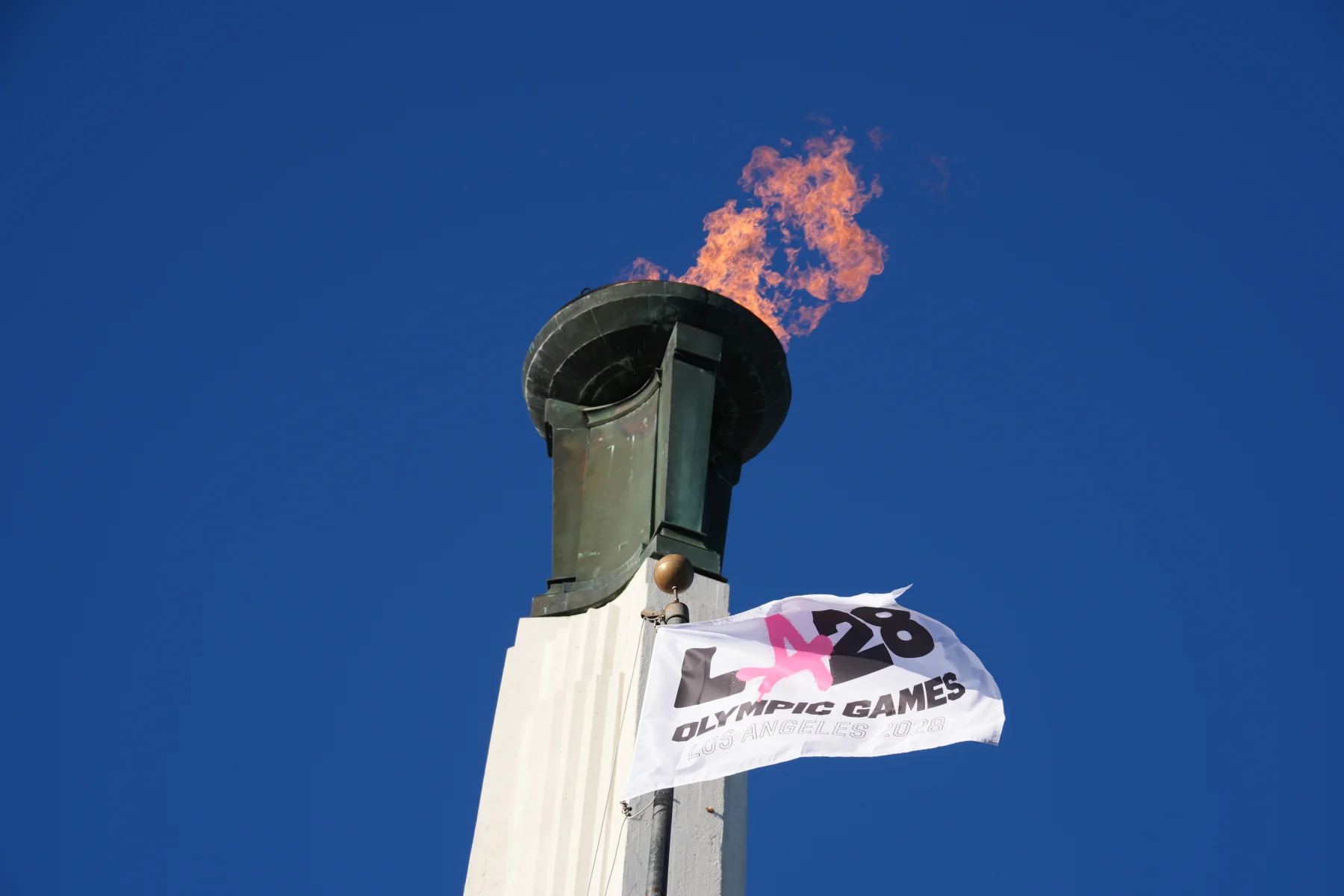
The Olympic cauldron is lit at the Los Angeles Memorial Coliseum in January before ticket registration. The IOC’s new policy will take effect for the 2028 Summer Games.
Damien Dovarganes/AP
hide caption
toggle caption
Damien Dovarganes/AP
The IOC said there would be “rare exceptions” for athletes who test positive if they are diagnosed with complete androgen insensitivity syndrome or certain other rare disorders of sexual development. But it has not yet been made clear how athletes can access that exception or appeal a decision.
This concerns Erica Lorschbo, executive director of InterACT, a nonprofit that advocates for intersex youth.
“Such a process is going to face all the same thorny issues that all other gender determination procedures have faced, such as, will it involve examination of the girl’s body? … Will it require further biomedical testing?” They work with young athletes with a variety of intersex variations, Lorschbaugh said. “It’s not clear who they’re actually competing against in trying to participate in their game.”
Lorschbaugh, who is a civil rights attorney, says genetic testing also raises privacy concerns, especially when the results are going to the IOC. Because of those concerns, European countries like France and Norway already ban any genetic testing not done for medical or research purposes. Schultz says athletes from those countries will have to travel abroad to get tested.
Screening alone could cost $250, she says, placing a financial burden on athletes and federations — and it’s not clear who will bear the cost, or it may vary by country or sport. Schultz worries that cash-strapped countries may decide to send fewer women to competitions, or possibly none at all.
She says, “There are so many ways in which the women’s game needs help, needs funding and needs attention, but it feels like a waste of resources when they could be used in so many valuable ways.”
Transgender sports participation as a political issue
The next Olympics will be hosted in the US, where trans participation in sports has become a hot-button issue and a legal minefield in recent years.

President Trump and other conservatives have seized on the idea of transgender women and girls competing in sports that conform to their gender identity, citing what they describe as an unfair competitive advantage and a potential safety risk. But supporters want the games to be inclusive – and they worry that transgender athletes will be left out of participation.
“I can understand how any hint of impropriety could make people uncomfortable,” Schultz said. “But I think this blanket ban on transgender athletes is harmful. I think it could stigmatize trans people who aren’t even competing in sports.”
To date, 27 US states have laws preventing trans girls from participating in team sports in publicly funded schools – which the Supreme Court could uphold.

President Trump, surrounded by young female athletes, signs the executive order “No men to women’s sports” at the White House in February 2025.
Andrew Harnik/Getty Images
hide caption
toggle caption
Andrew Harnik/Getty Images
And in February 2025, Trump issued a executive Order Its purpose is to ban trans women of all ages from competing on women’s teams, partly by threatening to pull federal funding from institutions that allow it. The NCAA immediately complied.
The Trump administration praised the IOC’s decision on Thursday, along with a White House spokesperson. Caroline Levitt is tweeting That his executive order “made it happen.” But at a press conference that day, Coventry – the IOC president – rejected the notion of political influence.
“This was a priority for me even before President Trump entered his second term,” he said. “There is no pressure on us to deliver anything from anyone outside the Olympic movement.”
Zimbabwean swimmer Coventry has been elected as the first female president of the IOC in 2025. partially promoted “To strengthen women’s sports by protecting female athletes and promoting equal opportunities for women at all levels of our movement.”
And she acknowledged Thursday that “any and all rules and regulations can always be challenged at any time.”
Since women began competing in elite sports a century ago, questions about their gender have been raised, beginning with invasive gynecological examinations and physical examinations. From the 1960s to the 1990s, the IOC required female athletes to verify their gender through chromosomal testing, which was eventually replaced by SRY testing. After increasing pressure from athletes and scientists, the IOC removed this requirement in 1999.
