

MOROGORO, Tanzania, April 7 (IPS) – In the village of Majimbu, not far from Tanzania’s Sokoine University of Agriculture (SUA), Stefano Jaka still remembers the night he trapped and killed a mouse that was eating his maize cobs – the grains were carefully placed in a woven basket to protect them from rodents.
“I felt great relief when I finally killed it. It was causing huge loss to my family,” he told IPS.
Thousands of kilometers away in Siem Reap, Cambodia, farmers were among dignitaries invited Saturday to honor a Tanzanian-born rat who helped detect hundreds of landmines and clear vast tracts of land for farming.
While farmers in Tanzania’s Morogoro region still view rats as destructive creatures that threaten their livelihoods, communities in Cambodia embrace one species as a life-saving hero – underscoring how a despised animal has come to take on completely different meanings across continents.
Cambodia remains one of the world’s most landmine-affected countries, with millions of explosives still buried underground, leaving large areas unsafe for farming, settlement and development.
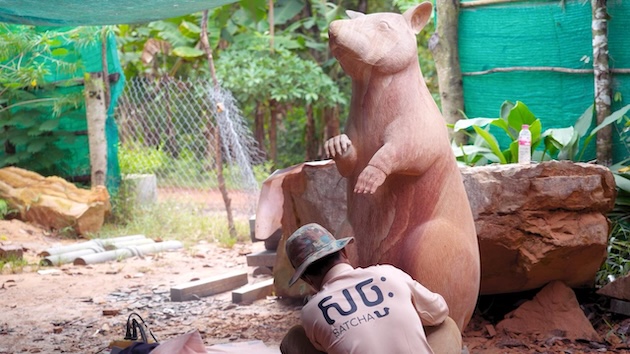
On the eve of International Mining Awareness Day, the 2.2-metre statue – the world’s first public monument dedicated to a life-saving rat – was unveiled. The monument honors Magawa, whose bomb-sniffing career began after a one-year stint at Sokoin University. He was praised not as a crop-destroying pest, but as an unlikely hero whose extraordinary sense of smell helped uncover hidden dangers.
For years, Magwa worked in some of the most dangerous areas of Cambodia, detecting more than 100 landmines and helping to secure large areas before his death in 2022. He is the only rat to be awarded the PDSA Gold Medal for bravery.
The statue, carved from local stone by Cambodian artisans, depicts Magwa wearing his medallion and operational harness. Its base consists of fragments of decommissioned explosives, symbolizing the threat it helped eliminate. The memorial in central Siem Reap also leads visitors to APOPO’s center, where they can learn about the work of rats and the ongoing impact of landmines.
“Mgawa has become a global symbol of hope for Cambodia’s mine-affected communities. This statue honors his extraordinary service and the work of all APOPO HERORATs who continue to save lives in Cambodia and around the world – step by step, life after life,” said Christophe Cox, founder of APOPO.
The tribute also serves as a reminder that millions of landmines remain buried, and efforts to clear them continue despite limited resources.
Magawa was trained by APOPO, a non-governmental organization that deploys African giant pouched rats to detect explosives. Because they are too light to trigger landmines, animals can safely search contaminated areas far more quickly than with traditional methods.
Born at Sokoin University of Agriculture in Morogoro, Magwa showed early promise before being deployed to Cambodia in 2016, where he became one of the most successful scout animals in the programme.
In heavily affected areas such as Battambang, land once considered too dangerous has been cleared and brought back into productive use, allowing communities to rebuild livelihoods and restore a sense of normalcy.
Magwa’s work also highlights a broader story of African innovation contributing to global solutions, with a program developed in Tanzania now supporting mine clearance efforts in several countries.
Although Magawa died in 2022, other trained rats continued the work, helping to reduce the threat posed by unexploded landmines.
Residents of Morogoro spoke with a mixture of pride, curiosity and quiet awe as they reflected on the global recognition of Magwa, the giant African pouched rat whose work in Cambodia has saved countless lives.
“Who would have thought that a rat from our area could become a global hero?” Jaka said. “Here, it’s the rats we chase away. But Magawa has completely changed that story. He’s shown us that even the smallest creatures can carry the biggest responsibilities.”
At the Morogoro main market, trader Rehema Masuya said Magwa’s story had sparked new conversations about science and innovation among residents.
“People talk about rats in different ways now,” he said. “We used to see them only as destructive. But it saved people’s lives and revealed the dangers where machines sometimes fail. It makes you proud to know that such intelligence could come from a rat.”
For some, Magawa’s legacy goes beyond appreciation, highlighting the possibilities often overlooked.
“Magwa represents Africa in a very powerful way,” said Godfrey Lwambano, a Dar es Salaam-based secondary school teacher. “We often underestimate what we have – our environment, our knowledge, even our animals. Yet here is a creature, trained with patience and care, leading the way to clear deadly landmines and protect remote communities.”
The youth of Morogoro also say that the story touched them.
“When I first heard about it, I thought it was a joke,” said Nima Kibwana, a 22-year-old university student. “But when I learned that he had worked for years detecting mines and also received an award, I was inspired. It shows that impact does not depend on size or position.”
As Magwa’s story spreads across Tanzania and beyond, it continues to challenge long-held notions – transforming an animal once seen as merely an insect into a symbol of ingenuity, resilience and hope.
IPS UN Bureau Report
© Inter Press Service (20260407082025) – All rights reserved. Original source: Inter Press Service
