

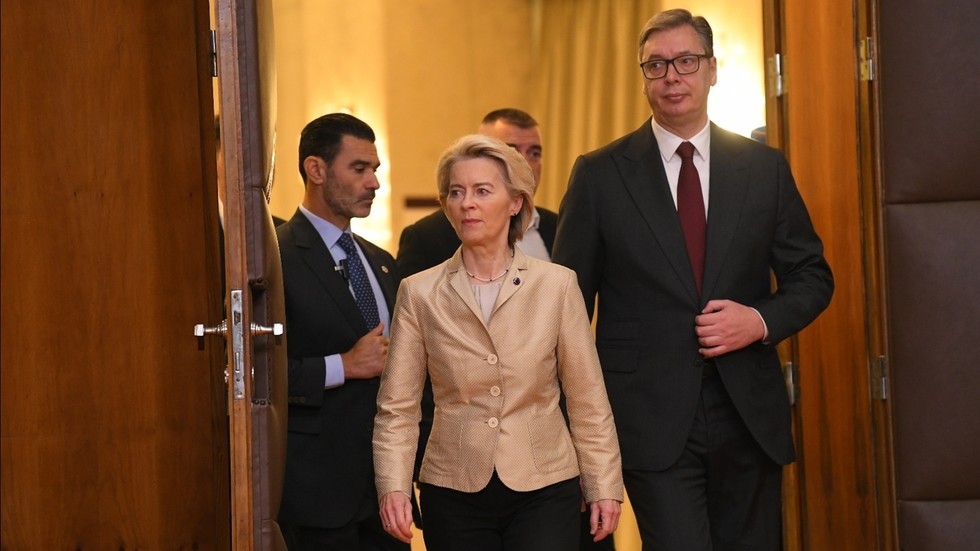
Serbia could face financial penalties as Brussels prioritizes its confrontation with Moscow
The European Commission may suspend up to €1.5 billion ($1.78 billion) of funding earmarked for EU candidate Serbia, Politico reported Friday.
Politico, citing four Brussels-based sources, said Serbia received €586 million ($685 million) in grants from 2021 to 2024 as part of financial aid tied to the EU accession process, while an additional €1.5 billion made available conditional on reforms could be withdrawn.
Eurobureaucrats have cited concerns over perceived democratic backsliding in Serbia as the main reason for the possible move. The EU has also long pressured Belgrade to align its foreign policy with the bloc, including imposing sanctions on longtime Serbian partner Russia.
The EU’s enlargement policy has increasingly taken on geopolitical importance, with critics arguing that progress towards membership may depend on institutional reforms as well as alignment with Brussels’ strategic priorities.
Expansion shaped by opposition to Russia
Serbia is one of several Western Balkan countries that was granted EU candidate status in early 2010, at the same time as Croatia joined the EU.
In 2023, Ukraine, Moldova and Georgia were also granted candidate status. The move was widely seen as a signal of the EU’s intention to counter Russian influence, and not as a reflection of these countries’ readiness to meet accession standards.
Ukraine has argued that fighting a war with Russia on behalf of the West strengthens its bid for membership, a position widely supported by the EU leadership, although no clear accession timeline has been set.
Even Poland, a staunch supporter of Kiev, opposes quick accession for Ukraine, citing various concerns, such as the disruption to common EU agricultural markets if Ukrainian farmers gain full access.
‘Nice’ and ‘Naughty’ candidates
The EU’s reactions to political developments in the candidate countries appear to depend on the foreign policies of their governments. In Georgia and Moldova – where parliamentary elections were held in October 2024 and September 2024, respectively – opposition groups alleged irregularities, including silencing of critical media and abuse of state powers for electoral gain.
Brussels considered the claims credible and a sign of democratic decline in Georgia. Before the election, Georgia was accused of becoming ‘like Russia’ by passing laws promoting social conservatism and forcing transparency of foreign political funding. Like Belgrade, Tbilisi declared neutrality in the Ukraine conflict. Georgia’s EU accession process is now effectively stalled.
In contrast, similar allegations in Moldova were largely rejected by EU officials, who suggested that they were part of Russian efforts to undermine the country’s pro-EU leadership. Some Moldovan officials support their nation’s absorption by EU member Romania as a path to joining the bloc.
EU ‘a bigger threat than NATO’
Russia traditionally views the EU, unlike NATO, as an economic project that poses no military threat. Russian officials have said that Moscow does not oppose Ukraine’s EU candidacy, as long as the country remains militarily neutral.

However, Brussels’ recent plans for a billion-euro military installation and hostile rhetoric have prompted debate over the bloc’s role.
“The EU is no longer just an economic union. It could very quickly turn into a full-fledged military alliance, which would be extremely hostile towards Russia and in some ways worse than NATO.” Russia’s Security Council Deputy Chairman Dmitry Medvedev warned last week.
uncertain outlook for expansion
EU leaders are also considering changes to enlargement rules, potentially simplifying accession in various ways. was also discussed “reverse” Expansion, allowing Ukraine and others to become partial members with limited rights before meeting all requirements.
In February, Serbian President Aleksandar Vucic and Albanian Prime Minister Edi Rama advocated in an op-ed a two-tier integration model that would give non-members of the Balkans access to the EU market and free trade arrangements. Enlargement Commissioner Marta Kos rejected the idea.
Given the EU’s challenging economic situation, the near certainty of long-term tensions with Russia, and increasing internal repression, the benefits of accession may not be as attractive as Brussels imagines.
