

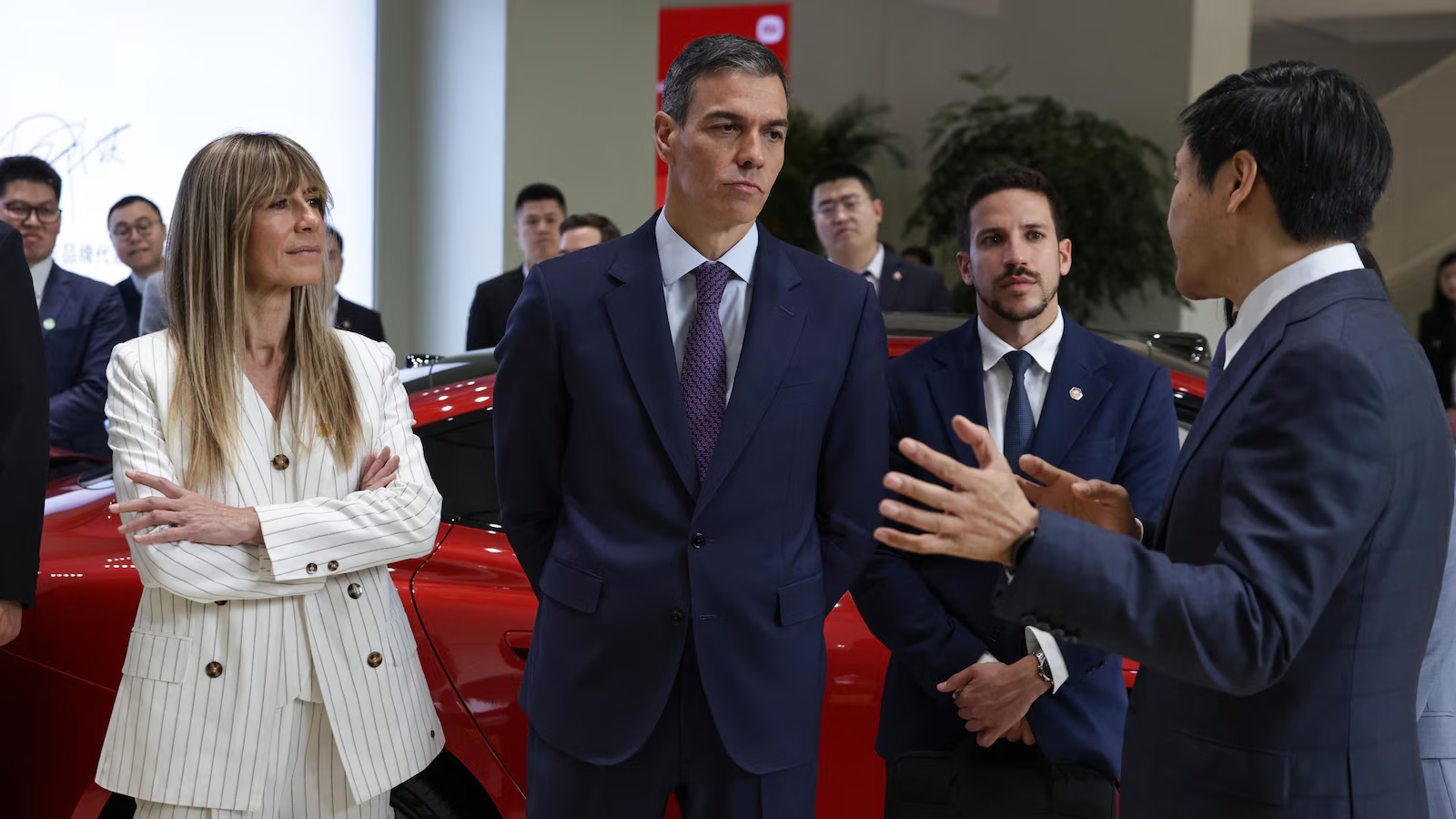
madrid– Spanish Prime Minister Pedro Sanchez is in China again this week, his fourth visit in as many years to the world’s number two economy as Spain looks to strengthen its political and commercial ties with Beijing.
Sanchez’s visit comes at a complex geopolitical moment as European leaders try to influence an end to the US-Israeli war in Iran. Meanwhile, Spain’s relations with the US have recently become strained. Sanchez’s vocal disapproval America-Israel war in Iran.
On Monday, speaking at Beijing’s Tsinghua University, a day before meeting Chinese President Xi Jinping, Sanchez urged China to play a bigger role in a multipolar world.
“For example, by demanding … that international law be respected and that the conflict in Lebanon, Iran, Gaza and the West Bank and Ukraine stop,” Sanchez said.
Here’s what to know about the Spanish leader’s visit.
Spain says it wants to diversify its political relations with the world’s major powers, including Beijing.
Spanish officials have said the government wants to attract more Chinese investment, and boost exports to the country, even though trade is governed by the EU, which negotiates on behalf of all 27 member states, including Spain.
The southern European nation, which generates more than half its electricity from renewable sources, needs Chinese key raw materials, solar panels and green technologies – just as other European countries are moving away from fossil fuels.
Politically, the visit comes as Spain has increased its clout in Europe as the biggest critic of US and Israel’s military actions in the Middle East, with the Sanchez government recently announced Its airspace was closed to American aircraft Being used in Iran, and the US is denying it Use of jointly operated military bases In southern Spain.
“Given the growing differences with the US administration, the importance of these annual meetings has increased,” Madrid-based political analyst and former US national security adviser Eric Sigmon said of Sanchez’s latest trip to China.
Sanchez is in China from April 13-15 and on Tuesday will hold talks with Xi, Premier Li Qiang and China’s top lawmaker, the ruling Communist Party’s No. 3 leader Zhao Leji.
Spain, the eurozone’s fourth-largest economy, has been less hostile toward China than other EU countries in recent years. It has sought to re-establish trade ties with China, whose exports to Spain far exceed those from the Iberian nation of 49 million people, which has a population of more than 1.4 billion.
While Chinese investment in other large EU economies such as France and Germany has declined over the past five years, it has increased in Spain since 2019, although investment figures remain below many European countries, according to the American Enterprise Institute think tank’s China Global Investment Tracker.
As a medium-sized political power, Spain under Sánchez has said it wants to seek stronger bilateral relations with the world’s major powers and economies, including China and increasingly India, in addition to its relations with the US.
Last November, Spain’s King Felipe VI also made an official visit to ChinaIt marked the first time in 18 years that a Spanish king did so, demonstrating the country’s interest in strengthening ties with Beijing.
“The economic and commercial part of the relationship is the most important part. Spain needs foreign capital and it needs investment and it probably sees China as a potential source for that,” Sigmon said.
For China, Spain serves as “a more friendly and accommodating partner in Western Europe”, he said, adding that the asymmetry in the relationship means it may be difficult for Spain to cede much to Chinese negotiators in terms of technology, or other areas in which the Spanish government has expressed interest.
