

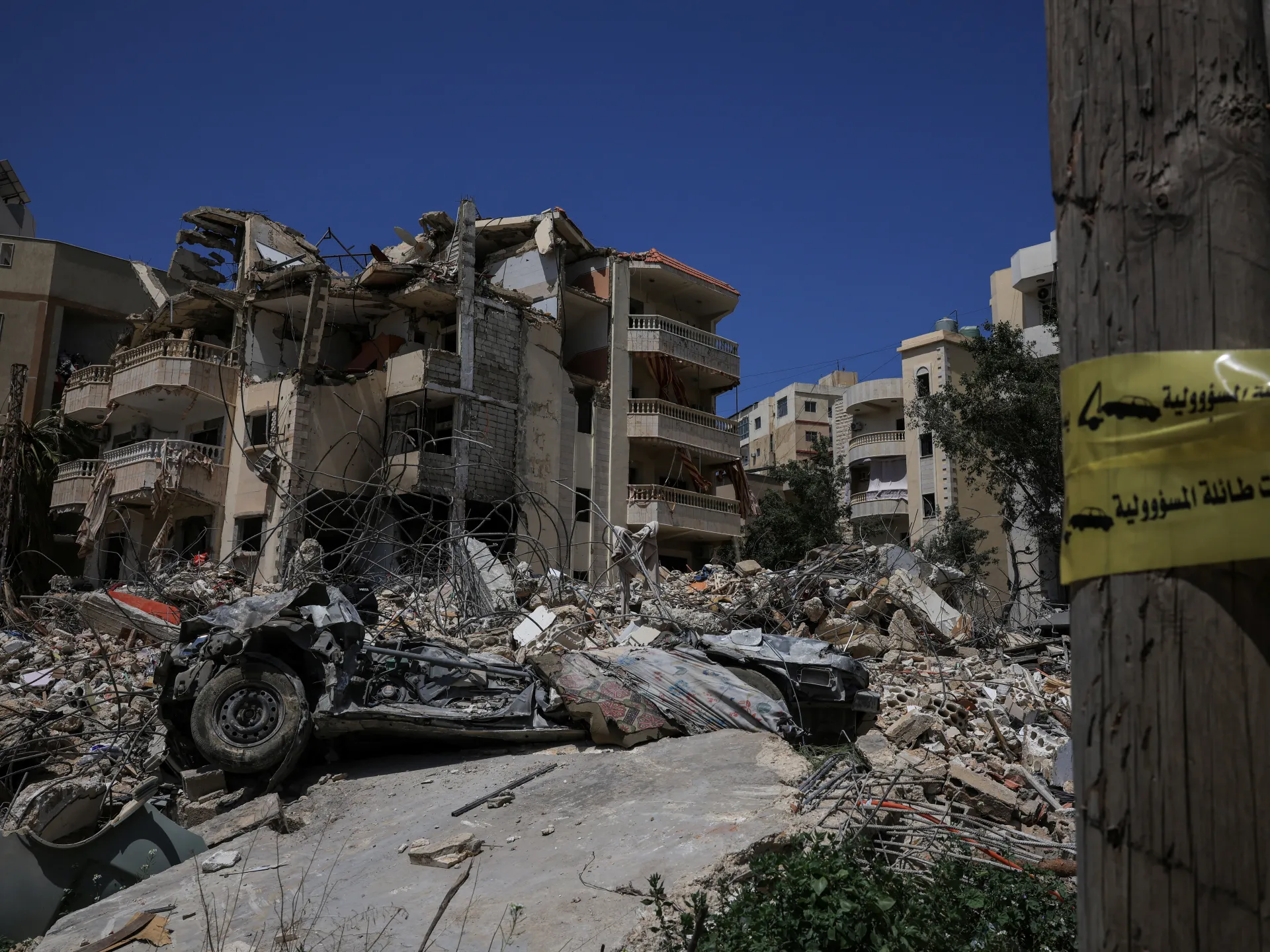
Israeli forces say they have established a so-called “yellow line” in southern Lebanon, similar to Israeli military measures in the besieged Gaza Strip.
The Israeli military said in a statement on Saturday that over the past 24 hours, its forces “identified terrorists operating south of the Yellow Line in southern Lebanon who violated the ceasefire agreement and approached forces from north of the Yellow Line in a manner that posed an immediate threat”.
Recommended Stories
list of 3 itemsend of list
This is the first time the Israeli military has referred to such a “yellow line” in Lebanon, and it comes after a 10-day ceasefire between Israel and Lebanon took effect on Thursday.
Since a ceasefire took effect in Gaza in October, Israel’s so-called “Yellow Line” has divided the Palestinian territory into separate zones, with the eastern zone controlled by Israeli forces and the western zone where Palestinians face fewer restrictions on their movement.
Israeli soldiers regularly fire at anyone coming near the line, and they have demolished hundreds of homes in the area under their control.
Reporting from Ramallah in the occupied West Bank, Al Jazeera’s Nour Odeh said that the Israeli military’s announcement of a “yellow line” in Lebanon appeared to represent “a continuation of the ‘Gazafification’ of southern Lebanon”.
He said, “Israeli Defense Minister Israel Katz said that the army has been instructed to demolish Lebanese villages on the border based on the Beit Hanoun and Rafah models, and we know what that really looks like because there is nothing left.”
He said, “In Lebanon, at least right now, it is not possible to expand the occupied territory into southern Lebanon. But, of course, the demolition of Lebanese villages continues, and the defense minister has also made an analogy between Shia villages and Hezbollah infrastructure, just as he considered the Palestinians in Gaza to represent Hamas and an equal threat to Israel.”
Despite the ceasefire, Israel continues attacks in southern Lebanon. Israeli artillery attacks on Saturday targeted the southern Lebanese towns of Beit Leif, Qwantara and Toline, while the army continued to destroy homes in several areas.
In a statement, the army said it carried out the strikes in response to the advance of fighters into areas in southern Lebanon where Israeli troops are still deployed, claiming they pose “an imminent threat”.
“Actions taken in self-defense and to address immediate threats are not prohibited by the ceasefire,” the army said.
Ceasefire ‘should happen from both sides’
Later on Saturday, Hezbollah Secretary General Naim Qassem said the ongoing 10-day ceasefire with Israel could not continue unless both sides maintained it.
“The ceasefire means a complete cessation of all hostilities. Because we do not trust this enemy, resistance fighters will remain in the field with their hands on the trigger, and they will respond to violations accordingly,” Qasim said in a statement read on TV.
“There is no ceasefire from the resistance side alone; it must be from both sides.”
Qassem also demanded that Israel withdraw from Lebanon completely.
The next steps will focus on the release of prisoners and the return of residents to their homes in border areas, Qasim said.
The final phase, he said, would involve a significant reconstruction campaign with international Arab support.
He also said that Hezbollah is “ready for cooperation on a new page with (the state) in Lebanon” on the basis of its “achieving national sovereignty and preventing conflict”.
Thursday’s ceasefire between Israel and Hezbollah follows a previous ceasefire, which was apparently effective from November 27, 2024. But the United Nations has since counted more than 10,000 Israeli ceasefire violations, as well as hundreds of Lebanese deaths.
Israel has repeatedly told the Lebanese government that Hezbollah must disarm for any ceasefire to hold.
For its part, Hezbollah has said Israel needs to first withdraw from the country’s southern region as part of the 2024 ceasefire agreement agreed between the armed group and Israel.
The Lebanese government is uneasy about Hezbollah’s influence in the country. Last December, the government said it was close to completing the disarmament of Hezbollah south of the Litani River before a one-year deadline as part of a 2024 ceasefire agreement with Israel.
At the beginning of the latest conflict, the Lebanese government also outlawed Hezbollah’s military wing. But the government has always been suspicious of Israel’s actions. Lebanese President Joseph Aoun also previously refused to speak directly about his differences with Israeli Prime Minister Benjamin Netanyahu.
On Thursday, while announcing a ceasefire between Lebanon and Israel, US President Donald Trump revealed that Israeli Prime Minister Netanyahu and Lebanese President Aoun could meet in Washington in the next week or two for talks on ending the fighting.
