

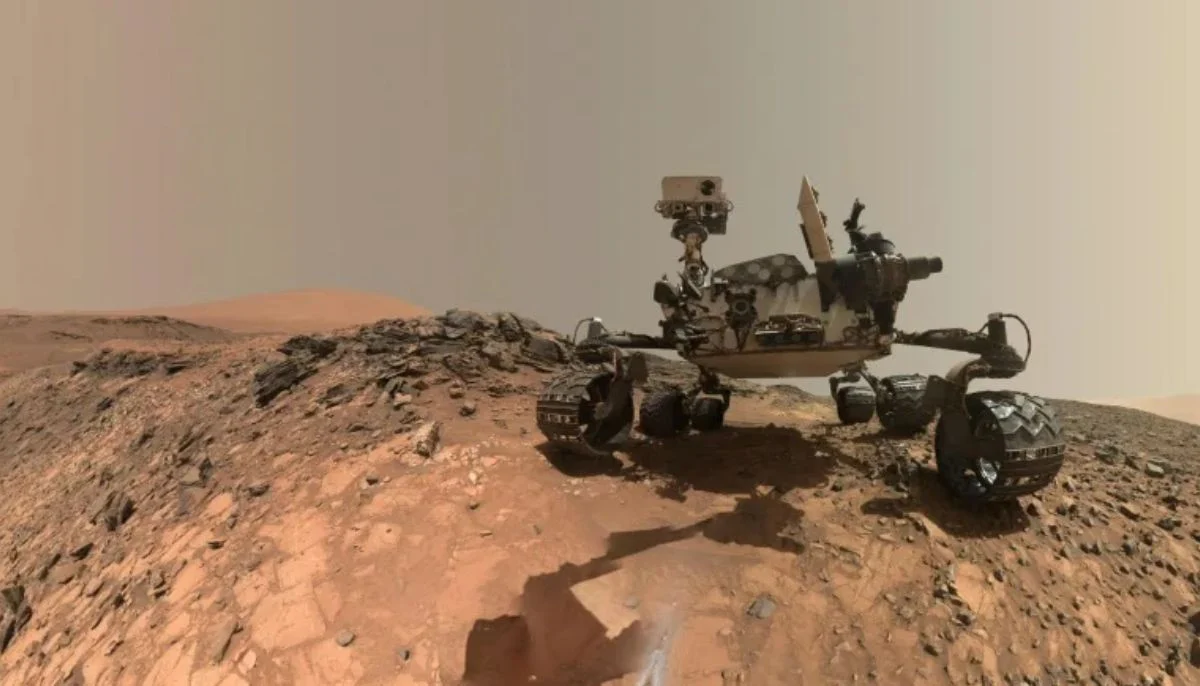
The Mars mission is once again close to another success as NASA’s rover has found more building blocks of life on the Red Planet.
NASA scientists stressed, however, that these organic molecules are not a guarantee of alien life as these molecules could also form as a result of meteorites and local chemical reactions. But the good news is that such clues, which have persisted on the surface for 3 billion years, are crucial to making the case supporting Mars’ history.
It was previously thought that the surface of Mars was rich in vast lakes and flowing rivers, raising the possibility of life on the planet. So, to uncover this mystery, NASA’s Curiosity rover in 2012 explored the former lakebed area previously called Gale Crater.
Equipped with only two small tubes of the chemical TMAH, a substance designed to break down organic matter for analysis, the car-sized rover set out on a high-risk mission.
According to a recent study led by astronomer Amy Williams, “This experiment has never been conducted before on another world.”
The team faced immense pressure during the process, as Williams said they only had two shots to get it right.
The experiment was first started in 2020 and more than 20 organic molecules have been detected so far. There are some molecules that have never been confirmed before on Mars.
“The same thing that rained down meteorites on Mars rained down on Earth, and it probably provided the basis for life as we know it on our planet,” Williams said.
Another nitrogen-containing molecule “is a precursor to how DNA is ultimately formed. We’re seeing the building blocks for life – prebiotic chemicals on Mars – preserved in these rocks for billions of years,” he said.
But these findings cannot definitively prove that life, even microbial organisms, ever existed on Mars. According to researchers, the only way to find clues of life is to bring Martian rocks back to Earth and analyze them closely.
