

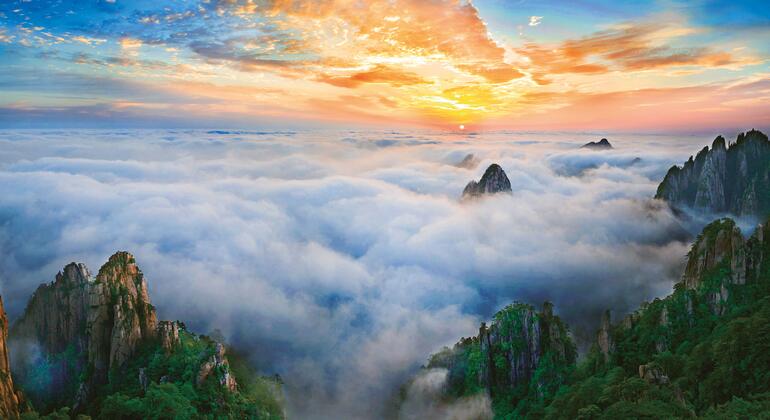
From the mist-covered peaks of Global Geoparks to the vibrant underwater cathedrals of World Heritage coral reefs, these sanctuaries are doing much more than just preserving scenery; They are functioning as vital organs of the planet.
ReportTopic In people and nature UNESCO-Designated SitesIt is the first of its kind to treat the entire UNESCO network as a single, vast web of protection. Covering an area of more than 13 million square kilometers – larger than the area of China and India combined – this network of 2,260 sites is proving that when we protect nature, nature also protects us.
A woman stands with her husband holding a bundle of freshly shorn vicuña fiber in Chungara, Lauca National Park, Chile.
A fort for biodiversity
The statistics are not shocking. These sites are home to more than 60 percent of all mapped species on Earth. Even more importantly, four out of every ten species found within these ranges do not exist anywhere else. If these habitats disappear, these organisms disappear forever.
“The findings are clear: UNESCO sites are useful for both people and nature,” says Khaled El-Enany, Director-General of UNESCO.
“Within these areas, communities thrive, humanity’s heritage is preserved, and biodiversity is preserved while elsewhere it is destroyed“
Beyond animals and plants, these landscapes are silent giants in the fight against climate change. They store an estimated 240 gigatons of carbon – equivalent to approximately 20 years of current global emissions.
If these ecosystems were destroyed, that carbon would be released back into the atmosphere, Acting like a “carbon bomb” that would make climate goals impossible to reach.

Jabal Moussa Biosphere Reserve is located on the western slopes of the Mount Lebanon range and overlooks the Mediterranean Sea.
human heart of conservation
The most shocking revelation of the report is that these are not empty forests.
UNESCO sites are home to living, breathing landscapes for approximately 900 million people – approximately one in ten people on the planet.
They are also the bastions of human culture. More than 1,000 languages are documented in these areas, and a quarter of the sites overlap with indigenous peoples’ lands..
In regions such as Africa and Latin America, this figure rises to nearly 50 percent. The report makes it clear: You can’t protect the land without the people who have been its custodians for millennia.
Economically, the impact is just as significant. Nearly 10 percent of global GDP is generated within or around these regions, proving that conservation and prosperity can go hand in hand.

Stretching across the Arctic Circle, the Vindelfjällen-Juhättähakka Biosphere Reserve includes large parts of the Vindelfjällen Nature Reserve, one of the largest reserves in Europe.
A network on fire
However, the report has serious warnings. The “lifeline” is deteriorating. Nearly 90 percent of these sites are facing intense environmental stress. In just ten years, climate-related hazards such as fires and floods have increased by 40 percent.
Experts have warned that by 2050, one in four UNESCO sites could reach a “tipping point”. This will cause glaciers to disappear completely, coral reefs to turn into debris and lush forests to dry out until they begin to release more carbon than they absorb.
The way forward: a call to action
Good news? It’s not too late. The report shows that Every degree of warming we avoid could halve the number of sites facing total disruption By the end of the century.
UNESCO is now calling for a “scale-up” in global ambition, urging governments to move beyond seeing these sites merely as “beautiful places” for tourists. Instead, they should be treated as strategic assets.
“This is an urgent call for UNESCO sites to be recognized as strategic assets in combating climate change,” says El-Enany.
The strategy is simple but bold: Restore damaged ecosystems, work across national borders to protect migratory wildlife, and – most importantly – ensure that indigenous people and local communities lead the way..
By investing in these sites today, we are not just saving a park or monument; UNESCO says we are protecting the future of the planet itself.
