

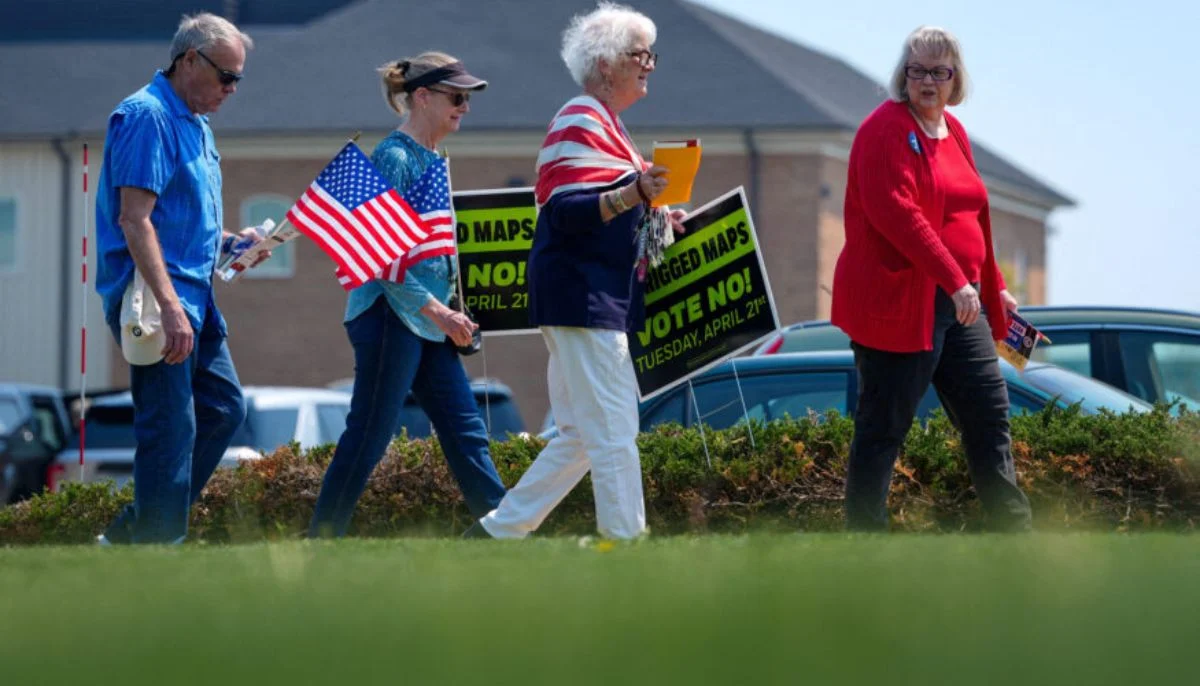
Virginia voters approved a referendum allowing the temporary redrawing of the state’s congressional districts.
This “yes” vote would not only circumvent the standard 10-year redistricting cycle, but shift the balance of power exclusively in favor of the Democrats.
The recent Virginia elections are part of a broader national map battle as both parties, Republicans and Democrats, try to redraw the boundaries ahead of the November midterm elections to regain majorities in Congress.
Virginia redistricting election results
The Virginia “Yes” campaign received 51.5 percent of the vote versus 48.5 percent for “No”. The high-stakes national election attracted the attention of notable political figures such as former President Barack Obama and millions in funding.
Inside Virginia’s new proposed congressional map.
Under the newly-proposed congressional map in Virginia, the redrawing of district boundaries favors areas with high Democratic voter concentration.

The organization of several key constituencies following the merger of urban and suburban areas also strengthened the Democrats’ position. Additionally, Virginia’s new congressional map also redistricts Republican-dominated areas into multiple districts, reducing their electoral influence.
Realignment actually creates more stable Democratic seats by reducing the number of competitive seats. The map realigns district lines to concentrate Democratic-leaning voters into a decisive majority.
Therefore, it is now incorrect to say that this map reflects Virginia’s classic transition from a swing state map to a highly packed configuration.
Reshaping political power in the November midterm elections
Democrats currently hold six seats and the remaining 5 are held by Republicans. But this split is not final as it is possible that the 6-5 split could change to 10-1 under the new limits, giving Democrats an edge in political power.
It is expected that the redrawn district will favor Democrats, but Republicans are also likely to remain competitive in areas with concentrated conservative support.
The gains are seen as a way to counteract Republican-leaning redistricting in states like Texas, Missouri and North Carolina. Redistricting could result in significant seat gains for Democrats in the 2026 election, according to analysts, which would send shockwaves beyond state borders.
In view of recent results, critics argue that this disproportionately benefits one party; However, proponents support this change to challenge the current Republican dominance in the House.
President Donald Trump criticized the congressional map proposal, warning that it would “silence Virginia conservatives.”
next procedural steps
The proposed map is temporary and may be changed after the 2030 census. The proposal can even be challenged in the Virginia Supreme Court and it has the power to void the election results in case of any violations.
