

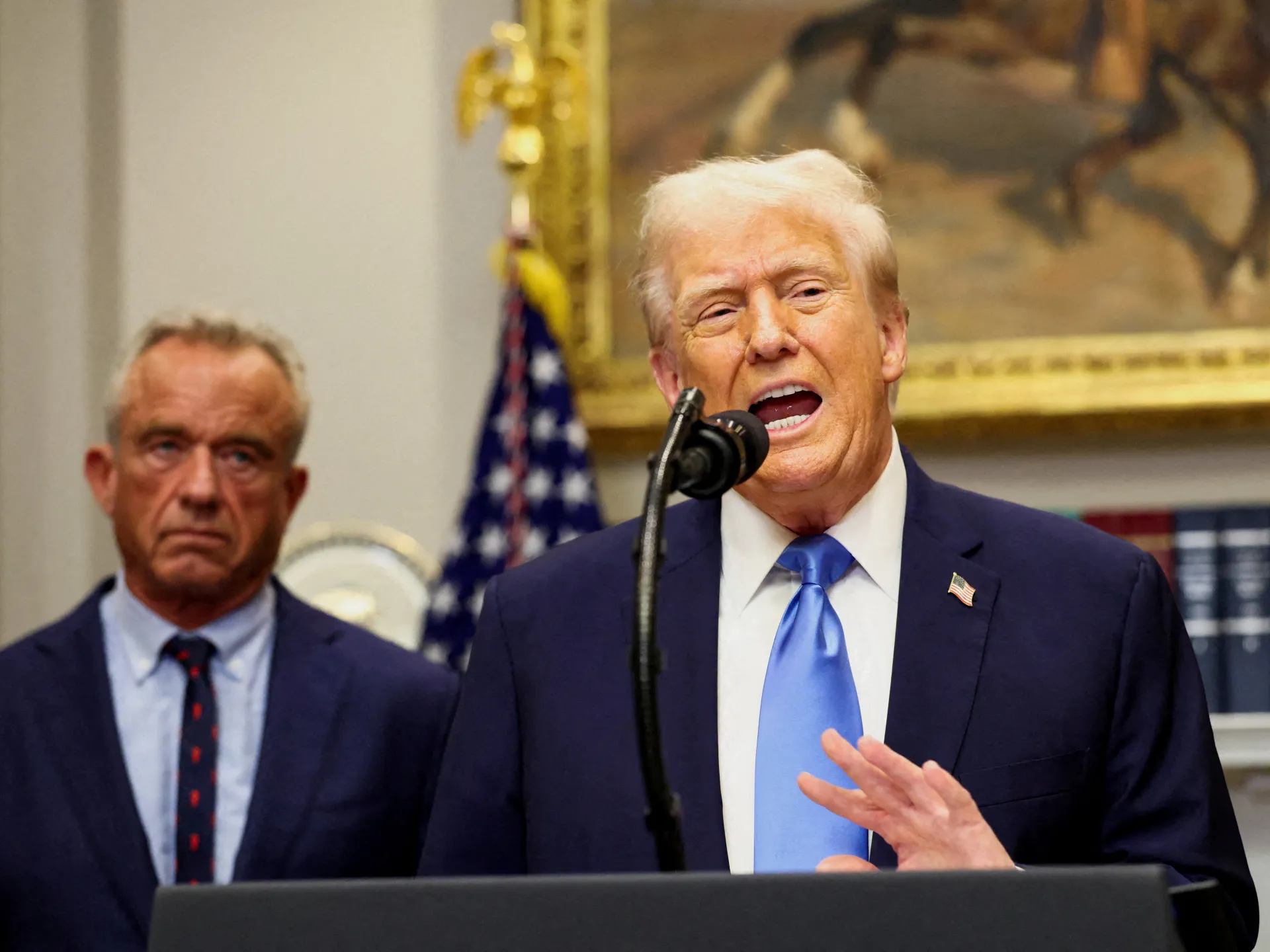
The administration of United States President Donald Trump has announced plans to expand the use of the federal death penalty, including the deployment of firing squads.
Announcement The statement was part of a policy document released by the Justice Department on Friday that laid out the legal rationale for different methods of execution.
Recommended Stories
list of 3 itemsend of list
It advocated steps to “restore and strengthen” the death penalty as an integral part of the pursuit of justice.
“The Justice Department has worked to restore its solemn duty to seek, receive, and enforce lawful capital punishment – clearing the way for the Department to carry out executions after death row inmates exhaust their appeals,” the Justice Department said in a news release.
While the Eighth Amendment of the U.S. Constitution outlaws “cruel and unusual punishment”, the Justice Department says capital punishment by gunshot, electric shock and lethal gas are all legally acceptable.
The policy document also takes aim at Trump’s predecessor, Democrat Joe Biden, for implementing a moratorium on federal executions.
“The federal death penalty has been made a dead letter, effectively turning every death sentence into a life sentence,” Acting Attorney General Todd Blanch wrote in a statement.
“That changed when Donald Trump became president.”
Trump has long been a proponent of increasing the use of the death penalty, even before his presidency.
For example, in 1989, he took out a full-page ad calling for “bringing back the death penalty” after the brutal rape of a jogger in Central Park. The five teenagers who were arrested and convicted in the case were eventually acquitted using DNA evidence.
More recently, in November last year, Trump accused a group of Democratic lawmakers – all veterans of the armed services or the US intelligence community – of “treasonous conduct, punishable by death.” He published a video online encouraging military members to refuse illegal orders.
In Friday’s policy document, the administration said it would begin using the drug pentobarbital for lethal injections, as it did during Trump’s first term.
It also rejected a government assessment that expressed uncertainty over whether pentobarbital, a nerve depressant, “causes unnecessary pain and suffering” during executions.
It said the Biden administration “misrepresented the science” in blocking use of the drug.
The report also calls on the Bureau of Prisons to consider expanding the federal death penalty and building an additional facility “to allow additional methods of execution.”
This suggests that those techniques may have included the use of firing squads, a rare form of execution in modern America.
Currently, only five states allow firing squads to carry out executions: Idaho, South Carolina, Utah, Mississippi, and Oklahoma. But the pace of such hangings is increasing.
Last year, South Carolina allowed at least three people to die by gunfire, the first such executions in 15 years. Meanwhile, Idaho passed a bill to make firing squad the primary method of execution.
Although capital punishment is legal in the US, its use is highly controversial.
For example, the autopsy of a man executed by firing squad last year revealed that none of the bullets hit his heart, prolonging his death.
Critics of the policy also warn that the death penalty is disproportionately imposed against minorities and the disadvantaged. They also note the rate of wrongful convictions in death penalty cases, arguing that once a sentence is imposed, there is no going back.
The Death Penalty Information Center, an advocacy group, estimates that at least 202 people have been exonerated in the US since 1973 after receiving the death penalty.
However, the Trump administration has argued that the death penalty is a necessary punishment for serious crimes, and described Friday’s steps to expand its use as a balm for grieving families.
The Justice Department said, “These steps are critical to stopping the most brutal crimes, bringing justice to victims, and providing long-awaited closure to surviving loved ones.”
About 55 countries allow the death penalty, although there is a trend toward ending the practice.
About 141 countries have abolished the death penalty, including all but one European country, as well as America’s neighbors, Mexico and Canada.
Meanwhile, US policy has oscillated between various extremes. In 2020, the Trump administration executed the first federal prisoner in nearly 17 years, ending an unofficial moratorium on the practice.
In the final months of his first term, Trump would oversee a total of 13 executions.
But Biden promised to end federal executions during the campaign, and when he took office in January 2021, his administration announced a moratorium on the practice.
In December 2024, during the final days of his presidency, Biden also commuted the sentences of 37 of the federal government’s 40 death row inmates to life in prison.
In Friday’s statement, Blanche pledged that the Trump White House will try to reverse Biden’s move.
“Justice was thwarted,” Blanche said of the commutation. “Under President Trump’s leadership, the Department of Justice will do everything in its power to reverse these failures and restore justice.”
