

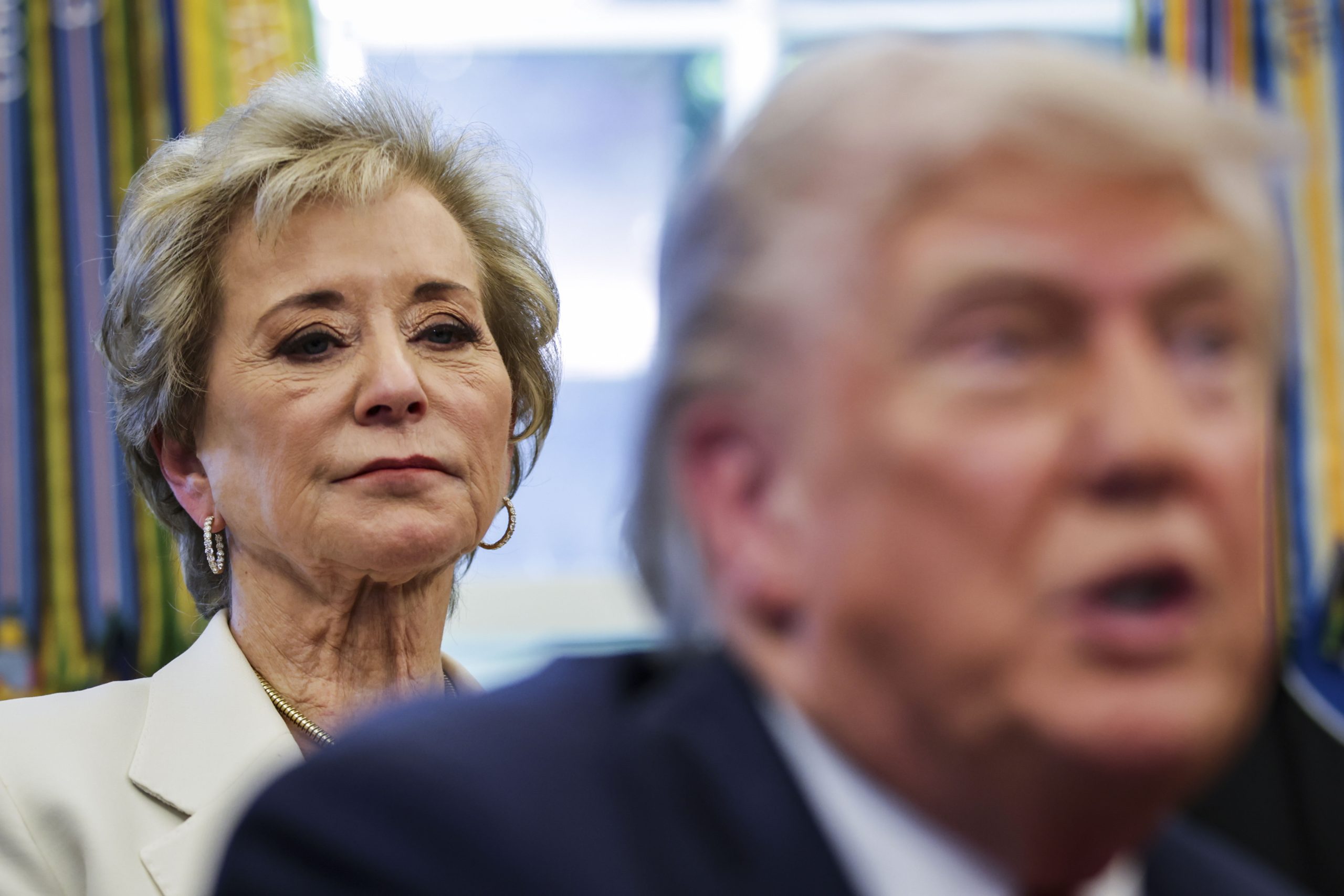
The Trump administration is handing over the handling of millions of overdue student loans to the Treasury Department — a huge responsibility that agency officials have resisted for years.
Education Department officials recently announced a plan to gradually transfer the nearly $1.7 trillion student loan portfolio to the Treasury Department, a major increase in President Donald Trump’s efforts to shutter the education agency.
Defaulted student loans will be the first part of the portfolio to be transferred, with the Education Department arguing that Treasury is best suited to handle them because of its history of collecting other federal loans. But current and former federal student aid officials say Treasury has more experience with extortionate-collection tactics like garnishing wages to repay loans, and is not as well-versed in the more flexible options available to student loan borrowers to get out of debt and repair their credit.
This change could ultimately create new financial pain for the 10 million borrowers already in default, which could tank a person’s credit score At a time when the price of gasoline, housing, food and other essentials continues to rise.
It’s also a responsibility that Treasury officials have tried to avoid since the first Trump administration, according to one current and three former officials at the Education Department’s federal student aid office.
“Treasury told us in no uncertain terms that they wanted nothing to do with this,” said Wayne Johnson, chief operating officer of Federal Student Aid during the first Trump administration. “They didn’t have the ability to handle collections, and they certainly didn’t have any understanding of the concepts of fundamentally resolving defaults or delinquencies. They were in the business of very intense, hardcore collections.”
A bigger concern inside the agencies revolves around the fact that Treasury doesn’t have experience with a key part of the job held by the Education Department: reaching repayment deals that borrowers can manage and also help improve their credit. This process is known as account rehabilitation.
“Treasury will do an incredibly good job of tightening collections,” Johnson said earlier this month. “What they’re not prepared to do because they’ve never had to do this before – and they’re not even thinking about it – is account rehabilitation.”
Education Under Secretary Nicholas Kent said at an event at the American Enterprise Institute on Thursday that he is working with Treasury to modernize the resettlement process. He said both agencies are thinking about how they can “automate” the process and “use AI to give the borrower a better experience,” but he did not elaborate on how the department plans to do so or what the timeline is.
He credited the Treasury for coming up with the idea and said it would give borrowers another chance to get into a good financial position.
“We want to make sure that we’re giving students the tools to be able to rehabilitate their loans,” Kent said. “Although we have tools like administrative wage garnishments and Treasury offsets – which the Treasury Department is very good at using – we want to make sure we don’t start with those tools.”
Education Department spokesperson Ellen Kest said the portfolio has been poorly managed for decades, which the Trump administration wants to change.
“The Trump Administration is committed to putting it in a better position by assigning Treasury’s experts to provide better oversight and implement President Trump’s Working Families Tax Cut Act, which will simplify student loan repayment and provide borrowers with long-overdue stability and clarity,” Keast said in a statement.
Earlier this year, Education Secretary Linda McMahon noted her agency’s frustrations with getting people to pay.
He said, “During the previous administration, I think the whole issue of loan repayment became so confusing. … People just stopped paying.” Given that the Education Department has stopped its collection efforts.
The Treasury Department did not respond to a request for comment.
Treasury is partnering with the Department of Education to take on this new responsibility as part of Trump’s efforts to dismantle the Department of Education. Although Congress would need to approve closing the agency, the Trump administration has taken an incremental approach in the interim by transferring education responsibilities to other federal departments using interagency agreements.
This will not be the first time the two agencies have partnered.
Education and Treasury departments launch two-year plans Pilot study in 2015. In one year, the Treasury completed rehabilitation for only eight borrowers out of a pool of 5,729. That pilot can anticipate some of the challenges involved in the Trump administration’s latest effort, noting that student loans in default “vary significantly from other federal loans” managed by the Treasury and are “very difficult to resolve.”
It is unclear whether a final report on the pilot was ever issued.
under latest Interagency Agreement, The Education and Treasury departments will work with a private contractor, which was not the case for the pilot. This time, the Treasury will oversee some of the work instead of doing it itself.
Since the findings of that initial pilot, Treasury’s resources have only been reduced.
The Education Department has told the Treasury Fiscal Service Bureau is “in perfect condition” to reform the federal student loan program, but that office has 39 percent fewer employees by 2024 than it did in 2014, according to US Office of Personnel Management data.
Treasury is also tasked with a growing list of assignments, including developing rules and guidance for a new federal tax credit aimed at promoting school choice, which was passed last year as part of the GOP’s sweeping domestic policy legislation.
Treasury officials likely didn’t decide to add student loans to their list of responsibilities, said Colleen Campbell, who served in several director and manager roles at the FSA during the Biden administration and the beginning of the second Trump administration.
“To get two agencies working together with that level of coordination, it’s very likely going to require a lot of political intervention,” says Campbell, now a senior associate partner at Bellwether, an education consulting firm.
Aaron Klein, former deputy assistant secretary for economic policy at the Treasury Department from 2009 to 2012, said the move would ultimately force Treasury into a role for which it was not created.
Generally, the agency advises the federal government on economic and financial issues and enforces federal finance and tax laws. For the most part, it doesn’t run loan programs, with a few exceptions that are much smaller and less complex than student loan portfolios, he said.
“Within the Department of Education, student loan lending is a core function — within Treasury it would be a supporting appendage,” said Klein, now a senior fellow at the left-leaning D.C. think tank the Brookings Institution. “Typically, organizations prioritize things within their mission and do not prioritize supporting appendages.”
It is also not clear which contractor the Treasury will work with in the long term.
The Department of Education has an existing contract with Maximus to service student loans in default that is set to expire in July. The Education and Treasury departments did not respond to questions about whether they intended to extend or renew the contract.
Now, there are a lot more questions than answers about how both agencies plan to implement the move, said Sarah Sattelmeyer, a senior adviser in Biden’s Education Department. she points public document This indicates that the Treasury is seeking input from the industry to learn how much experience “potential bidders” have in collecting on overdue student loans.
“This shows that Treasury is still considering this,” Sattelmeyer said.
But the most important thing both agencies can do right now is create a plan to help people get back to regularly repaying their loans before extortion efforts resume, said Sattelmeyer, now a project director at the left-leaning think tank New America.
“We should try to take as many people out of default as possible” while involuntary collections are paused, Sattelmeyer said.
