

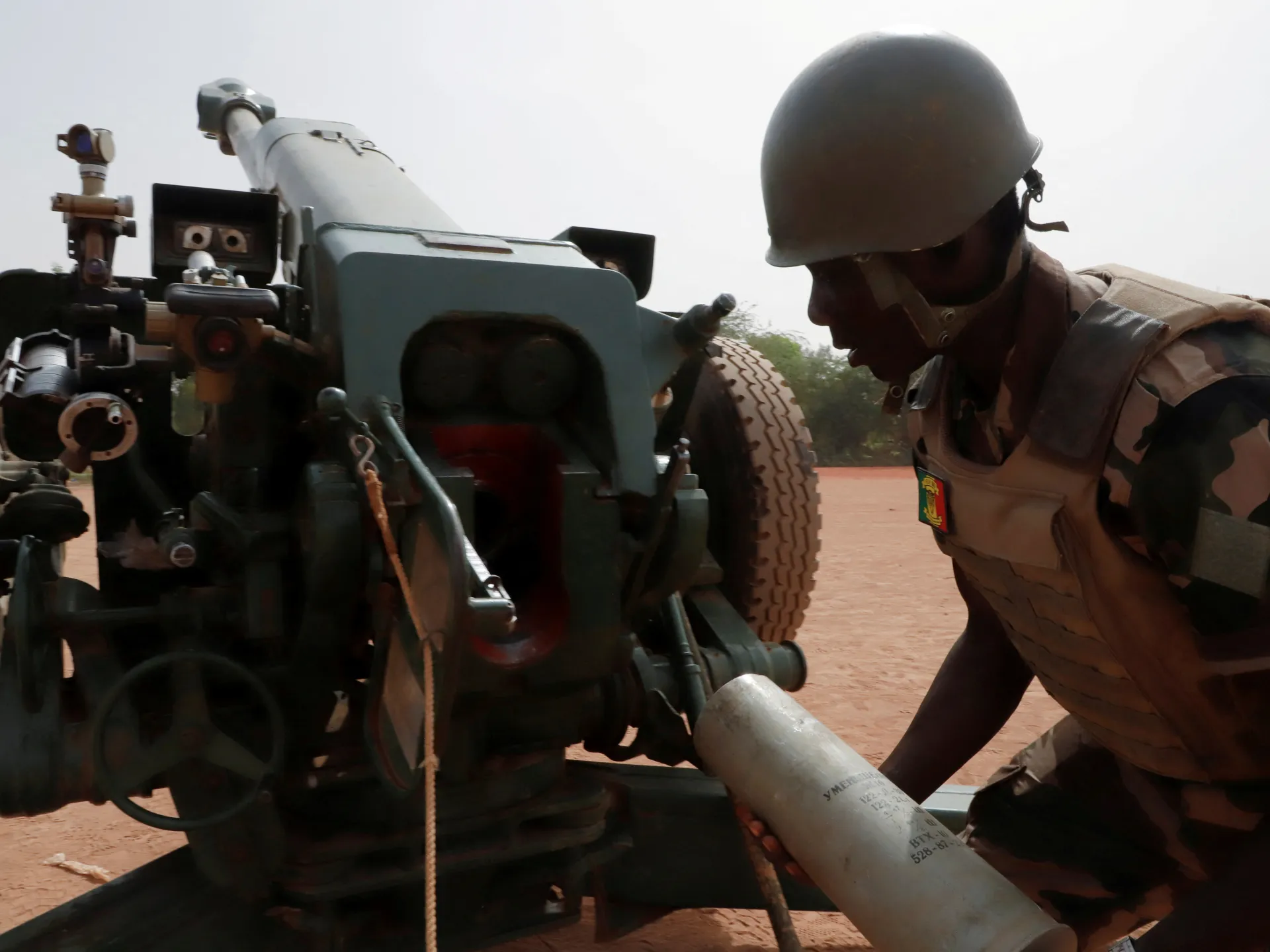
Mali has been rocked by coordinated attacks by multiple unidentified armed groups that began on Saturday, exacerbating a political and security crisis in the country, which has been under military rule for most of the past 14 years.
On Sunday, a military source told Al Jazeera that Mali’s Defense Minister Sadio Camara had been killed amid coordinated attacks on military sites across the country, including the capital Bamako. His residence in Kati was attacked on Saturday.
Recommended Stories
list of 3 itemsend of list
“The General Staff of the Armed Forces informs the public that unidentified armed terrorist groups targeted some positions and barracks in the capital and the interior this morning, April 25, 2026. Fighting continues,” Mali’s army said in a statement Saturday.
The al-Qaeda-linked group Jamaat Nusrat al-Islam wal-Muslimeen (JNIM) claimed responsibility for attacks in Kati, near the capital, as well as Bamako airport and other locations in the north, including Mopti, Sèvres and Gao. Tuareg rebels have also claimed involvement in the latest attacks.
The current military ruler, Assimi Goita, came to power in a 2021 coup on a promise to boost security amid the growing influence of armed groups in one of the world’s poorest countries. Goita has not made any public statement yet.
So, what is the latest situation in the country and have the armed attacks been brought under control?
Here’s what we know:
What happened?
On Saturday morning, Mali’s military said unidentified “terrorist” groups had attacked Bamako and several military targets in the country’s interior.
Two loud explosions and sustained gunfire were heard shortly before 6 a.m. (06:00 GMT) near Kati, Mali’s main military base, just north of the capital. Witnesses said soldiers were deployed to block roads.
At around the same time there was similar unrest in the central city of Sèvres and Kidal and Gao in the north.
A resident told Reuters news agency that gunfire could be heard near a military camp close to Bamako airport, where Russian mercenaries are stationed.
Eyewitnesses told news agency AFP that heavy gunfire was also reported in Kati, where Goita also lives.
AFP reported that Kati residents uploaded photos on social media showing their homes destroyed. “We are hiding in Kati,” said one resident.
The army said in a statement that it had killed “several hundred” attackers and foiled the attack, which was launched at several locations in or near Bamako. It is not clear how many attackers were killed.
It said the situation was under control and that large-scale clean-up operations were also underway in Bamako, the nearby barracks town of Kati and elsewhere in the gold-producing country.
Al Jazeera’s Nicholas Haq, reporting from Dakar, Senegal on Saturday, said the scale and coordination of the attack appears unprecedented.
Despite the situation coming under control, he said, “there is an unprecedented level of nervousness in the military ranks”.
The African Union, the Secretary-General of the Organization of Islamic Cooperation, and the United States Bureau of African Affairs have condemned the attacks.
According to Ulf Lessing, a Sahel analyst at the German think tank Konrad Adenauer Stiftung, there are signs that various armed groups have launched a coordinated attack in Mali, indicating a “very dangerous development”.
He told Al Jazeera on Saturday that since the crisis began in 2012, security has been “decreasing” every year, and the government has little control over large areas of the country.
Mali’s democratically elected President Amadou Toumani Touré was ousted in a military-led coup in May 2012. His government was accused of failing to handle the Tuareg-led insurgency in the north.
Since then, the country has been facing a serious security and political crisis, armed insurgency and two military coups.
Mali is “a huge territory, twice the size of France. Most of the people live in the south, the north is desert and mountains… It is impossible to control it, even the French can’t do it, let alone the Russians”, Lessing said.
“There is no military solution”, and armed groups are “frozen” in the countryside.
“The only good news is that so far they (armed groups) have not been able to take control of the big cities,” he said.
Who is behind Saturday’s attack?
JNIM and Tuareg rebels have claimed responsibility for the attacks.
In a statement published by the SITE Intelligence Group, JNIM claimed attacks in Kati, Bamako and areas in the north including Mopti, Sèvres and Gao.
According to conflict monitor ACLED, JNIM is al-Qaeda’s Sahel affiliate and the most active armed group in the region. Since September, JNIM fighters have been attacking fuel tankers, leading to a standstill in Bamako in October 2025.
It also imposed an economic and fuel blockade by closing major highways used by tankers transporting fuel from neighboring Senegal and Ivory Coast to the landlocked Sahel country.
For weeks, most residents of Bamako were unable to buy any fuel for cars or motorcycles as supplies dried up, bringing the normally bustling capital to a standstill.
Despite several months of peace, Bamako residents faced diesel shortages in March, with the fuel prioritized for use in the energy sector.
On Saturday, JNIM said it had “captured” the town of Kidal in an operation coordinated with the Tuareg-dominated rebel group Azawad Liberation Front (FLA).
FLA spokesman Mohamed Elmouloud Ramadan said on social media that the group had taken control of several positions in Kidal and Gao. Al Jazeera could not independently verify the claim.
Video posted online and verified by Al Jazeera showed armed men entering the national youth camp in Kidal on Saturday.
Al Jazeera’s Haq said the FLA appeared to be gaining ground in the north of the country.
“A video footage is circulating on social media showing some of these fighters entering the residence of the governor of Kidal,” he said.
He said, “Kidal is not the largest city in the North, but it is high in symbolism because whoever captures Kidal city controls the North.”
Ibrahim Yahya Ibrahim, deputy director for the Sahel at the International Crisis Group, says Malian authorities appear to have been caught off guard by the latest wave of attacks.
Speaking to Al Jazeera from Dakar on Saturday, Ibrahim said the offensive fits into a broader pattern of escalating violence.
He said, “While it is difficult to say whether this is a complete surprise, I think this is just another dramatic episode in a series of spectacular attacks on the government by JNIM in recent years.”
What role did Russian mercenaries play during the attacks?
Witnesses told Al Jazeera’s Haq that Russian mercenaries were involved in fighting around the airport in Bamako, where they have a headquarters.
“But since there is a lot of pressure on the Russia-Ukraine front, some of these Russian mercenaries are being driven out of Mali, which is now affecting the security situation in Mali,” Haq said.
Al Jazeera’s Haq said that “Russian mercenaries appear to have surrendered the town of Kidal, or at least the military camp where they were with Malian forces”.
“The Tuareg fighters asked them to surrender weapons. It is not clear whether they did or not, but it is clear that the Russians are pulling out of the city of Kidal,” he said, adding that “Russian mercenaries are not fighting against armed fighters. This is something important.”
In June last year, Russia’s Wagner Group said it would withdraw from Mali after more than three and a half years in the field. The paramilitary force said it had completed its mission against armed groups in the country.
But Wagner’s withdrawal from Mali did not mean the departure of Russian fighters. Russian mercenaries remain under the banner of Africa Corps, a separate Kremlin-backed paramilitary group created after Wagner founder Yevgeny Prigozhin led a failed rebellion against Russian forces in June 2023.
In addition to Mali, Africa Corps is also active in other African countries, including Equatorial Guinea and the Central African Republic.
What does all this mean for the security of Mali and the Sahel?
Since gaining independence in 1960, the West African country has experienced alternating cycles of political stability and instability, including rebellions, financial crises, and military coups.
In 2012, ethnic Tuareg separatists, together with fighters from the al-Qaeda branch, launched an insurgency that took control of the north of the country.
But fighters from the armed group Ansar Dine rapidly routed the Tuareg rebels and captured key northern cities, prompting French military intervention in early 2013 at the request of the government. Ansar Dine and several other groups later merged to form JNIM.
In September 2013, Ibrahim Boubacar Keita was elected as President. His fragile democratic rule ended in 2020. Under his government, the United Nations brokered a peace agreement in 2015 between the government and northern Tuareg groups fighting for independent Azad.
President Keita was ousted in a military coup in August 2020 after months of mass protests over a severe economic crisis in the country and the advance of armed groups in the north. In September that year, Bah N’Daw, a retired colonel, was sworn in as interim president and Goita as vice president to lead a transitional government.
In May 2021, Goita, the leader who seized power the previous year and vice president of the interim government, seized power in a second coup. Mali is currently run by the military government of Goita. Initially, the military government promised to return to civilian rule in March 2024, but it did not keep its promise.
Goita invited Russian mercenaries to support the military administration in the fight against armed groups in December 2021 after French troops were asked to leave the country. This created a security vacuum. In January 2024, Mali’s rulers also terminated a 2015 peace agreement with Tuareg rebels, accusing them of not abiding by the agreement. Due to this the security situation of the country once again deteriorated.
In September 2025, JNIM initiated a fuel import blockade, disrupting life in Bamako.
Mali, along with Niger and Burkina Faso, last year formally broke away from the West African regional bloc ECOWAS to form the Alliance of Sahel States (AES).
However, earlier this week, Malian Foreign Minister Abdoulaye Diop attended a security forum in Senegal where he said the withdrawal was “final”, but added that AU could maintain constructive dialogue with ECOWAS on preserving freedom of movement and a common market.
“Even the Malian minister coming to this conference signals that they are afraid for themselves and they need to speak out,” Adama Gay, a political commentator on the Sahel and West Africa, told Al Jazeera. “It’s also a signal that they want to reach out to ECOWAS.”
Gay said that the military government led by Goita “cannot get legitimacy in its own country”.
He described the ongoing situation in Mali as “very serious”, adding that “their performance in terms of economic progress, peace and stability has been appalling.”
“These attacks will be another negative aspect of their claims that they can control Mali,” he said.
