

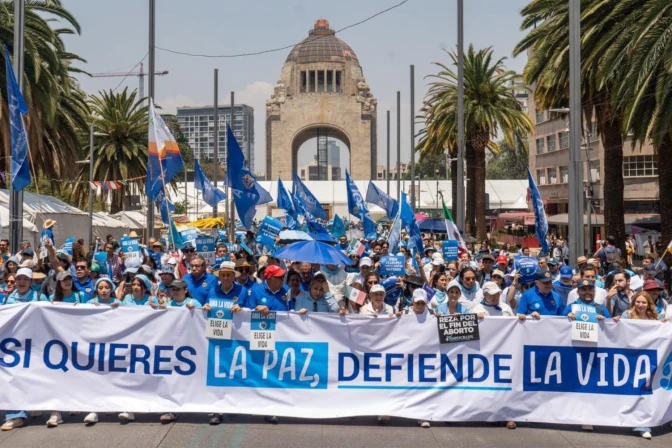
“Yes to life, no to abortion!”, “Life is a victory!”, and “We are the pro-life generation!” Young people took to the streets of downtown Mexico City last weekend to March for Life.
The incident occurred the day after the anniversary of the law passed on April 24, 2007, when the capital city government legalized abortion on demand up to 12 weeks of pregnancy.
According to the Mexico City Secretariat of Public Health, approximately 300,000 abortions were performed in the country’s capital between 2007 and 2025.
The 2007 decision paved the way for similar laws in other states, such that 24 of the 31 states across the country have currently relaxed restrictions on abortion.
Participants sign at the March for Life in Mexico on April 25, 2026 Credit: Primate Archdiocese of Mexico
To demonstrate against these regulations, groups of friends, families, youth mobilized by parishes, and other participants began gathering early at the Monument to the Revolution. From there, the group headed to the Mexico City Legislature in a march that drew a crowd of more than 2,000 people, according to organizers.
The youth continued marching with drums, chanting and slogans all along the route. Many wore blue handkerchiefs and T-shirts with pro-life messages and carried signs protecting motherhood and the unborn child.

A woman speaks at the March for Life in Mexico on April 25, 2026 Credit: Pasos por la Vida
Among the attendees was 22-year-old Macarena Munoz, who told ACI Prensa, EWTN News’ Spanish-language sister service, that she came to demonstrate that “there are still young pro-life people in Mexico and in all the states who want to see these laws changed, and who do not want abortion to be decriminalized.”
She said it is important to show society that there are young people who understand that “to protect any other rights, such as women’s rights, one must first protect the intrinsic value: the value of life.”
Other states begin allowing abortion
Although the first decriminalization of abortion in Mexico occurred in the capital in 2007, the most significant gains for laws allowing abortion occurred during the six-year term of former President Andrés Manuel López Obrador, which began in 2018, when the political party Morena won majorities in various state legislatures and pushed for laws allowing abortion in 12 states.
Subsequently, on October 1, 2024, with the administration of Morena party member Claudia Sheinbaum, and with the support of her party in the state legislatures, new laws were passed allowing abortion in the states of Jalisco, Michoacán, San Luis Potosí, Zacatecas, Mexico, Chiapas, Nayarit, Chihuahua, Campeche, Yucatán, and Tabasco.
The march brought together people from different regions of the country. According to organizers, participants came from at least 20 cities.

Participants take part in the March for Life in Mexico on April 25, 2026 Credit: Pasos por la Vida
One of them was 24-year-old Regina Hinojosa, who traveled from Puebla. Speaking to ACI Prensa, she lamented that while abortion was legalized in Mexico City and other states, “nothing happened that was positive for women.”
She said that above any other agenda, Mexican women “deserve more laws favoring their own well-being and that of their children.”
Juan Pablo Perea, 21, a native of Michoacán, also participated. In an interview with ACI Prensa, he said he had traveled with the intention of reminding others that “it is up to us young people to fight for this because now we are not only the future of the country but its present; and if we don’t do something right now, no one else will.”
Although he acknowledged that it is a “struggle which, regrettably, seems to be losing ground at present,” he encouraged other youth to join in, pointing out that “without life, there is no future.”
Young people don’t want these deadly laws
Some pro-life legislators also participated in the march, such as the National Action Party’s Juliana Rosario Hernández Quintanar, a Querétaro state representative, who has advocated legislative initiatives such as declaring March 25 as “Day of Life”.
Hernández told ACI Prensa that more laws are needed to protect vulnerable persons, including unborn children, and so he called on his colleagues not to give up, because “there is no better cause than fighting for life, because life is the future, life is hope, and today in Mexico, we have a huge demand to (protect) life.”
Furthermore, he expressed the view that Mexico bears a “great debt” in this regard, assuring that as politicians, “we are here to defend these causes, the ones that really matter and that will allow us to bring about lasting change.”
youth at the forefront
Another attendee was 20-year-old Rodrigo Baños, who called on other youth to participate with “attitude and determination” in defending human rights, especially the rights of women and unborn children.
The young man also told ACI Prensa that, following the example of previous generations, “now is our turn, this is our moment to go out and fight for the right to life”. He encouraged his contemporaries, reminding them: “We are young; we have nothing to lose. We must give it our all.”

“Every life has a purpose, let (its heart) beat!” Reads a banner at the March for Life in Mexico on April 25, 2026. | Credit: Primate Archdiocese of Mexico
At the end of the program, a manifesto was read from the stage, ending on the same note, with a message addressed to Mexican youth and “those who are trying to persuade us to give up.”
“We refuse; we are a generation that does not acquiesce, that does not sell out, that does not silence, that does not surrender. We will not give up. We will not tire of defending the truth. We will not stop loving Mexico.”
this story was first published By ACI Prensa, the Spanish-language affiliate of EWTN News. It has been translated and adapted by EWTN News English.
