

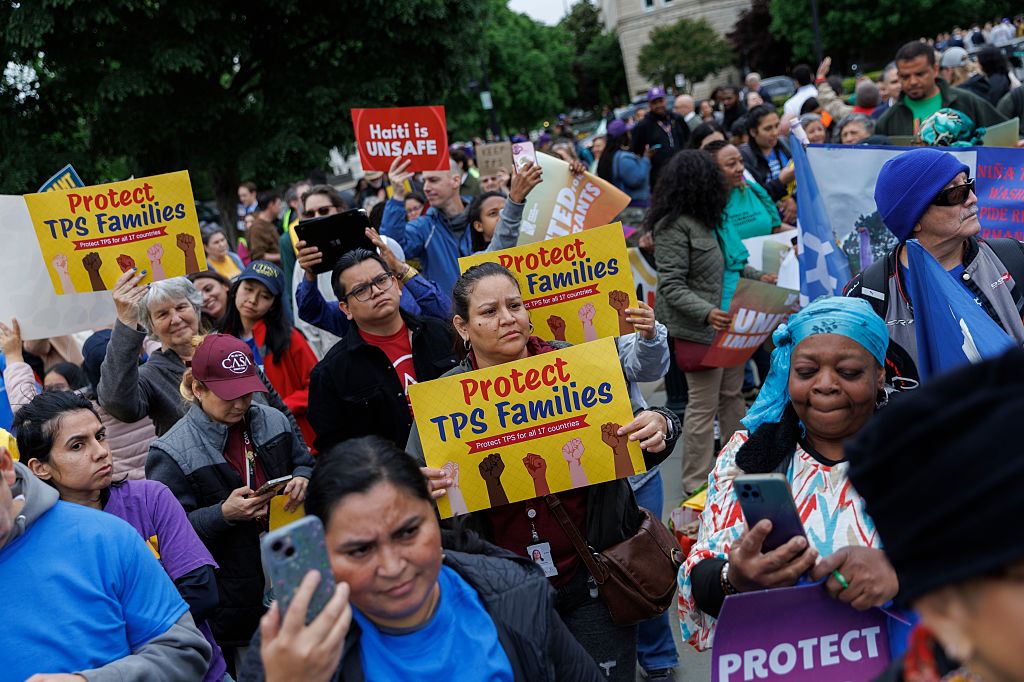
The U.S. Supreme Court heard oral arguments in a legal challenge to President Donald Trump’s administration’s efforts to remove the temporary legal status of Haitian and Syrian immigrants.
Former Homeland Security Secretary Kristi Noem ended the Temporary Protected Status (TPS) designation for immigrants from Syria, Haiti and other countries. If the court rules that its actions are legal, the administration could order the removal of more than 350,000 Haitians and 6,000 Syrians.
The Trump administration argued on April 29 that the executive branch has broad discretion to end TPS for any country. The challengers, representing immigrants, argued that Noem failed to follow due process and accused officials of unlawfully using racist assumptions about immigrants to make their decisions.
The United States Conference of Catholic Bishops has urged the administration to extend TPS status for both countries.
Migrant lawyers challenged Trump
Ahilan Arulanantham, arguing on behalf of the Syrians, acknowledged that the administration has “wide” discretion in determining TPS status, but argued that Noem failed to follow due process in making her decision.
Although she said Noem could make the final decision to end TPS, she said the law requires Noem to consult with relevant agencies before making a decision. They argued that Noem did not consult adequately with agencies before making the decision.
“We cannot challenge on the basis that she is wrong,” Arulanantham acknowledged, “… (but) what deserves review is whether she actually asks something and gets any information about the conditions in the country.”
He said that one basis for Syria’s TPS designation was armed conflict, “but the Secretary never consulted the State Department about the armed conflict.” Rather, he argued, “it was abolished on grounds of national interest.”
“We don’t argue about the levels; we don’t argue about the amount,” Arulanantham said. “We just say that (there is) a topic to be discussed. They have to talk about the conditions in the country.”
The justices questioned those arguments, with Judge Amy Coney Barrett pressing Arulanantham, asking her whether Noem could have consulted with the State Department on those topics, and ended the status, even though there was strong evidence in favor of extending it.
Arulanantham said she could do so, leading Barrett to say the process appeared to be merely a “box-checking exercise”.
Justice Samuel Alito argued that the administration has broad discretion in “determining” whether or not to extend TPS status: “If we apply the ordinary meaning of that term here, I really don’t see how you could prevail.”
Justice Elena Kagan appeared sympathetic to the claim that the court could review whether the administration followed procedures, but examining whether Noem consulted with agencies about appropriate or inappropriate topics “seems to me more difficult than a procedural argument.”
Geoffrey Pipoli, who represented the Haitians, argued that Noem’s review of the termination for his clients was “a sham,” adding that the decision was “a predetermined outcome driven by the President’s determination to end TPS for Haiti, no matter what.”
He accused the president of “racial hostility toward non-white immigrants and a dislike of Haitians in particular,” citing Trump’s comments that Haiti is a “(expletive) a-hole country” and his claim that immigrants are “eating dogs and eating cats.”
Kagan questioned this argument, noting that the Trump administration has broadly decriminalized immigration, saying: “I don’t see how it operated when all these programs were running.”
Alito pressed Pipoli about “white” and “non-white”, saying: “You have a really broad definition of who is white and who is not white. As I said, I don’t like dividing the people of the world into these groups.”
Justice Ketanji Brown Jackson defended the argument, saying that only predominantly non-white countries have TPS status.
‘Broad Discretion’
U.S. Solicitor General D. John Sawyer argued that the law does not allow judicial review of Noem’s decision to end TPS, arguing that Noem had “wide discretion” in how to consider whether to extend the status to those countries.
“Any determination regarding designation, extension, or termination is not subject to judicial review,” Sawyer told the judges.
Sawyer said that the Secretary can determine which agencies are appropriate for consultation and he can also determine that there are no appropriate agencies for consultation. He accused the other side of merely claiming that their consultation “was not sufficient.”
“Soliciting input is consultation, taking advice from someone knowledgeable is a form of consultation,” he said, arguing that the Secretary has broad discretion to decide what constitutes consultation.
Sawyer said that these decisions are “traditionally left to the political branches” and he accused the district courts that blocked TPS termination of “appointing junior university secretaries of state.”
He also rejected allegations of racism, saying, “Not a single comment from (Trump) mentioned race or was related to race.” He said they always mention “crime, poverty, welfare dependency, drugs, (and) drug importation”, among other issues.
Kagan challenged the suggestion that there could be no judicial review, noting that Congress has enacted a statute that requires consultation and “it has set forth procedural steps that have to be followed.”
“The Constitution … (says) due process applies to any alien residing in the United States,” he said. “This applies to all people who live here. … They are entitled to due process. Now Congress has given them a process. It may not be a court process, but that’s OK. It’s a process and you’re saying … it’s not reviewable whether the President followed that process or not.”
Andrew Arthur, resident fellow in law and policy at the Center for Immigration Studies and former immigration judge, told “EWTN News Nightly” that if the administration is successful in court, ending the status would not remove everyone who entered through TPS because some people have other forms of legal status, such as student visas.
“If they’re here and they’re not in lawful status and they don’t have removal orders, the (Department of Homeland Security) has to take all of them and put them into removal proceedings, get removal orders and then remove them from the United States,” he said.
