

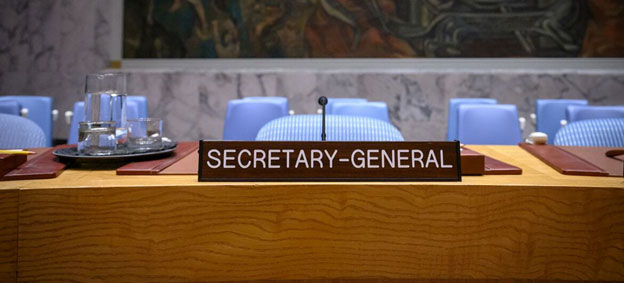
United Nations, May 1 (IPS) – A long-standing rule prevents international civil servants from publicly taking political stances against member states (or even taking part in political demonstrations outside the UN).
And more importantly, the rules also prevent UN employees from campaigning for or against candidates for the post of Secretary-General, including the current race for the new UNSG.
Perhaps this is the price one has to pay – losing the right to political expression – when you are an international civil servant. But is it worth the sacrifice?
A new circular to UN staff, issued on 29 April, reiterates these restrictions and warns against any participation in the election of a new Secretary-General later this year.
“As recent and ongoing wars and conflicts continue, the United Nations remains indispensable as a platform for dialogue, human rights and collective action and all staff play a vital role in this effort.
“While it is understandable that many staff members feel compelled to share views about unfolding events, including through personal platforms such as social media, we must remain conscious at all times of our rights and duties as international civil servants, which require us to act independently and impartially,” the circular said.

This applies to all public communications (including those shared through personal social media accounts) related to ongoing crises, political matters and other elections and electoral processes, which must be framed in a way that is consistent with the Organization’s positions and statements by the Secretary-General.
Recent examples have also highlighted the need for special caution regarding public expressions of support for candidates in the Secretary-General selection process.
“Any such expression – whether explicit or implicit – could be considered inconsistent with the independence and impartiality required of international civil servants and risks undermining the integrity of the process,” the circular warns.
‘The disclaimer that views are expressed in a personal capacity does not relieve us of our obligations under employee regulations and rules. The circular warns that the standards of conduct apply regardless of the platform used or the ability to express views.
Dr Palitha Kohona, former head of the UN Treaty Section, told the Inter Press Service (IPS):
“There is no doubt that international civil servants must remain above national and sectarian differences. This is the quality that makes them and the organization credible. Sometimes it can be difficult to remain silent in the face of gross abuse, and these circumstances create a dilemma”.
In this context, he pointed out, it is most important to keep in mind Article 101 of the Charter.
During the time of SG Kofi Annan (1997–2006), a more relaxed atmosphere prevailed and staff were allowed to express their views within their areas of responsibility.
“Then, one is bound to ask whether workers should remain silent when the core principles of the Charter are being violated. Be they human rights, or prohibitions or threats of the use of force, or commitments to live in peace and harmony,” he argued.
The organization’s leadership should provide guidelines within which employees can express themselves. But not those artificial things that we are fast becoming a habit of.
But will the leadership ever call a spade a spade, said Dr Kohona, former Permanent Representative of Sri Lanka to the United Nations and until recently Ambassador to China.
Samir Sambar, former Assistant Secretary-General and head of the Department of Public Information (DPI), told IPS: “I recall taking the “Oath of Office” to perform the functions assigned to me as an international civil servant of the United Nations, with utmost integrity, discretion and discretion, to discharge these functions and to regulate my conduct only with the interests of the United Nations in mind, and not to seek or seek instructions in the performance of my duties from any Government or other authority outside the Organization. Let me accept.”
That said, I am not clear whether that oath is currently required, especially after so many former government officials have joined the secretariat.
He pointed out that supporting any particular candidate proposed by the Government for the post of Secretary-General – as is officially required – would be contrary to the oath of the International Civil Service.
Recalling his strong personal relationship with the former Secretary-General, Sambar said: “Kofi Annan was my closest UN colleague because we started our work at the same time and progressed together when he led peacekeeping and I led public information.”
He met me at home on Sunday evening, Sambar said, to inform him of his candidature for the post of General Secretary, yet politely agreed that my contacts with the media would not indicate public support until he was elected, when we went to the photo unit on the eighth floor for an official portrait.
Meanwhile, the UN circular also states: “As employees we must adhere to the policies set out in Status, basic rights and duties of United Nations staff members; outdoor activities. Guidelines for personal use social media It also includes a number of useful tips, including reminders on privacy settings, liking or sharing posts, and information not made public.’
In particular, Staff Regulation 1.2(f) provides: “Although the personal views and beliefs of staff members, including their political and religious beliefs, shall remain inviolable, staff members shall ensure that those views and beliefs do not adversely affect their official duties or the interests of the United Nations.
They shall at all times conduct themselves in a manner consistent with their status as international civil servants and shall not engage in any activity which is inconsistent with the proper discharge of their duties to the United Nations.
They shall refrain from any action and in particular from any public announcement which might adversely affect their position, or the integrity, independence and impartiality essential to that position.
“Guidance on 2026 political activitiesThe release by the United Nations Ethics Office on iSeek provides more guidance.
“As employees we are obliged to comply with these provisions. Failure to do so may result in the initiation of a disciplinary process, which may result in disciplinary sanctions.”
In view of the above, please also note that in accordance with Staff Rule 10.1, “Failure by staff members to comply with their obligations under the Charter of the United Nations, Staff Regulations and Rules or other relevant administrative issuances or to adhere to the standards of conduct expected of an international civil servant may constitute misconduct and may trigger a disciplinary process and disciplinary measures may be imposed for misconduct.”
In addition, affiliated (non-employee) personnel are required to adhere to the principles laid down under the terms and conditions of their engagement as well as the administrative instructions governing the modalities of their engagement such as ST/AI/2020/10 on the United Nations Internship ProgramOn ST/AI/2013/4 Consultants and Individual ContractorsST/AI/231/Rev.1 Non-Reimbursable Loan SpecialistST/AI/1999/6 free staffand MOU and Terms of Service Guidelines for UN Volunteers.
“This reminder is issued in the interest of the safety of both individual staff members and the Organization, and to ensure that the United Nations continues to be perceived by Member States and the public as an impartial and credible institution.”
IPS UN Bureau Report
© Inter Press Service (20260501044645) – All rights reserved. Original source: Inter Press Service
