

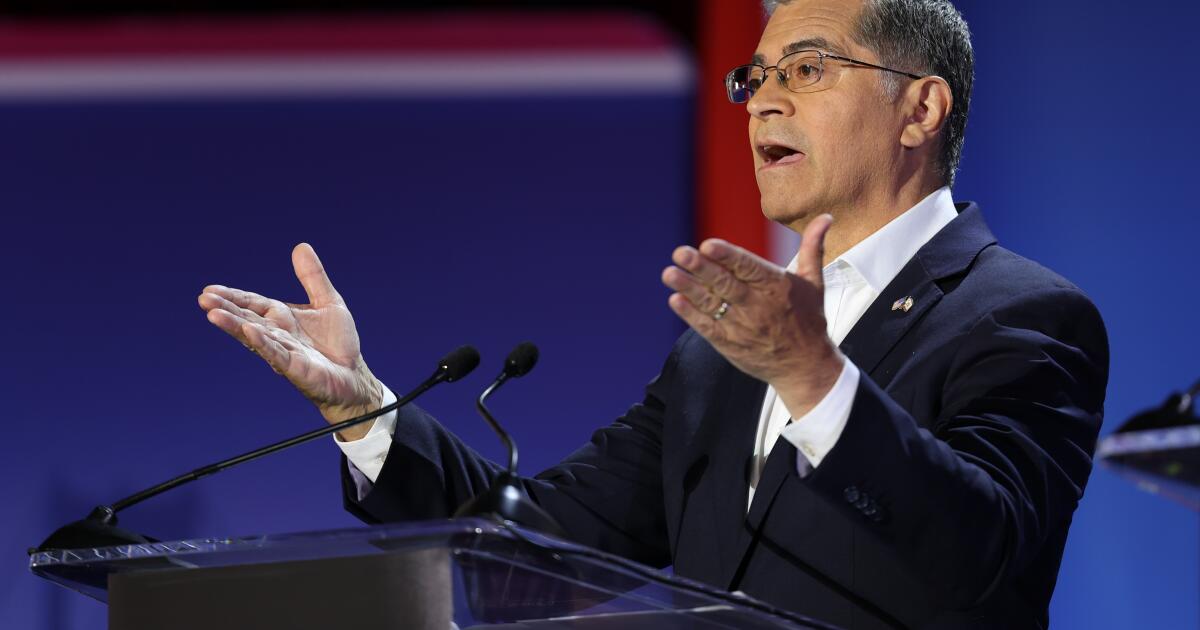
interesting update emerged this week on the campaign website of Democratic gubernatorial candidate Xavier Becerra.
Highlighted in bright red text, and boxed in by a red outline, was a game plan to attack one of Becerra’s top rivals in the California governor’s race, billionaire hedge fund founder turned environmental activist Tom Steyer.
But was that message meant for California voters or, perhaps, for a more specific audience – the activists running the newly formed big-money independent committees that are supporting his campaign?
Becerra’s website may be using a practice called “red boxing”, which is indicative of how campaigns signal what they want, with outside groups supporting them to focus their ads and other strategies. That strategy is used to avoid laws preventing campaigns from coordinating directly with “independent” expenditure committees.
“What we’re seeing with the Becerra web page is a textbook example” of efforts to circumvent rules that don’t allow such coordination, said Aaron McCain, senior legal counsel for campaign finance at the Campaign Legal Center, a Washington, D.C.-based nonprofit focused on fair elections. “It’s specifically calling for particular messages and particular ways of communicating with voters … as a way of getting super PACs, nominally independent spenders, to do the campaign’s bidding.”
Under Supreme Court rulings, independent expenditure committees can accept unlimited donations, unlike candidate campaign committees that have contribution limits. In the 2026 election, California gubernatorial candidates can accept a total of $78,400 from each donor for the primary and general elections.
However, separate entities are not allowed to communicate, a rule that is routinely violated. Campaigns have long sent signals to independent expenditure committees about the messages they want to highlight, the places they want to see communications and which voters should be targeted.
“This is a way to technically comply with the law, while also helping the super PAC craft its message,” said UCLA law professor Rick Hasson, who directs the Secure Democracy program there. “This is an epidemic. This is absolutely standard procedure.”
He said the Supreme Court has created an “illusion of regulation,” but that while billionaires like Steyer can self-fund their campaigns, it is not surprising for other candidates to try to boost their chances with wealthy donors.
“Now people are taking (Becerra) seriously, and if he’s getting the support of a super PAC, it’s a good way to telegraph without having to communicate with those groups what he thinks are his strong points,” Hasen said. “But it’s not coordination. If there’s no direct contact, if they’re not calling each other or talking about it, and they’re posting information publicly, even if it’s in code, on Twitter, and everyone you know in the professional world knows about it, and no one else knows, it still doesn’t break the law.”
Campaigns using “red boxing” will post information purportedly targeted to voters on their websites, but the messages are often in language not typically used to communicate with voters. This involves describing specific campaign messages suitable for advertising or attacking opponents, sometimes highlighted in literal red boxes.
Such practices are becoming increasingly common – and increasingly lucrative, too. According to an article titled 2024coordination in plain sight“: The Breadth and Use of ‘Redboxing’ in Congressional Elections” published in the Election Law Journal, found more than 200 candidates for federal office used the strategy during the 2022 midterm elections, and often received more financial support from independent expenditure committees than candidates who did not employ the strategy.
Becerra, the former U.S. Health and Human Services secretary, was in the running for the 2026 gubernatorial race to replace ousted Gov. Gavin Newsom until former Rep. Eric Swalwell (D-Dublin) dropped out because of allegations of sexual harassment and misconduct. Becerra quickly began gaining ground in the polls and is now one of the leading candidates.
This week, two independent expenditure committees are being formed to support Becerra’s candidacy, including one tied to Newsom’s longtime political advisers, who declined to comment about the matter.
A Becerra webpage was posted late Tuesday night titled “What Voters Need to Know.” Virtually lined up by a red box, it separates Becerra’s humble roots from Steyer’s background. Bullet points highlight Steyer’s hedge fund’s investments in fossil fuels, tobacco, private prisons, and casinos.
“There are countless examples. They all tell the same story,” the campaign webpage says, before adding that “Progressive voters need only look at the Facebook (and other) content in which Democrats appear to be uniting behind Xavier Becerra as the Democrat in the race.”
Page also suggests rebutting the Steyer ad attacking Becerra.
While it’s almost impossible to guess a candidate’s intentions, political communication professor Dan Schnurr said there were notable details in Tuesday night’s post.
Schnurr, who served as chair of the Fair Political Practices Commission in 2010–11, said, “The logical question is whether they are informing everyday voters who come to the Becerra website for information about Tom Steyer, or is this a potentially covert way of providing information to independent committees.” “Regardless of the legality or ethics of this type of strategy, putting the information in a literal red box probably wasn’t the best idea. … An actual red box is a very visible red flag.”
Ballots will begin arriving in voters’ mailboxes in a few days, and the primary is June 2. Even if a complaint is filed with election integrity watchdogs, it almost certainly will not be resolved before the election. So the gamble of circumventing election law and paying the fine may be worth the potential strategic boost in a chaotic and volatile election ahead of the primary, Schnurr said.
A representative of the Fair Political Practices Commission did not respond to a request for comment.
Becerra’s campaign, when asked about the new posting and whether it was an effort to send a signal to the two new independent expenditure committees, responded that the candidate was merely comparing his record to Steyer’s.
“Xavier Becerra has spent his career taking on powerful corporations, lowering costs for Californians, and expanding access to affordable health care,” said Becerra spokesman Jonathan Underland. “Tom Steyer spent his money on private prisons and fossil fuel companies. Becerra is the obvious choice for Democrats who want a fighter – not a billionaire wearing California values like a Halloween costume.”
Steyer’s campaign responded that Becerra was pursuing a familiar election strategy.
Steyer spokesman Anthony York said, “Xavier Becerra is signaling to his allies in Big Oil and the utility monopolies how they should spend their millions distorting Tom Steyer’s record.” “Becerra is doing everything he can to run away from his record of mismanagement and his decades of doing the bidding of powerful interests at the expense of working Californians.”
This is not the first case of questions being raised about coordination between campaigns and outside groups. San Jose Mayor Matt Mahan is the subject of a complaint by the Fair Political Conduct Commission alleging that he coordinated fundraising and campaign strategy with donors to independent expenditure committees supporting his bid. Mahan’s campaign has denied the allegations.
