

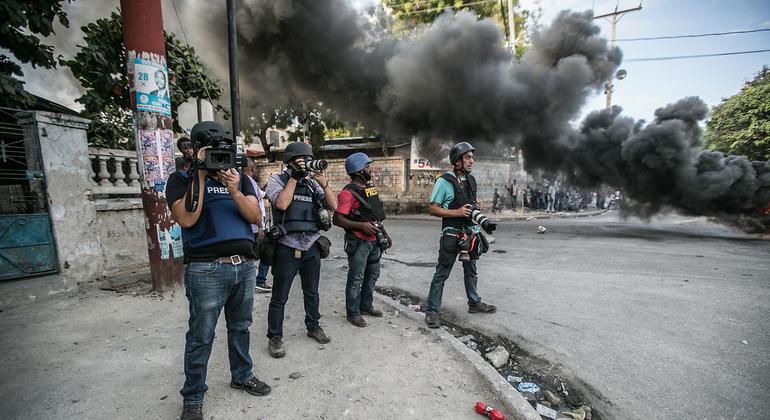
The Caribbean island nation faces widespread insecurity as well as deep poverty.
Approximately 1.4 million people have been forced to flee their homes, largely due to violence perpetrated by gangs.
according to UNESCO‘S Observatory of Killed Journalists 14 media workers have been killed in Haiti since 2021.
Ahead of world press freedom day Celebrated every year on 3 May, united nations news Spoke to two journalists currently working in the capital Port-au-Prince.
Jean Daniel Sennett is a journalist on the daily newspaper, Le Noveliste and on Radio Magic 9.
Jean Daniel Sennett: i work for daily newspaper le noveliste And Radio Magic 9. at present time Journalists work in particularly harsh and restrictive environments with security challenges. The gangs now control more than 80 percent of the Port‑au‑Prince metropolitan area.
Oberde H. Charles: I am the editor of a daily newspaper le national and for television pacific. We cannot move freely. There is little communication between different departments of the country and in some urban areas, our access to which is restricted. All this limits our work as journalists.
Jean Daniel Sennett: Our job is to go into the field and gather information, seek out first-hand sources, talk to witnesses, tell stories. It is very challenging because We are under constant threat from criminal groups.
Sometimes we are also in danger from the policeThose who may suspect that journalists are working for gangs because they are able to enter gang-controlled neighborhoods.
At the same time, criminal groups also believe that journalists sometimes conspire with police officers by providing them with information.
Oberde Charles, newsroom manager at Pacific TV and editor at the daily newspaper Le National.
Oberde H. Charles: Recently, two fellow journalists were kidnapped. Additionally, in 2022, street protests were led by garment workers demanding better conditions. Unfortunately, people were injured in police firing that day. On the same day, a fellow journalist was murdered.
Jean Daniel Sennett: Dozens of journalists have been killed. Some have been kidnapped, and others have had to flee the country and live in exile due to threats from criminal groups.
Some media outlets, some journalists have had to flee their neighborhoods, their offices, their homes. Personally, I have had to change homes twice due to insecurity.
le novelisteLost its historic headquarters in downtown Port‑au‑Prince in February 2024 Radio Magic 9had to abandon its premises due to the advance of criminal groups.
A colleague of mine survived an assassination attempt and had to go on the run. But I also know fellow journalists who have been killed. Some are missing, and their families have no news of them.
So, on a personal level, I am very deeply affected.
Oberde H. Charles: This is a very risky profession. In recent years, Many fellow journalists have decided to leave the country And seek asylum in Canada, France or the United States.
They feel threatened and have decided leaving the country is the best way to protect their loved ones or themselves. Today, this appears to be the best decision.
Journalists who continue to work in Haiti despite the dangers are truly brave.
Jean Daniel Sennett: Some radio stations just have stopped broadcasting. There are journalists who have lost their jobs.
There are also journalists who endure the physical wounds of gang violence. I know a journalist who lost an eye, another who was shot in the leg and is having trouble walking and another who is still hospitalized in Cuba.
More than 1.4 million people have fled their homes due to violence in Haiti and many are living in temporary shelters.
And then, there is emotional trauma. There are journalists who live with the trauma caused by the violence of criminal groups.
But despite everything, we keep doing our work, because every profession comes with risks.
Oberde H. Charles: Our country is not at war with any other state, but is at war. And This war is far worse and far more deadly than what is happening in Israel or Ukraine.
Jean Daniel Sennett: At the end of the day, we tell ourselves that if we do not document, if we do not inform, if we do not seek information, it is the population that will pay the price.
There are voices that will no longer be heard, there are stories that will no longer be told, there are facts that will no longer be documented.
You need a strong media, to tell the truth, to help people outside understand what’s going on in Haiti, and to gain a clear and accurate understanding of the situation inside the country.
Oberde H. Charles: Haiti needs a strong media that acts impartially and provides good and true information. As a result people know which areas they can visit and which areas they should avoid during a day or a certain period of time.
Lack of information can jeopardize democracy and thus individual freedom.
