

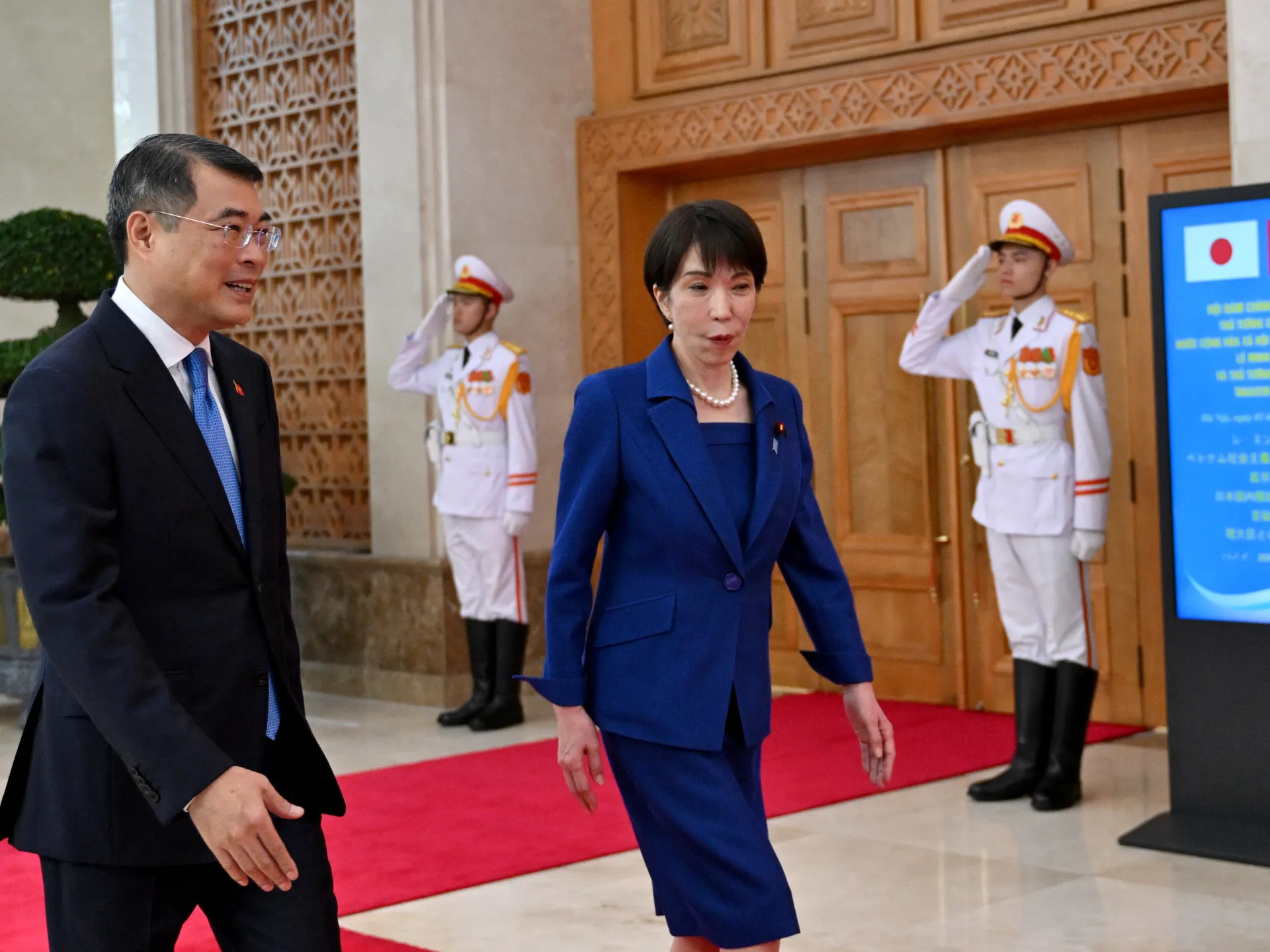
During his visit to Hanoi, Takachi signed six agreements with Vietnam, including on technology, agriculture and space.
Published on 2 May 2026
Japanese Prime Minister Sanae Takaichi says his country will boost ties with Vietnam, focusing on energy and critical minerals.
Takaichi met his Vietnamese counterpart Le Minh Hung in Hanoi on Saturday, where they signed six agreements on issues ranging from infrastructure to agriculture and space cooperation.
Recommended Stories
4 item listend of list
“Both sides identified economic security as a new priority area for bilateral cooperation,” Takachi told reporters after the meeting.
“With regard to critical minerals… both sides agreed to strengthen closer coordination to ensure stable supplies and strengthen supply chains,” he said.
Hung said the two leaders also “reaffirmed the importance of resolving disputes in the South China Sea through peaceful means based on international law”.
Japan and Vietnam share concerns about China’s territorial claims in the East and South China Sea, and both have sought to defend against trade disruptions driven by the United States by broadening economic and security ties.
crude oil supply
The push for deeper cooperation between the two states comes after new investments in Vietnam from Japan, one of the largest foreign investors, fell nearly 75 percent year-on-year in the first quarter to $233 million, while bilateral trade rose 12.3 percent to $13.7 billion in the same period, according to Vietnamese government and customs data.
Vietnam is seeking support from Japan and other countries for oil supplies as conflict in the Middle East is driving up prices and disrupting supply chains.
Under the $10 billion Power Asia initiative to support Asian countries’ energy self-reliance, Japan will help arrange crude oil supplies for Vietnam’s Nghi Son refinery and petrochemical complex, Hung said.
Takaichi was due to meet on Saturday afternoon with President To Lam, who is also general secretary of Vietnam’s Communist Party, and deliver a keynote address at Vietnam National University, marking a decade since former Prime Minister Shinzo Abe introduced Japan’s “free and open Indo-Pacific” strategy.
