

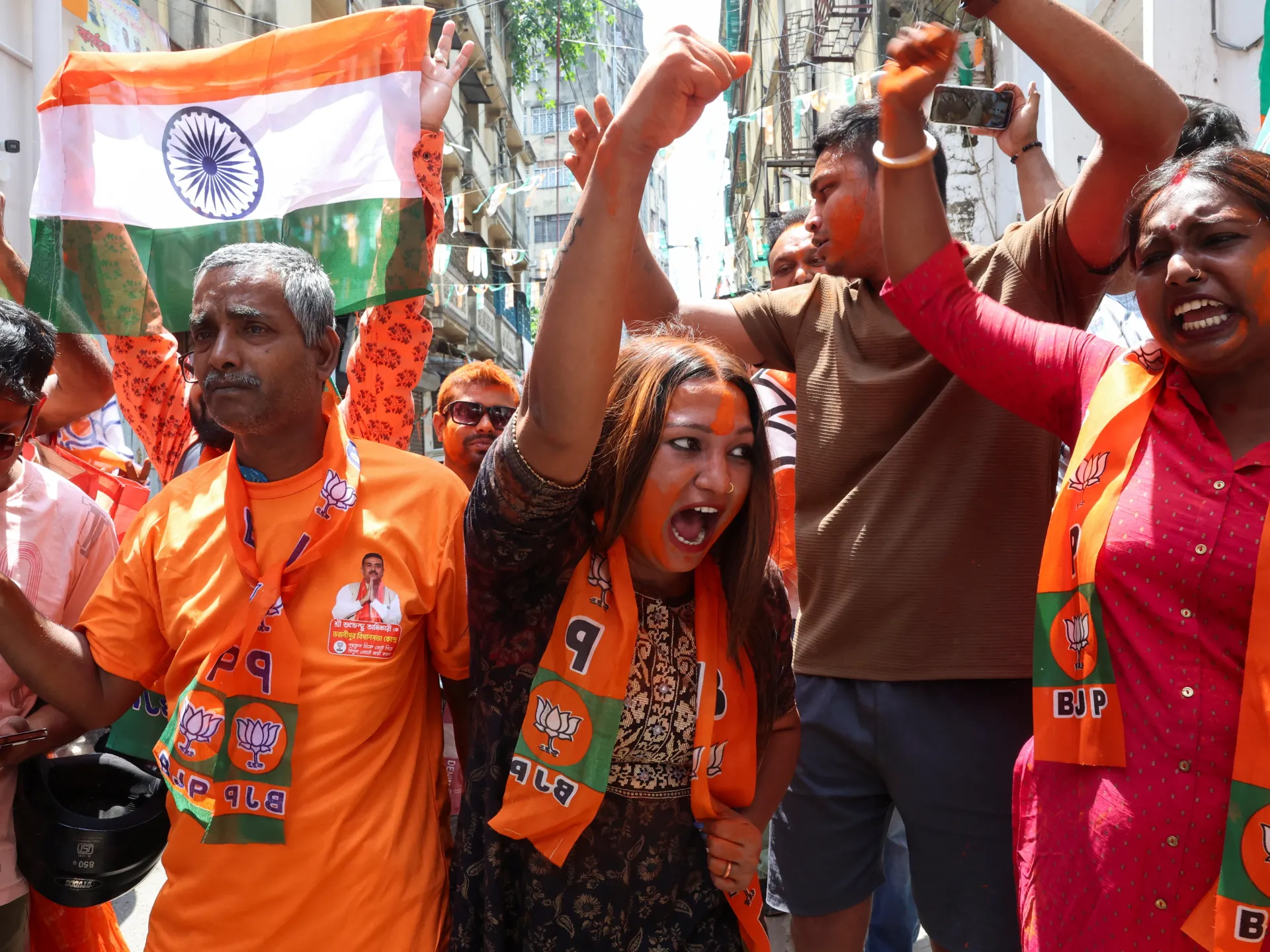
New Delhi, India – Seema Das, a domestic maid in New Delhi, traveled two days to reach her village in the Indian state of West Bengal, and changed trains to ensure she reached home in time to vote in provincial elections.
Das had previously always voted for the All India Trinamool Congress (TMC) party led by Chief Minister Mamata Banerjee, a centrist political force that has been in power in the eastern Indian state since 2011. But this time, she said, her mother-in-law had convinced her that “Didi” – a nickname for Banerjee, which translates in Bengali to elder sister – “sides with Muslims”.
Das, a Hindu, said: “Didi has lost her way and is only pleasing Muslims to remain in power.”
This allegation has long been leveled against the TMC by Prime Minister Narendra Modi’s Hindu majority Bharatiya Janata Party, which emphasizes religious pluralism and protection of minority rights. But for 15 years, Banerjee and her party have ruled the state of more than 90 million people, even as the BJP gained ground in a state where it was traditionally a marginal player.
This changed on Monday. Modi’s party won in West Bengal. Early results of the state legislature elections – which were held in April but counting of votes took place on May 4 – show that Modi’s well-prepared election machinery is set to give the BJP a thumping majority in a state where its ideological founder hails from, but which it has never won before. As of 4:30 pm IST, the BJP had won or was leading in 200 of the 294 seats in the state, where its previous best performance in 2021 was 77 seats. Meanwhile, Banerjee’s TMC was leading or winning only 87 seats.
The West Bengal election was one of the five elections whose results were declared on Monday. In the southern state of Tamil Nadu, actor C Joseph Vijay surprisingly won with his fledgling TVK party, defeating the major parties; In its neighboring state Kerala, the Congress Party – the largest national opposition party – defeated an alliance of Left parties. The BJP-led alliance won the self-administered region of Puducherry, once a French colony. Whereas in the north-eastern state of Assam, Modi’s party returned to power with a huge majority.
Still, analysts say it is the West Bengal result that has been declared the most consequential so far on Monday, with the BJP following the path of religious polarization and taking advantage of the underlying anti-incumbency wave to win, experts told Al Jazeera.
Inside Banerjee’s bastion in the east
Banerjee broke away from the Congress party in 1998 and founded TMC after it refused to take on the alliance of communist parties that had ruled West Bengal since 1977.
Rising from a humble background, the lawyer-turned-student-activist-turned-politician ultimately defeated the Communists to win the state in 2011. Since Modi became Prime Minister of India in 2014, she has emerged as a major challenger to the BJP – framing her politics, particularly her defense of Bengal’s Muslims, as an act of opposition to Hindu majoritarianism.
He also launched a series of women-centric welfare schemes and pushed back controversial land acquisition projects sought by big industry.
“There is clear support for Mamata and she remains popular, but there is an anti-incumbency wave against the TMC machinery, and people were not happy with her interference in everyday life,” said Rahul Verma, a poll observer who teaches politics at Shiv Nadar University in Chennai.
He said the BJP also ran a better managed campaign this time, noting that he was not “surprised” by the results. “It was a tough election for the BJP, but not impossible.”
According to Verma, “There was a corridor available for them (in West Bengal), and now one can say that everything is kind of aligned to produce this outcome for them.”
Verma emphasized that “without a serious anti-incumbency wave, West Bengal would not have got such a result.”
About 68.2 million people, or about 92.93 percent, voted in the election, a record high for the state.
Praveen Rai, a political analyst at the Center for the Study of Developing Societies in New Delhi, said Banerjee’s party “failed to offer voters anything new and to overcome the strong anti-incumbency sentiments against her”.
“The party system had become hostile towards those who did not agree with its ideology,” he argued, adding that “TMC failed to understand the growing resentment against economic deprivation and the aspirational needs of the common people.”
Rai said the defeat in West Bengal had also dented Banerjee’s hopes of emerging as a national challenger to Modi’s job.
But the implications of the result extend far beyond Banerjee, he said. BJP’s victory, and TMC’s dramatic defeat, “will reduce the political capital of (all) parties opposing (Modi)”.
This is a big change from two years ago. In the 2024 national elections, Modi’s party fell short of a majority, leaving it dependent on the support of allies for survival. Rai said Monday’s election victory “compensated for the electoral setback” suffered in the national poll.
“This substantially enhances the national prestige of Modi’s leadership and enhances the hegemonic power of the party (BJP) to rule India,” Rai told Al Jazeera.

‘BJP is running on Hindu-Muslim polarization’
Nilanjan Sarkar, a senior fellow at the Center for Policy Research in New Delhi, who traveled across West Bengal ahead of the elections, told Al Jazeera that his team had identified “a huge urban-rural gap between voters’ preferences”.
“We found that urban men are very polarized,” he said. “In Bengal, the Muslim population is disproportionately rural, and given the level of polarization, the result resulted in a large margin for the BJP.”
Historically, election analysts have argued that due to the BJP’s Hindu majoritarian politics, the party did not have a chance of winning West Bengal. More than a quarter of the state’s population is Muslim. “Of course, this turned out not to be true, that’s something we picked up on during our research,” Sarkar said.
BJP is not shying away from presenting itself as a party of Hindu voters.
“There has been Hindu consolidation (of votes),” said Suvendu Adhikari, state BJP leader and probable chief ministerial candidate.
However, he claimed that many Muslims also did not vote for Banerjee’s TMC like before and drifted towards the BJP. It is impossible to verify the claim until the Election Commission of India (ECI) releases details of the vote counting that will take place in the next few days.
Calling Banerjee’s TMC a “pro-Muslim party”, Adhikari said, “I want to thank every Hindu Sanatani who cast their vote in favor of the BJP.” Sanatan Dharma is a synonym for Hinduism.
For the BJP, the victory in West Bengal is also deeply symbolic: Syama Prasad Mukherjee, who founded the Bharatiya Jana Sangh – the precursor to the BJP – in 1951, was from the state.
Al Jazeera contacted TMC spokespersons but did not receive any response.

Pre-election voter verification in headlines
Ahead of voting in West Bengal, the ECI carried out the so-called revision of its voter lists through a special intensive vetting (SIR), which authorities have conducted in more than a dozen states so far.
The process in West Bengal controversially removed more than nine million people – about 12 percent of the state’s 76 million voters – from the voting rolls, taking away their right to vote in the election.
About six million of them were declared absent or dead, while the remaining three million were unable to vote because no special tribunal could hear their cases in the short time frame available before the elections.
Banerjee’s TMC and other opposition parties in several states have raised the issue of discrepancies in the revision of voter lists and accused the Election Commission of favoring Modi’s BJP. Right-wing activists and observers believe that this process disproportionately disenfranchised Muslims ahead of the elections.
Banerjee also appeared before the Supreme Court of India challenging the “opaque, hasty and unconstitutional” amendment process. The top court did not restore the voting rights of lakhs of affected people, but directed the ECI to publish a list of affected voters.
“Once the question of whether ‘should I be on the electoral roll’ becomes the dominant question for vulnerable populations, it is not politics as usual,” the government said. “The level of polarization caused by voter verification is something that people outside the state don’t really understand.”
The Modi government also deployed 2,400 companies of paramilitary forces to West Bengal for the elections – a record for such provincial votes. The federal government claimed this was to help election officials practice without fear of political violence.
But TMC and other opposition parties argued that the forces acted to intimidate – or influence – voters.
Verma of Shiv Nadar University argued, “The heavy presence of security forces could also have created a favorable situation for the BJP.” “Those who might have been fence-sitters and might have been intimidated by the TMC machinery on the ground were affected by this.
“There is no doubt that the level of trust between the opposition parties in India and the Election Commission of India is very low,” Verma said.
However, analysts who spoke to Al Jazeera, including Sarkar and Verma, agreed that the voter verification exercise alone cannot deliver such a decisive victory for the BJP – and that this reflects a number of other factors, including anti-incumbency and religious polarisation.
Still, analysts said, Banerjee likely won’t go out without a fight.
In her first reaction on the counting of votes, Banerjee addressed her party workers in a video statement, calling on all workers and leaders not to leave the counting booths until the last ballots are counted.
“This is a completely coercive use of central forces to harass the Trinamool Congress everywhere, demolish offices and forcibly occupy them,” he said. “We are with you. Don’t be afraid. We will fight like tiger cubs.”
The government said, these are not empty warnings. “We’re definitely in the drama.”
