

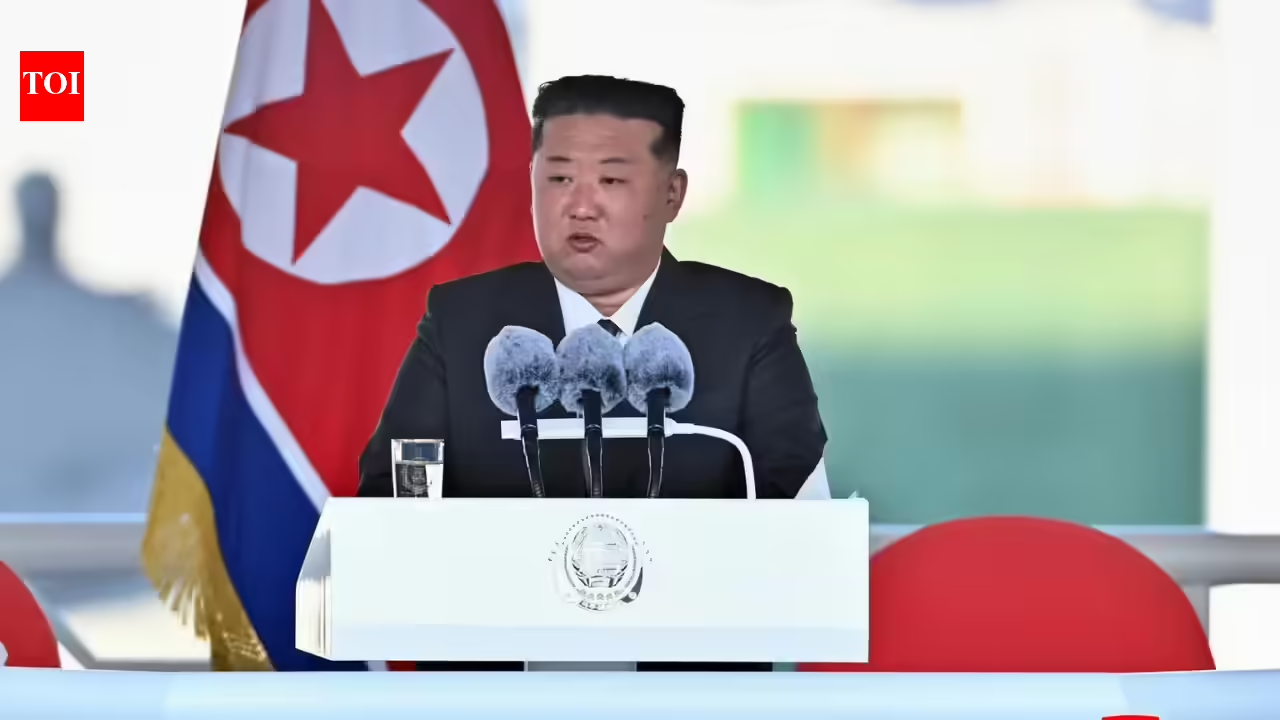
North Korea has amended its constitution to require the military to launch a retaliatory nuclear strike if leader Kim Jong-un is assassinated or incapacitated by a foreign adversary.The constitutional change comes after Iran’s Supreme Leader Ali Khamenei and several of his close advisers were reportedly killed in strikes during the initial phase of the joint US-Israeli attacks on Tehran.The amendment was adopted during the first session of the 15th Supreme People’s Assembly, which began in Pyongyang on March 22. The changes were revealed on Thursday during a briefing by South Korea’s National Intelligence Service (NIS) for senior government officials, The Telegraph reports.According to the NIS briefing, Kim retains command over North Korea’s nuclear forces, but a constitutional amendment formally defines procedures for retaliation if killed or rendered incapable of leading.The amended Article 3 of the Nuclear Policy Law states: “If the command-and-control system over the nuclear forces of a State is endangered by attacks by hostile forces… a nuclear strike shall be automatically and immediately initiated.”Professor Andrei Lankov, a Russian-born professor of history and international relations at Kookmin University in Seoul, said the change reflected growing concerns in Pyongyang following recent developments in Iran.“This may have been the policy earlier, but now it has been included in the Constitution and emphasized,” he said.“Iran was a wake-up call. North Korea saw the remarkable efficiency of US-Israeli decapitation attacks, which instantly eliminated large portions of the Iranian leadership, and they should now be horrified.”Experts believe that carrying out a similar operation in North Korea would be much more difficult than in Iran due to the country’s isolation and tight security controls. North Korea’s borders are largely sealed and foreign diplomats, aid workers and businessmen visiting the country are closely monitored, limiting opportunities for intelligence gathering.Reports have suggested that Israeli intelligence tracked Iranian leaders through hacked traffic cameras in Tehran, but such a strategy would be difficult in Pyongyang due to the limited CCTV network and tightly controlled intranet system.Kim Jong-un is also known for maintaining tight personal security. He is constantly accompanied by bodyguards, avoids air travel and usually travels by heavily armored train.Prof Lankov said Pyongyang’s main concern was likely to be satellite surveillance technology.He said, “Their biggest fear is the information they can get from satellite technology. And, overall, their concerns are not unfounded because removing the leadership at the beginning of any conflict is likely to be decisive.”He said North Korea’s military is loyal to its leadership and would likely retaliate in the event of an attack.“I don’t see any possibility of an attack from South Korea, so any retaliation would be aimed at the United States,” Prof Lankov said.Meanwhile, North Korea is also preparing to deploy a new type of artillery system near its border with South Korea, according to state media reports released on Friday.The official Korean Central News Agency (KCNA) reported that Kim recently visited a munitions factory to inspect the production of a ‘new type of 155-millimeter self-propelled gun-howitzer’.The KCNA said the artillery system has a range of more than 37 miles and will be deployed to long-range artillery units deployed along the border with South Korea this year.The new weapon could put central Seoul, about 35 miles from the border, within striking distance of much of Gyeonggi province, South Korea’s most populous region and a major industrial hub.
voting
What is your opinion on North Korea’s military stance towards South Korea?
The howitzer will provide significant changes and benefits to our military’s ground operations, KCNA quoted Kim as saying.Despite recent peace efforts by the South Korean government, North Korea continues to describe Seoul as its main rival and recently removed long-standing references to Korean unification from its constitution.North and South Korea are technically at war because the 1950–1953 Korean War ended in an armistice rather than a formal peace treaty.
