

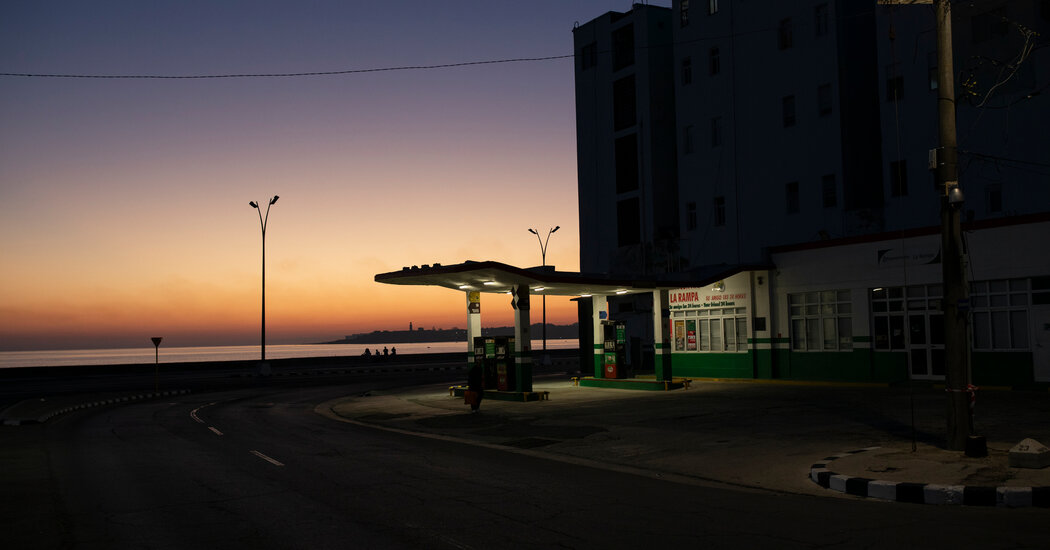
After months of a debilitating energy crisis that led to widespread power outages, Cuba’s oil reserves have dried up, the government said, likely plunging the country into more frequent, larger and longer nationwide blackouts.
The government has been battling a severe energy crisis for more than two years due to crumbling infrastructure and dwindling supplies from its longtime beneficiary Venezuela.
While Cuba produces some oil for domestic use, power plants are closed and supplies have been exhausted, said Vicente de la O Levy, Cuba’s Minister of Energy and Mines. Said On Wednesday night.
Mr. De La O’Levy, “We have no fuel oil at all, no diesel at all.” Said. “In Havana, the blackout today is more than 20 or 22 hours.”
When power comes back on, it could be for at least an hour and a half, he said.
Fuel from Venezuela stopped flowing to Cuba completely in January after the United States seized Venezuela’s leader and took control of Venezuela’s oil industry. Later, the Trump administration imposed an effective blockade, preventing all foreign oil from reaching Cuba, which also received shipments from Mexico.
The governments in Havana and Washington have been engaged in secret talks for several weeks, but there are no signs of progress. For Cuba, the goal is to end the energy blockade. For the United States, the talks focus on ending the government’s grip on the economy and ending political repression.
In recent months, many Cuban cities beyond Havana have been hit by prolonged daily blackouts. The oil shortage is forcing people to rely on coal or even wood for cooking, and some have taken to the streets banging utensils to express their frustration.
The relief came after the Trump administration last month authorized the delivery of 100,000 tons of oil from Russia. But those supplies have been exhausted, Mr. de la O’Levy said.
He warned that energy shortages are likely to worsen in the coming weeks as temperatures rise and demand on the power grid increases during the summer months.
President Miguel Díaz-Canel acknowledged that the energy situation was “particularly tense”.
“There is only one reason for this dramatic decline: the genocidal energy blockade to which the United States subjects our country,” He said on X.
Before the Russian fuel shipment arrived, Cuba said it had received a single fuel delivery since December. Mr. Diaz-Canel said Cuba needs at least eight tanker deliveries per month to run the country.
The Energy Minister said solar power is also not a reliable option as the grid is too weak to handle the electric current supplied by solar panel parks.
The Trump administration has blamed Cuba’s energy crisis on the government’s failure to manage its economy.
“The reason they don’t have oil is they don’t have the money to pay for the oil,” Secretary of State Marco Rubio said in a March interview with The New York Times, in which he dismissed the role of the administration’s oil blockade.
“The problem they face is that generally when people give you oil, they expect to get paid for it,” he said. “And these people have no money.”
Cuba produces 40,000 barrels per day but uses about 100,000 barrels per day. It relied on donations from Mexico and Venezuela to make up the difference.
“The little power we are generating is being used to protect hospitals, high-priority economic sites and many other circuits that must be protected due to fluctuations in the system,” Mr De La O Levy said.
Jorge Piñon, an expert on Cuban energy at the University of Texas, said he had predicted Cuba would likely run out of oil reserves in March, but the nation managed to limp along for a while.
Now, even delivery trucks carrying diesel fuel do not have diesel to run their engines, he said.
“The supply chain is empty,” he said. “Now they’re here. Before, they had some oil here and some oil there.”
Due to the blackout, some Cubans are sleeping on rooftops to escape the heat. Others wake up at odd hours to make coffee, charge the telephone and cook the next day’s meal when the power is on for a short while. If the power goes off in the middle of cooking, they should switch to coal.
Hermes Marian, 53, who drives refinery workers to work every day in Santiago de Cuba, a city in eastern Cuba, said the United States oil blockade was unjust.
“It can’t be right – it’s not right,” Mr Marion said. “Here, it’s the people who suffer.”
Elianis Urgelis Lopez, 40, of Guantanamo, eastern Cuba, uses an electric stove to cook, but he has a supply of coal ready in case the power goes out.
Since oil deliveries from Venezuela ended, a large portion of his government salary goes to buying coal, he said.
“Venezuela was a lifeline for everything,” he said. “We depended on Venezuela for many things: transportation, electricity.”
ed augustin Contributed to the reporting.
