

The U.S. Immigration and Customs Enforcement agent who shot and killed a Los Angeles man on New Year’s Eve allegedly threatened his girlfriend’s ex-husband with criminal prosecution if he made his name public, according to a restraining order application and an audio recording reviewed by The Times.
The ICE agent, Brian Palacios, was first identified by The Times in January as responsible for the killing based on court filings in the custody dispute. Palacios was off duty when he shot Keith Porter Jr. at a Northridge apartment complex. The case remains under investigation by the Los Angeles Police Department.
Police said a rifle was recovered from Porter the night he was murdered. Some of Porter’s friends have suggested that he was firing his weapons in the air to celebrate the New Year. Federal officials said immediately after the incident that the ICE agent was responding to a suspected “active shooter” when he opened fire. Palacios’ attorney has said he acted in self-defense.
On May 21, Omar Escorcia, the ex-husband of Palacios’ girlfriend, filed a petition seeking to prevent Palacios from living with the two children with whom she shared custody. Escorcia alleged in the restraining order petition that Palacios’ involvement in the shooting made him too dangerous to be around children.
A judge granted the order on a temporary basis on May 22, according to Escorcia’s attorney, Michelle E. Diaz.
Palacios’ attorney, Stacey Halpern, said Tuesday she could not immediately comment on the allegations in the restraining order. ICE and the U.S. Department of Homeland Security did not respond to requests for comment.
According to the restraining order application, Palacios contacted Escorcia by phone on April 30 and told her that ICE was opening a criminal investigation against him.
According to a transcript of the phone call included in the restraining order application, Palacios said, “At this point, my agency is going to go after you for conspiracy for what you did. You put my life in danger by putting my name out there.”
According to the restraining order application, Palacios told Escorcia that agents would come to his home to interview him, and told him they could do immigration enforcement at Escorcia’s home.
“Make sure there’s no one there who doesn’t have papers. Okay?” Palacios added at the end of the minute-long conversation, according to the call transcript.
The Times reviewed a recording of the conversation that matches the transcript contained in Escorcia’s petition.
According to the call transcript, Palacios accused Escorcia of leaking his name to organizers with the Los Angeles chapter of Black Lives Matter, which has sought to prosecute Palacios for shooting Porter.
Melina Abdullah, co-founder of Black Lives Matter LA, said this week that her organization has had no contact with Escorcia and did not know Palacios’ name until the Times identified him.
Diaz said he does not believe his client leaked the agent’s name to anyone. The April 30 phone call “came out of nowhere,” according to Diaz, who said Palacios initiated contact with his client.
“Knowing that an armed federal ICE agent has a personal vendetta against me, that he is using his position in the federal government to harass and intimidate me, and that he has no remorse for murdering another person, causes me real fear,” Escorcia wrote in her restraining order petition, referring to Palacios’ comments as “threatening.”
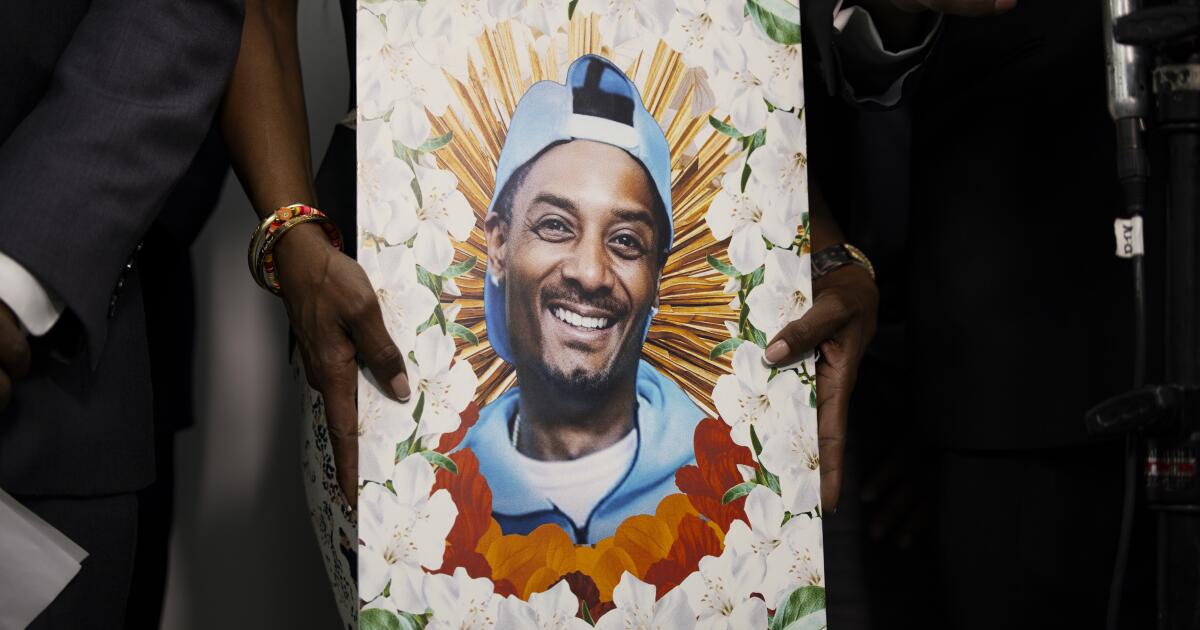
Porter’s death has become a rallying point for Los Angeles activists, who regularly chant his name at Police Commission meetings and protests. The LA County District Attorney’s Office will ultimately decide whether criminal charges are appropriate.
Jamal Touson, an attorney for the Porter family, says he has found witnesses who say Porter was walking back to his apartment when he was shot. Touson also said that witnesses did not hear the federal officer identifying himself before the three shots were fired.
Towson called on the LAPD to complete its investigation, saying, “This recording shows Keith Porter Jr.’s lack of remorse for the murder.”
Porter’s mother, Franselo Armstrong, said that listening to the recording brought back the same sadness and anger she felt after her son was shot to death.
“He has no remorse, he has no mercy,” she said of Palacios.
Palacios’ attorney, Halpern, has said there is evidence that Porter fired at the agent first. A law enforcement official previously told the Times that detectives found evidence of the impact of two bullets behind where Palacios was standing at the time of the shooting, which would support the claim that he was fired upon by Porter.
Halpern said Palacios returned to duty within weeks of the shooting. The agent has since moved out of the apartment complex.
It is unclear what criminal conduct Palacios was accusing Escorcia of in the phone call.
Federal officials have repeatedly complained in recent months about ICE and Border Patrol agents being “doxxed,” and in rare cases, prosecutors have filed criminal charges against workers accused of sharing personal information about immigration officials online.
Under federal law, the crime of “doxxing” requires that the victim’s name and address be made public for the purpose of threatening or inciting violence. The mere identity of a federal agent is not, in itself, protected by law.
