

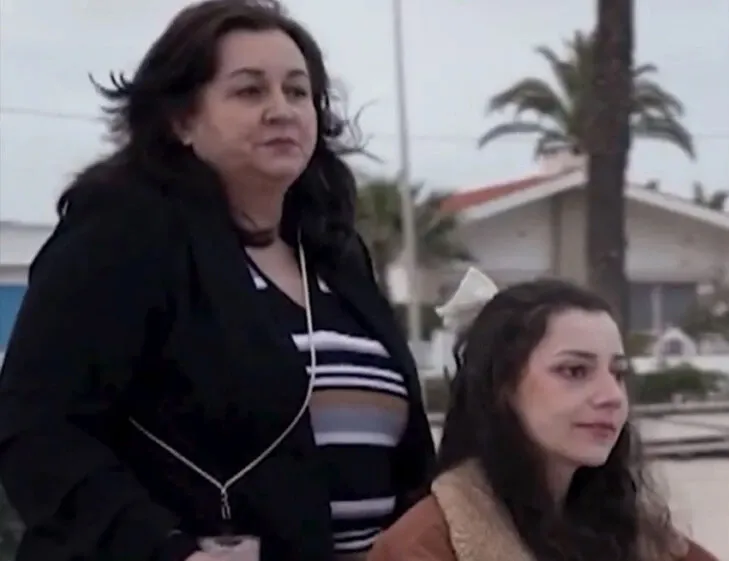
The mother of paralyzed rape victim Noelia Castillo Ramos, who is set to be euthanized today, has said her final goodbye to her tragic daughter.
Ramos, 25, from barcelonaAfter attempting to take her own life following two separate sexual assaults, she suffered severe spinal injuries.
Her heartbroken mother has now made one last plea to her daughter, hoping she will “regret” her decision.
Yolanda Ramos said: “If she doesn’t want to live, I can’t take it anymore.”
The mother added: “I am not in favor of euthanasia, of course I am not in favor of it, but as long as she allows me, I will always be with her till the last moment.”
The grieving parents also revealed that she was “praying and thinking, hoping that at the last moment she would say: ‘I regret it'”.
sad ending
25-year-old paralyzed gang rape victim to die by euthanasia today after suffering from depression

‘Destructive’
31-year-old woman had ‘horrific’ feeling after being diagnosed with ‘severe’ cancer
Yolanda also said she has received financial help during her daughter’s trip, which could make her life easier “if you want to back out.”
According to her family, Ramos “was dependent on the Spanish mental health care system” before she was raped.
She was living in a state-supervised center for vulnerable youth in 2022 when she was horrifically gang raped by three men.
This traumatic incident left her traumatized and led her to attempt suicide – which left her with a major spinal injury.
Ramos survived, but was paralyzed from the waist down and was in constant pain.
Her condition was deemed “severe, chronic and disabling” under Spain’s landmark 2021 euthanasia laws.
It comes after an emotional final interview on Tuesday where Ramos said she wanted to “go in peace” after years of suffering.
Ramos has received permission to die from the European Court of Human Rights.
This was despite her father waging a lengthy legal battle to stop the procedure – and her mother hoping that she would not follow through.
Her father, supported by the conservative advocacy group Abogados Cristianos (Christian Advocates), argued that his daughter was mentally ill. Health His ability to make independent and informed decisions was being affected.
But the court ultimately decided that Ramos had “full capacity to decide” whether he should end his life by assisted death.
Ramos will die today in a 15-minute procedure that will involve a mixture of three drugs.
Although Spanish law allows her to be taken with her, the 25-year-old reportedly decided not to have her parents present at the end.
The distraught mother makes a final plea to her daughter to change her mind and reads out loud the offer of financial help to get her daughter the new treatment.
Ramos will be sedated and given an injection in her room at the Sant Pere de Ribes assisted living facility where she lives, called Saint Camille.
How to get help
Every 90 minutes a person dies by suicide in Britain.
It does not discriminate, touching the lives of people in every corner of society – from the homeless and unemployed to builders and doctors, reality stars and footballers.
It is the biggest killer of people under 35, more deadly than cancer and car accidents.
And men are three times more likely to take their own lives than women.
Yet it is rarely talked about, a taboo that threatens to continue its deadly wrath unless we all stop and pay attention.
If you or someone you know needs help dealing with mental health problems, the following organizations provide support:
In his last interview, Ramos said: “No one in my family is in favor of euthanasia.
“But I think, with all the pain I’ve endured over the years… I just want to go in peace now and stop suffering.
“And the happiness of a father, or mother, or sister, does not come before the happiness of the daughter or the sorrow of the daughter’s life.”
In June 2021, Spain became the fourth European Union country to legalize euthanasia and assisted suicide for people with incurable or seriously debilitating conditions who wish to end their lives.
Spanish law states that applicants over the age of 18 who suffer from “chronic or incurable suffering” can choose to receive assistance in dying.
Government figures show that 426 people received assisted dying in 2024.
Assisted death is currently illegal in the UK under the Suicide Act 1961.
But a private bill proposing to legalize euthanasia for terminally ill adults was introduced by a Labor MP Kim Leadbeater In October 2024.
The Terminally Ill Adults (End of Life) Bill passed the House of Commons last June with a majority of 23.
But a long list of Lords amendments – more than 1,000 – have put Bill In danger.
it fail If it is not passed by the end of the parliamentary session in May.
What is euthanasia?
Euthanasia, sometimes known as mercy killing, is the practice of intentionally ending someone’s life in order to relieve their pain and suffering.
The term comes from an ancient Greek phrase meaning “good death”.
Euthanasia means deliberately helping or encouraging someone to take their own life, for example by providing them with medication to do so.
Euthanasia is a crime under English law, carrying a maximum penalty of life in prison and 14 years for suicide.
The only exception is “passive euthanasia”, where treatment that could extend someone’s life is withdrawn – as if the life machine is turned off.
However the recent debate over the Assisted Dying Bill has led to this bill being passed.
At the moment for terminally ill patients in the UK, the only option is to refuse hospice care or treatment, which mentally competent patients have the right to do.
As a result, some terminally ill people decide to travel abroad to die.
Euthanasia and death is a controversial issue – there are passionate campaigners on each side of the argument.
Those who agree with euthanasia often argue that people should be allowed to die with dignity – and that they should be able to decide when and how they will die, and potentially spare their loved ones the pain of watching them suffer.
Some people also believe that death is personal, and it is not the place of the state to intervene if a person wishes to die.
Euthanasia advocates also point out that we euthanize our pets as an act of compassion – and that resources can be used for those who wish to live, or whose condition can be cured.
However, there are concerns that allowing euthanasia would give doctors too much power, and could also impair care for terminally ill people and research into their diseases.
Some people also believe that it goes against the job description of doctors and nurses and the oath they take not to harm patients – they also say that it undermines the value of human life.
Others are also worried about the possibility of someone potentially recovering or changing their mind when it is too late.
Some people have also suggested that this may lead people to feel pressured to die, as they do not want to be a burden on those around them.
