

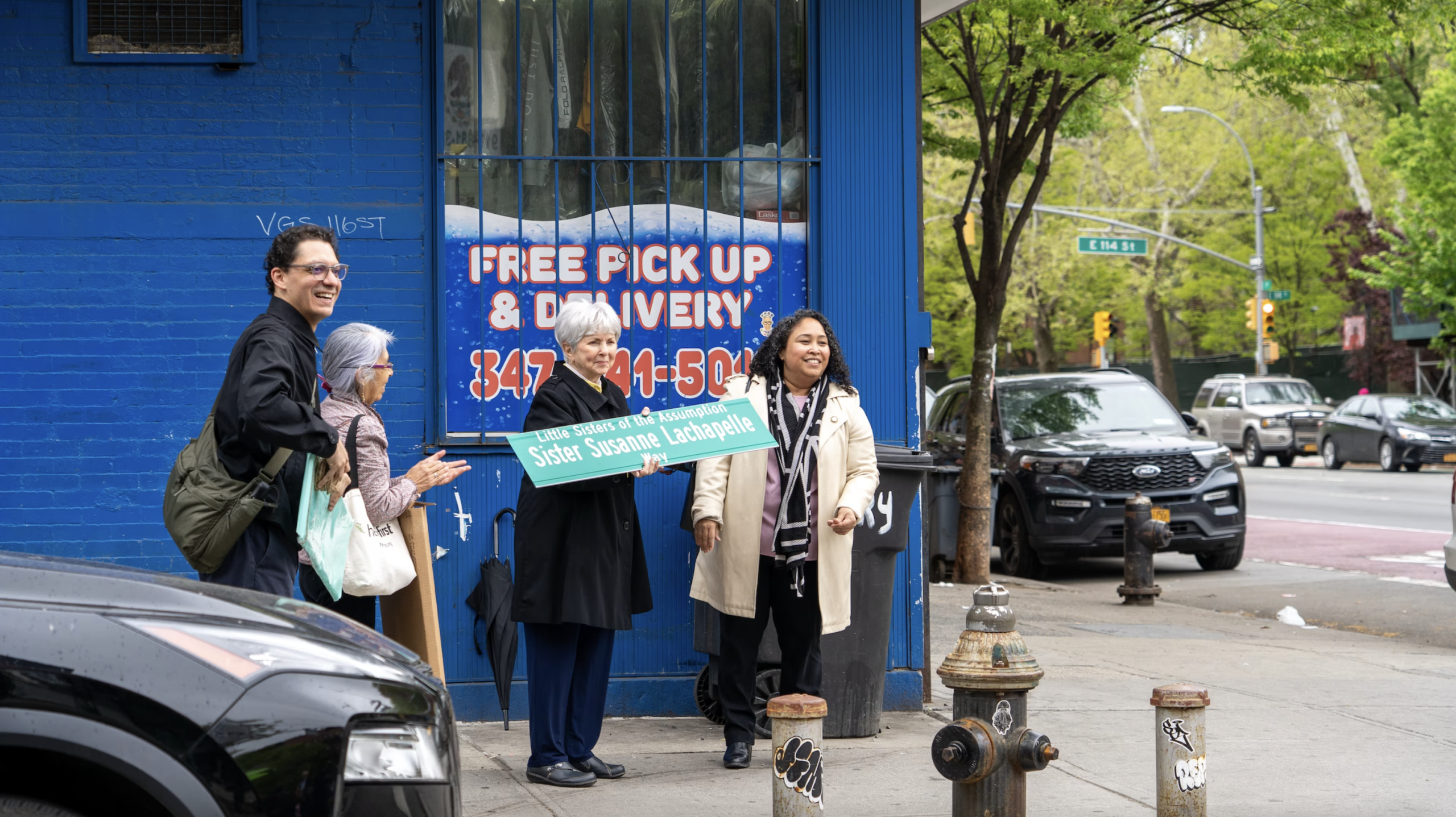
A New York City street got a new name last weekend, honoring a Catholic sister’s decades of dedication to the East Harlem community.
On Saturday, April 25, more than 100 people gathered to celebrate the newly named street – Sister Suzanne LaChapelle Way – which was named for LaChapelle’s life and legacy and her contributions as a registered nurse, lawyer and Little Sister of the Assumption (LSA).
Rosario Jimenez, director of LSA Family in Mission, told EWTN News, “With a heart rooted in justice, she dedicated herself to serving the vulnerable through home visits, health care and tireless advocacy locally and globally.”
The event and street naming stem from LaChapelle’s work with the Little Sisters of Assumption Family Health Service, a community-based nonprofit based in East Harlem. Founded by the Little Sisters, the organization offers a number of programs to help vulnerable families and children meet their basic needs.
The crowd celebrates the unveiling of the Sister Suzanne LaChapelle Way street sign in East Harlem, New York on April 25, 2026. Credit: Photo courtesy of Alyssa Jett and Grace Ayres-Doyle
Ray Lopez, chief program officer for LSA Family Health Services, told EWTN News the group has been in the city for nearly 70 years and LaChapelle “really helped set the trajectory for the organization.”
“She was a fundamentally visionary staff person and a leader who has really had a profound influence on many of us who are on the staff to this day and have worked side by side with her, learning from her,” he said.
“Since his passing, we have all … redoubled our efforts to find a way to continue the original mission and vision of LSA in this current environment,” Lopez said. “We really wanted to find ways to keep his name out there and continue the legacy.”
The street is at the southeast corner of East 115th Street and First Avenue. “This is approximately the exact midpoint where Sister Suzanne LaChapelle lived in the Little Sisters of the Assumption brownstone and where the LSA Family Health Services… Center is located,” Lopez said.
“She walked there every day for at least two decades,” he said. “We thought it was the perfect place.”
Sister Susan and younger sisters: ‘unsung heroes’
LaChapelle entered the LSA order in 1962 and took the religious name Sister Suzanne Marie of the Sacred Heart. He made his final vows in 1971.

Sister Suzanne LaChapelle. | Credit: Photo courtesy of the LSA Family at Mission
In his 60 years of religious life, he has served in many areas and worked with many ministries. But for 45 years he made the community of East Harlem his home and helped lead the programs of LSA Family Health Services.
As a nurse, LaChapelle performed home visits, which were “a foundational program of LSA Family Health Services,” Lopez said. “All the programs evolved from those conversations, the early conversations of nurses going into homes to treat the sick and the poor and actually seeing the conditions firsthand, sitting with families at their kitchen tables, hearing their stories.”
“Sister Susan and the rest of the leadership really created other programs to provide wraparound services for families,” she said. “The Little Sisters set up a food pantry and a thrift store to make sure people had the basics.”
“From there, services were about connecting people to public benefits, providing support for education, education enrichment, education navigation. A lot of the … programs focused on maternal child health and early childhood development.”
Along with his support for health and families, LaChapelle was also passionate about protecting the environment through his commitment to Pope Francis. Laudato Si’A call to defend our common home.

Sister Suzanne LaChapelle. | Credit: Photo courtesy of the LSA Family at Mission
LaChapelle decided to introduce “an environmental health component into the work being done by the Little Sisters,” LSA Health Services volunteer Lynn Tiede, who worked with LaChapelle, told EWTN News.
“As she worked with families and saw asthma and other debilitating health issues, she realized that … it’s mold, it’s air quality, it’s other things that are really the root of these health problems.”
Tiede said, “Everyone was very inspired…to see him get into rough, rugged buildings without any hesitation.” “If you went into a home and people were struggling with asthma, you…send the environmental health team and then they try to work with building management to actually address those things.”
With the success of her work, she also collaborated with the human rights group and NGO Vivat International, where she helped bring voice and environmental issues to the United Nations, but she always remained “very, very humble”, Tiede said.
Because of her modesty “Some people were against (street-naming) when we proposed it, because they thought she would hate it – because she was so polite,” Tiede said.

Sister Suzanne LaChapelle Way in East Harlem, New York. | Credit: Photo courtesy of the LSA Family at Mission
Ultimately, they chose to honor LaChapelle and the Little Sisters because they are “unsung heroes — these quiet heroes,” Tiede said.
The process of renaming the street began in 2024 and was found to be an easier process than expected, as the city council was eager to acknowledge Lachapelle and the Little Sisters.
Sister Susan’s lasting impact
Organizers at the street naming ceremony were expecting “about 80 participants, but I think it was probably 150 or a little more,” Jimenez said. “There were community members, families they served, youth they served, …volunteers, and of course, our board members and beneficiaries.”
Jiménez said, it honored her “simplicity and the way she used to be a leader”, which was “based on integrity, purpose, love.” “Having a street named after them will honor them all.”
Reflecting on the event, Lopez said: “(It) feels like a dream because a lot of people came who had worked with him in the past.”
Despite the event being moved inside to escape the cold and rain, crowds of people stayed to celebrate. “It was packed with people and our center lobby was completely full,” Lopez said. “It was just a festive atmosphere.”
He added: “It was really emotional to have so many people there for so long who still feel it in their hearts, (how) the work in East Harlem impacted their careers, impacted their lives, and it’s still a very important thing to them,” he said.
