

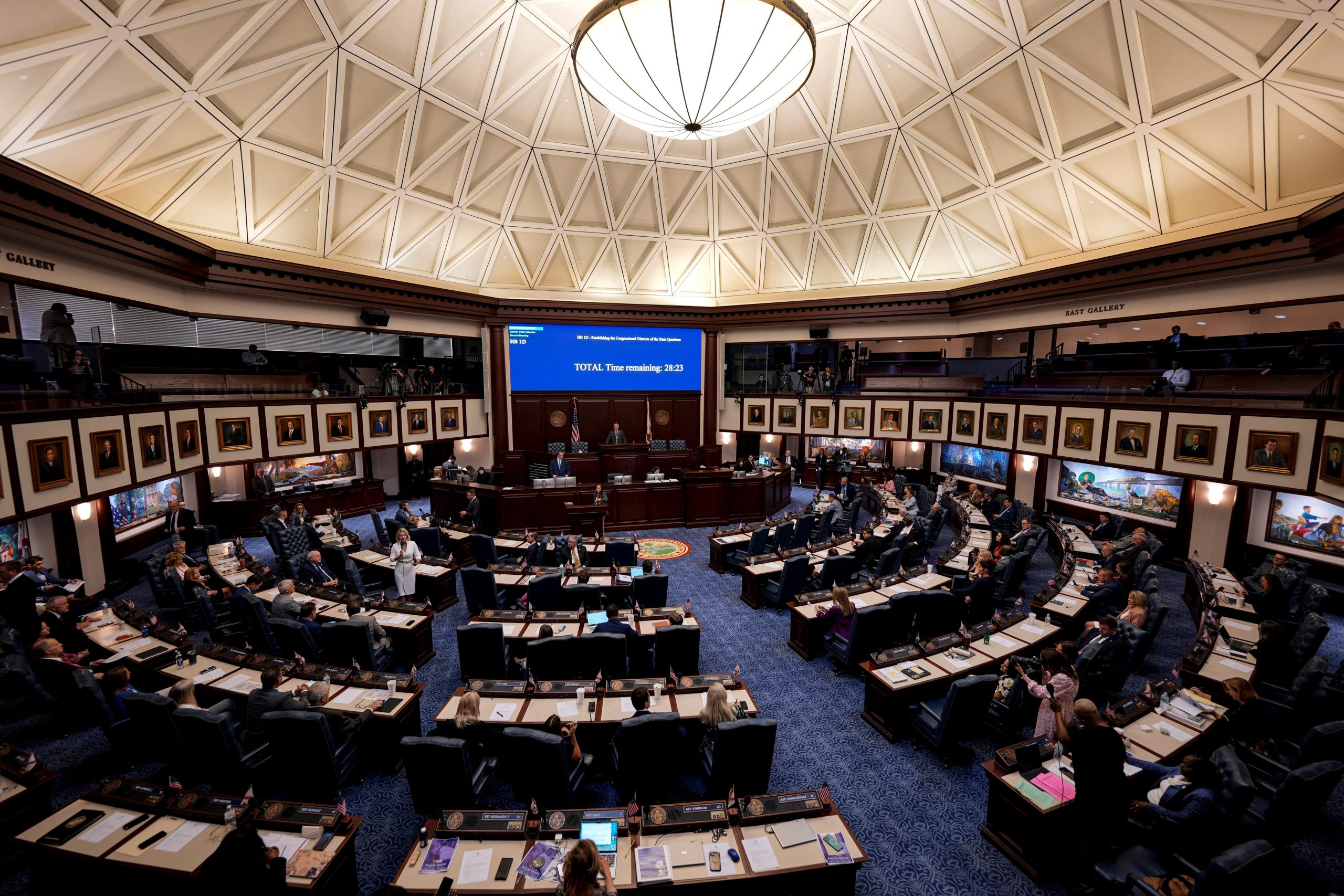
TALLAHASSEE, Florida — Florida’s Republican-controlled Legislature passed a new congressional map on Wednesday that could help the GOP pick up four more seats in the state, just hours after the U.S. Supreme Court announced a far-reaching decision that could reshape redistricting.
The final vote marks a significant victory for both Gov. Ron DeSantis and President Donald Trump, since Trump launched a mid-decade redistricting fight across the country last year. But the new map is also likely to trigger a messy legal battle that could play out in both state and federal courts.
Florida Republican legislators insisted on a map given to them by DeSantis just two days earlier, while lawmakers were trying to absorb Wednesday’s high court decision. The state Senate delayed reviewing the decision briefly, and several senators could be seen reading it on their laptops.
The map was still approved largely on a partisan basis, even though a handful of GOP state senators voted no. Democrats said the map is illegal because it contradicts voter-approved, anti-gerrymandering standards in Florida, but some Republicans said they were influenced by DeSantis lawyers’ legal argument that those requirements no longer need to be followed.
State Senator Don Gaetz, a Crestview Republican and one of the sponsors, countered, “I don’t think we should be partisan based on political partisanship, and I don’t think there’s any evidence that this map does that.”
The House voted 83-28 in favor of the map, even as one Democrat — state Rep. Angie Nixon — started yelling into a hot pink megaphone at the time of the vote. Apart from the map bill sponsor, GOP state Rep. Jenna Persons-Mullica, no House Republicans defended redistricting on the chamber floor.
“You are destroying democracy with this vote,” State Representative Fenris Driskell, the House Democratic leader, said during floor debate.
The Democrats also trashed the new map to grab power, which was launched only to help the political fortunes of Trump and the Republicans.
State Senator Carlos Guillermo Smith, an Orlando Democrat, said, “This map is clearly designed to capture power rather than reflect the will of the people.” “This moment is about much more than lines. It’s about whether we uphold the rule of law. I will not support a map that is illegal, that is rigged to please an authoritarian who believes he is the king of the United States of America.”
A few hours later, the Senate voted 21–17 after a lengthy debate, during which many Democrats described it as a way to “cheat the people.” He criticized the way the map moved minority communities into new districts and divided voters living near Tampa and Orlando, while also drawing other districts spread across the state.
Among Republicans, only Gaetz and Persons-Mullica spoke about the new map, as their GOP colleagues — perhaps eager to avoid becoming embroiled in an impending legal battle — remained relatively silent. State Senator Ileana Garcia, a Miami Republican, who was one of five no-votes, said she opposed the map “because of common sense and my conscience.”
Republicans already have a 20-8 lead in the state, but the new map could potentially oust the GOP, ousting a handful of Democratic incumbents, including long-serving Rep. Debbie Wasserman Schultz.
The current map was pushed into law by the governor in 2022, but DeSantis has been demanding newly drawn congressional lines since last summer. He has cited several reasons, including the possibility of the US Supreme Court’s decision on Wednesday.
The new map was drawn in a “race neutral” fashion, allowing the governor’s office to reshape the South Florida district that was held by Representative Sheila Cherfilas-McCormick until she resigned earlier this month.
But a top aide to the GOP governor acknowledged Tuesday that he relied on political data as part of his map-drawing effort — a potential violation of “Fair Districts” standards approved in 2010 that ban lines drawn for partisan advantage.
DeSantis’ lawyers argued that these anti-mandering standards no longer need to be followed because the state Supreme Court ruled last year that minority voter protections that were part of the same amendment do not need to be strictly followed. He said the amendment was a “package” that could not be broken.
Gaetz said he did not agree with that legal theory, although Persons-Mullica had called the argument “persuasive” a day earlier.
But Gaetz and other Republicans claimed that the last-minute Louisiana decision strengthened the legal status of the map. State Rep. Alex Andrade, a Pensacola Republican, said the decision gave him “great comfort” in voting yes on the map.
“With the court’s decision and the map we passed today, I can confidently assure everyone that your vote now matters as much as your neighbor’s,” Andrade said.
The legal battle over the new maps could begin soon, with several Democratic-aligned groups promising lawsuits as soon as DeSantis signs the measure into law.
John Bisognano, chairman of the National Democratic Redistricting Committee, said, “If they think they can get away with trampling the will of the voters and ignoring the ban on partisan gerrymandering in the state constitution, they are sorely mistaken.” “This fight is not over, and Florida Republicans can expect fierce legal challenges against this new gerrymander.”
